Field at a point on the axis of a ring with variable charge density

  • Thread starter Thread starter JesseAbberton
  • Start date Start date
  • Tags Tags
    Electrostatic
JesseAbberton
Messages
3
Reaction score
0
Homework Statement
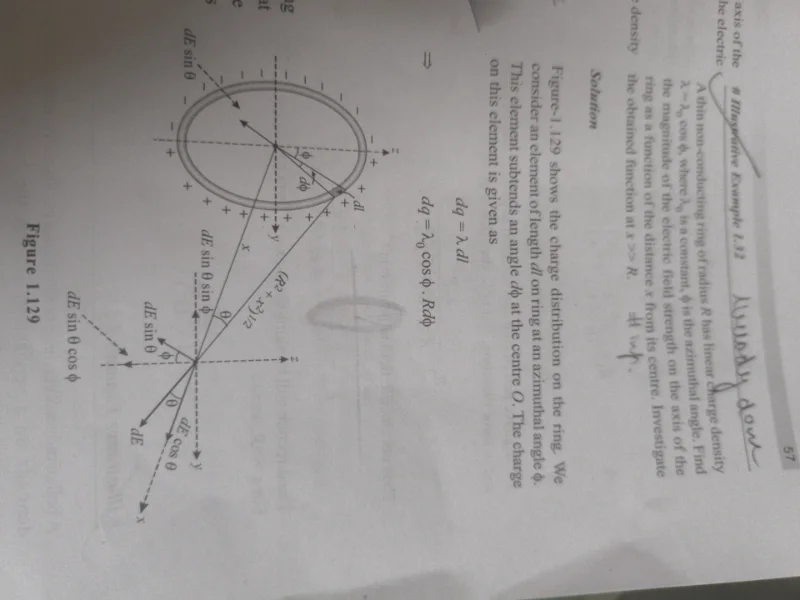
is the given charge density, is constant and Is the azimuthal angle. R is the radius and we have to find field at a point r distance from the centre of ring as a function of r.
I have great confusion regarding the question after reading the solution from the book. They haven't really correctly done the sign of the charge density if they have taken the angle as follows and the diagram i found a bit vague. Could somebody please help me out here? Thank you :)
17788692602771087579367518761419.webp
 
Physics news on Phys.org
You need to be more more specific about what you don't understand otherwise we cannot help you.

What is vague about the diagram? It shows how the electric field vector element ##d\mathbf E## is resolved along the three Cartesian axes ##x##, ##y## and ##z##.
What charge density have they not done correctly? If you know what the correct form for the charge density is, please post it and explain why you think it is what you say.
Also, it is much easier for us to help you if you post your equations in LaTeX. To learn how to do that, click on the link "LaTeX Guide", lower left above "Attach Files."
 
kuruman said:
You need to be more more specific about what you don't understand otherwise we cannot help you.

What is vague about the diagram? It shows how the electric field vector element ##d\mathbf E## is resolved along the three Cartesian axes ##x##, ##y## and ##z##.
What charge density have they not done correctly? If you know what the correct form for the charge density is, please post it and explain why you think it is what you say.
Also, it is much easier for us to help you if you post your equations in LaTeX. To learn how to do that, click on the link "LaTeX Guide", lower left above "Attach Files."
Since it's a ## \cos(x) ## function, so according to the diagram, if they have chosen the following Azimuthal angles, then positive charges must be on the top half and negative on the bottom half here.
 
JesseAbberton said:
Since it's a ## \cos(x) ## function, so according to the diagram, if they have chosen the following Azimuthal angles, then positive charges must be on the top half and negative on the bottom half here.
I agree, the positive and negative charges depicted do not match the stated charge distribution.
The diagram is tricky to interpret. It might have been clearer to show two 2D diagrams, one of the ring and one of the parallel plane containing the reference point.
 
I think it's obvious that the far field approximation should be that of a dipole from the picture shown.

That diagram is confusing. It shows too much info at once; it invokes ##\phi## too much when it could just do it at the end. I will try to create sequential set of illustrations today to help this process along.

I think you should pretend that the charge density is uniform. Set up the integrals accordingly then plug the proper ##\lambda## into the set up.
 
First of all, the charge density is given as ##\lambda(\phi)=\lambda_0\cos(\phi)## where ##\phi## is the azimuthal angle as shown in the diagram. Quantity ##x## is the distance from the center of the ring to the point of interest along the ##x##-axis. That kind of carelessness is not expected from someone who is worried about the correct placement of positive and negative signs along the ring.

The important feature of the diagram is that it (very generously) provides the Cartesian components of the vector element ##d\mathbf E##, $$\begin{align} & dE_x=dE\cos\theta \nonumber \\
& dE_y=dE\sin\theta\sin\phi \nonumber \\
& dE_z=dE\sin\theta\cos\phi. \nonumber
\end{align}$$ The rest of the solution, which you didn't post, probably finds an expression for the magnitude ##dE(x)##, substitutes in the three equations above and integrates to find ##\mathbf E(x)=(E_x, E_y,E_z).## The correct placement of the signs in the drawing along the ring is irrelevant to this process because the cosine in ##\lambda(\phi)=\lambda_0\cos(\phi)## automatically takes care of the sign changes when the integrals are performed.

So I will ask you again, what part of the solution is it difficult to understand?
 
kuruman said:
...what part of the solution is it difficult to understand?
Refer to:
haruspex said:
... the positive and negative charges depicted do not match the stated charge distribution.
Note that ##\phi## is measured from the ##z##-axis. So, all elements of the ring with positive ##z## coordinate should be depicted with positive charge. Elements with negative ##z## coordinate should be depicted with negative charge.
 
TSny said:
Refer to:

Note that ##\phi## is measured from the ##z##-axis. So, all elements of the ring with positive ##z## coordinate should be depicted with positive charge. Elements with negative ##z## coordinate should be depicted with negative charge.
Sure, I agree that the drawing has mislabeled the positive and negative arcs on the ring, but how does that affect the integrals' setup? OP has not posted the rest of the solution, but I suspect that the (mis)labeling of the arcs is not part of it.
 
  • Like
Likes   Reactions: TSny

Similar threads

Replies
17
Views
2K
  • · Replies 5 ·
Replies
5
Views
2K
  • · Replies 68 ·
3
Replies
68
Views
8K
  • · Replies 1 ·
Replies
1
Views
2K
  • · Replies 6 ·
Replies
6
Views
2K
  • · Replies 26 ·
Replies
26
Views
3K
Replies
1
Views
2K
Replies
9
Views
4K
Replies
4
Views
2K
  • · Replies 9 ·
Replies
9
Views
2K