Find $\angle BPC$ in Triangle ABC with $\angle ACB=\angle ABC=80^\circ$

  • Context: MHB 
  • Thread starter Thread starter anemone
  • Start date Start date
  • Tags Tags
    Challenge Geometry
Click For Summary
SUMMARY

In triangle ABC, with angles ACB and ABC both measuring 80 degrees, point P lies on segment AB such that BC equals AP. The objective is to determine the measure of angle BPC. The discussion highlights various approaches, including trigonometric and geometric proofs, with participants sharing insights and corrections regarding the proposed solutions. Notably, the 80-80-20 triangle is recognized for its rich structure and numerous problem-solving opportunities.

PREREQUISITES
  • Understanding of triangle properties, specifically isosceles triangles.
  • Familiarity with geometric constructions and proofs.
  • Basic knowledge of trigonometric functions and their applications in geometry.
  • Ability to interpret and analyze geometric diagrams.
NEXT STEPS
  • Explore geometric constructions related to isosceles triangles, particularly the 80-80-20 triangle.
  • Study trigonometric proofs in geometry, focusing on angle relationships.
  • Investigate various methods for proving angle measures in triangle configurations.
  • Review online resources that compile multiple solutions to geometric problems.
USEFUL FOR

Mathematicians, geometry enthusiasts, and students seeking to deepen their understanding of triangle properties and proof techniques.

anemone
Gold Member
MHB
POTW Director
Messages
3,851
Reaction score
115
In triangle ABC, $\angle ACB=\angle ABC=80^\circ$ and $P$ is on the line segment $AB$ such that $BC=AP$. Find $\angle BPC$.
 
Mathematics news on Phys.org
Let $AB = 2x = AC$ then $AP = PB = x$, use the cosine law in the triangle $APC$ we found that
$PC^2 = x^2 + 4x^2 - 2(x)(2x) \cos 20 = x^2 ( 5 - 4\cos 20)\Rightarrow PC = x \sqrt{5 - 4\cos 20} $

again

$AC^2 = PC^2 + AP^2 - 2(PC)(AP) \cos \angle APC$

$3x^2 = x^2 ( 5 -4 \cos 20) + - 2x^2 \sqrt{5 - 4 \cos 20} \cos \angle APC $

$3 = 5 - 4 \cos 20 - 2 \sqrt{5 - 4 \cos 20} \cos \angle APC $

$\cos APC = \frac{1 - 2\cos 20}{\sqrt{5 - 4 \cos 20}}= - 0.789$

$\angle BPC = 180 - \arccos( - 0.789 ) $
 
Amer said:
Let $AB = 2x = AC$ then $AP = PB = x$, use the cosine law in the triangle $APC$ we found that
$PC^2 = x^2 + 4x^2 - 2(x)(2x) \cos 20 = x^2 ( 5 - 4\cos 20)\Rightarrow PC = x \sqrt{5 - 4\cos 20} $

again

$AC^2 = PC^2 + AP^2 - 2(PC)(AP) \cos \angle APC$

$3x^2 = x^2 ( 5 -4 \cos 20) + - 2x^2 \sqrt{5 - 4 \cos 20} \cos \angle APC $

$3 = 5 - 4 \cos 20 - 2 \sqrt{5 - 4 \cos 20} \cos \angle APC $

$\cos APC = \frac{1 - 2\cos 20}{\sqrt{5 - 4 \cos 20}}= - 0.789$

$\angle BPC = 180 - \arccos( - 0.789 ) $

Hi Amer! Thanks for participating but I'm sorry...your answer isn't correct...:(
 
anemone said:
Hi Amer! Thanks for participating but I'm sorry...your answer isn't correct...:(
I understand the question in a wrong way I will edit my post :)
 
I'm quite certain I know the answer, but I can't prove it. If the following is the way you went, I'd appreciate a hint.
When I carefully draw the figure, I see that the circum center O of triangle PBC has the property that triangle OBC is equilateral. From this the desired angle is obvious, but why is OBC equilateral?
 
Trig proof:

WLOG, let $$\overline{BC}=1$$, so $$\overline{AP}=1$$. Construct segment $$\overline{PD}$$ such that $$D$$ lies on $$\overline{AC}$$ and $$\overline{PD}$$ is parallel to $$\overline{BC}$$.

$$\overline{PD}=2\cos80$$, so $$\dfrac{1}{\overline{PB}+1}=2\cos80\implies\overline{PB}=\dfrac{1-2\cos80}{2\cos80}$$

Let $$\angle{BPC}=\theta$$. Then

$$\begin{align*}\tan(\theta-10)&=\dfrac{\dfrac{1+2\cos80}{2}}{\dfrac{\cos10-2\cos10\cos80}{2\cos80}} \\
&=\dfrac{(1+2\cos80)\cos80}{\cos10-2\cos10\cos80} \\
&=\dfrac{\cos80+2\cos^280}{\cos10-\cos70} \\
&=\dfrac{\cos80+2\cos^280}{\sin40} \\
&=\dfrac{\cos80+1-\cos20}{\sin40} \\
&=\dfrac{1-\sin50}{\sin40} \\
&=\csc40-\cot40 \\
&=\tan20 \\
\theta-10&=20 \\
\theta=30^\circ\end{align*}$$
 

Attachments

  • measure of Angle BPC=30.jpg
    measure of Angle BPC=30.jpg
    12.2 KB · Views: 130
Albert said:
Geometric Solution:

Albert, please post attachments inline so that you can hide them using the spoiler tags. Also, I find your solution to be very hard to follow without the supporting computations. :)
 
johng said:
I'm quite certain I know the answer, but I can't prove it. If the following is the way you went, I'd appreciate a hint.
When I carefully draw the figure, I see that the circum center O of triangle PBC has the property that triangle OBC is equilateral. From this the desired angle is obvious, but why is OBC equilateral?

Hi johng,
I appreciate you taking the time to try this challenge out and I'm sorry as the solutions that I have don't use the method as you proposed so I think you have to rely on your own to figure out why OBC is equilateral...:)

And thanks to greg1313 for your trigonometric proof and Albert, I actually have hope to see your geometric proof to be back up by facts. :D
 
  • #10
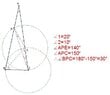
Two circles with centers C and E
We have BC=CE=EP=AP
then $\angle A=\angle 1=20^o=2\angle 2$
$\therefore \angle 2=10^o,\,\, and \,\,\angle APE=140^o$
$\angle APC=150^o$ , so we get
$\angle BPC=30^o$
I am sure my geometric proof is back up by facts.
 
Last edited:
  • #11
Albert,
I believe you have made an error in your proof. Here's why I think this:

21c8qib.png
 
Last edited by a moderator:
  • #12
johng said:
Albert,
I believe you have made an error in your proof. Here's why I think this:
from my diagram point E is on segment AC
no error I am sure,please check again
 
  • #13
anemone said:
In triangle ABC, $\angle ACB=\angle ABC=80^\circ$ and $P$ is on the line segment $AB$ such that $BC=AP$. Find $\angle BPC$.
The 80-80-20 triangle has a very rich structure, and is the source of many good problems. I remember coming across some of them when I was a teenager, 60 years ago. I found this particular problem on the internet, here, with links to seven different solutions. They are all interesting, especially Solutions #1–#3, which all use different (ingenious and elegant) geometric constructions.
 
  • #14
Albert,
My apologies. In your diagram, I didn't understand why |PE|=|BC| (I still can't see this). I then got all excited and drew the wrong diagram.
OpalG, I read the first three solutions in your link and I agree completely that they are elegant and ingenious. Thanks much for the link.
 
  • #15
johng said:
Albert,
My apologies. In your diagram, I didn't understand why |PE|=|BC| (I still can't see this). I then got all excited and drew the wrong diagram.
OpalG, I read the first three solutions in your link and I agree completely that they are elegant and ingenious. Thanks much for the link.
please see my post #10
 

Similar threads

  • · Replies 4 ·
Replies
4
Views
2K
  • · Replies 4 ·
Replies
4
Views
1K
  • · Replies 1 ·
Replies
1
Views
1K
  • · Replies 1 ·
Replies
1
Views
1K
  • · Replies 1 ·
Replies
1
Views
1K
  • · Replies 1 ·
Replies
1
Views
2K
  • · Replies 5 ·
Replies
5
Views
2K
  • · Replies 2 ·
Replies
2
Views
1K
  • · Replies 4 ·
Replies
4
Views
1K
  • · Replies 4 ·
Replies
4
Views
2K