Discussion Overview
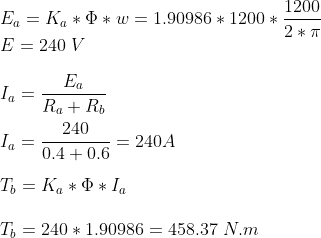
The discussion revolves around calculating the brake torque in a separately excited DC motor during dynamic braking. Participants explore the implications of torque direction, the mechanics of braking, and relevant equations while addressing specific parts of a homework problem.
Discussion Character
- Homework-related
- Technical explanation
- Debate/contested
Main Points Raised
- One participant questions whether the braking torque should be considered negative or positive, suggesting that it may depend on the instructor's definitions.
- Another participant asserts that during dynamic braking, the motor acts as a generator, implying that the torque is negative as it opposes the motor torque.
- A participant mentions that if the rotor is at a standstill, dynamic braking is not possible, indicating a need for alternative braking methods.
- There is a discussion about the formula for back EMF (Ea) and its relation to the motor's speed and torque constants.
- One participant calculates the mechanical power and discusses how to incorporate copper losses into the input power calculation.
Areas of Agreement / Disagreement
Participants express differing views on the direction of the braking torque, with some arguing it should be positive and others asserting it is negative. The discussion remains unresolved regarding the interpretation of torque direction during braking.
Contextual Notes
Participants reference specific parameters and equations related to the motor's operation, but there are unresolved aspects concerning the definitions of torque and the conditions under which dynamic braking is applicable.
Who May Find This Useful
Students studying electrical engineering, particularly those focusing on motor control and dynamics, may find this discussion relevant.