Find the force acting per unit width on the vertical wall

Click For Summary
SUMMARY

The discussion centers on calculating the force acting per unit width on a vertical wall of a container filled with water, which is subjected to horizontal acceleration. The relevant equations include \( F = \rho A a \) and \( \frac{F}{b} = \rho h L a \), where \( \rho \) is the water density, \( A \) is the area, \( b \) is the width, \( h \) is the height of the water, and \( a \) is the acceleration. The final expression for force per unit width is derived as \( \frac{F}{b} = 4 \times 10^4 \, \text{N/m} \). The discussion also highlights the importance of considering both the force due to acceleration and the force due to gravitational pressure.

PREREQUISITES
  • Understanding of fluid mechanics principles, particularly pressure and force calculations.
  • Familiarity with the concepts of density (\( \rho \)) and acceleration (\( a \)).
  • Knowledge of basic geometry, specifically area calculations for trapeziums.
  • Ability to manipulate equations involving force and pressure in fluid systems.
NEXT STEPS
  • Study the derivation of pressure in fluids under acceleration using the hydrostatic pressure equation.
  • Learn about the effects of horizontal acceleration on fluid behavior in containers.
  • Explore the relationship between force, area, and pressure in fluid dynamics.
  • Investigate the implications of fluid pressure on structural integrity in engineering applications.
USEFUL FOR

Students and professionals in physics, engineering, and fluid dynamics, particularly those involved in designing systems that utilize fluid mechanics principles.

Kaushik
Messages
282
Reaction score
17
Homework Statement
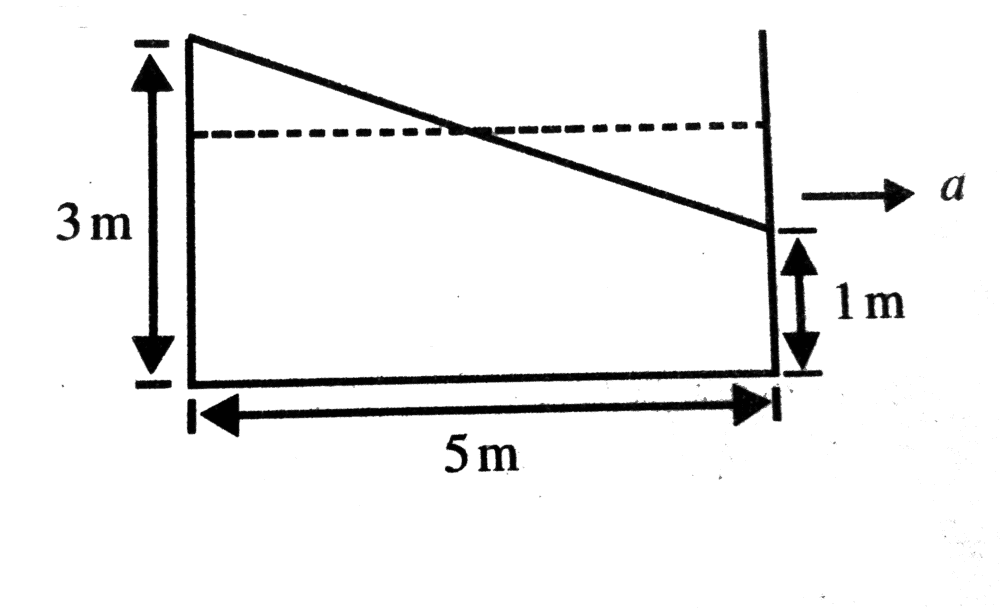
A container of height 3m and width 5m is filled with water upto 2 m. It is accelerated such that the water is at the brim (it is about to spill). When it moves with this acceleration find the force acting per unit width on the vertical wall.
Relevant Equations
I got ##a = 4 \frac{m}{s^2}##
A container of height 3m and width 5m is filled with water upto 2 m. It is accelerated such that the water is at the brim (it is about to spill). When it moves with this acceleration find the force acting per unit width on the vertical wall.
I found the acceleration for the condition provided but how to find the force per unit width?
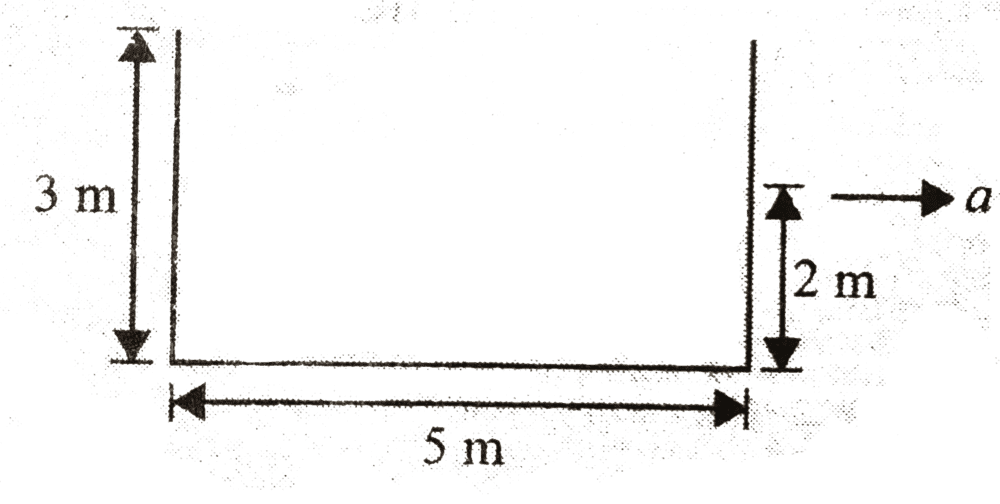
1574272474076.png

1574272481192.png
 
Last edited:
Physics news on Phys.org
Kaushik said:
I got a = 4
Units?

how to find the force per unit width?
Is there some relation between force and acceleration?
 
  • Like
Likes   Reactions: Kaushik
TSny said:
Units?
I added the units. Sorry!

TSny said:
Is there some relation between force and acceleration?
##F = ma ##
## F = ρAba## ; where ##A## is Area, ##b## is width, ##a## is acceleration and ##ρ## is density.
 
Kaushik said:
##F = ma ##
## F = ρAba## ; where ##A## is Area, ##b## is width, ##a## is acceleration and ##ρ## is density.
Great! You're almost home.
 
  • Like
Likes   Reactions: Kaushik
TSny said:
Great! You're almost home.
Oh! Now?
 
Can you express "force per unit width" in terms of F and b?
 
  • Like
Likes   Reactions: Kaushik
TSny said:
Can you express "force per unit width" in terms of F and b?
Dividing by ##b## both sides of the equation.
 
Kaushik said:
Dividing by ##b## both sides of the equation.
I think you're implying that "Force per unit width" is F/b. If so, good!
 
  • Like
Likes   Reactions: Kaushik
TSny said:
I think you're implying that "Force per unit width" is F/b. If so, good!
Yes, I actually meant that.
 
  • #10
Now what how to proceed further?
 
  • #11
Kaushik said:
Now what how to proceed further?
So what expression did you get for force per unit width? What number do you get when you plug in the data?
 
  • #12
haruspex said:
ber do you get when yo
I think I was wrong before. We will be getting the following expression : ##F = ρALa ## where ##A= h.b## is the area, ##L=5## is the length, ##a## is the acceleration.
## \frac{F}{b} = ρ.h.L.a = 6 * 10^4##
 
  • #13
Kaushik said:
I think I was wrong before.
Yes, I hadn't checked post #3 because TSny confirmed it. He must have thought your A was the base area.
Kaushik said:
F=ρALa
Ok, but what is A here? Think about the volume of the water.
 
  • Like
Likes   Reactions: Kaushik
  • #14
haruspex said:
Yes, I hadn't checked post #3 because TSny confirmed it. He must have thought your A was the base area.

Ok, but what is A here? Think about the volume of the water.
Oh , the volume of water is different. Should I consider the ##A## of trapezium?
In the above expression I considered area of the wall (left) . I think it would be better if I consider area of the trapezium and multiply it by width to get Volume.

So ##V = A_{trapezium} * b = 10b##
## F = ρVa = 10ρba \implies \frac{F}{b} = 4 * 10^4 N/m##
 
  • #15
Kaushik said:
Oh , the volume of water is different. Should I consider the ##A## of trapezium?
In the above expression I considered area of the wall (left) . I think it would be better if I consider area of the trapezium and multiply it by width to get Volume.

So ##V = A_{trapezium} * b = 10b##
## F = ρVa = 10ρba \implies \frac{F}{b} = 4 * 10^4 ##
That is the right answer, but you did not need to use the trapezium formula. The volume is not changed by the acceleration.
 
  • Like
Likes   Reactions: Kaushik
  • #16
haruspex said:
That is the right answer, but you did not need to use the trapezium formula. The volume is not changed by the acceleration.
What about the Force due to pressure due to g? (sorry for not writing the units once again)
 
  • #17
Kaushik said:
What about the Force due to pressure due to g? (sorry for not writing the units once again)
Whoops! You are right. All you have found is the additional force due to the acceleration. You need to add in the force when there is no acceleration.
 
  • Like
Likes   Reactions: Kaushik
  • #18
I think I totally misinterpreted the problem statement. I thought it was asking about the force per unit width required to accelerate the system if you neglect the mass of the container and assume no external friction acting on the system. I thought of "width" here as referring to the dimension of the container perpendicular to the diagram.

I'm still not sure about the meaning of "the force per unit width acting on the vertical wall". Are they asking about the force caused by the fluid pressure on the 3 m x 5 m wall while the system is accelerating? In that case, it seems odd to me to ask for the force per unit width rather than just the force.

Anyway, sorry for the confusion.
 
  • Like
Likes   Reactions: Kaushik
  • #19
TSny said:
I'm still not sure about the meaning of "the force per unit width acting on the vertical wall". Are they asking about the force caused by the fluid pressure on the 3 m x 5 m wall while the system is accelerating? In that case, it seems odd to me to ask for the force per unit width rather than just the force.
My understanding is that they are asking about the force on the left hand vertical wall against which the water is piling up. Expressed as force per unit depth-into-the-paper-drawing. It seems to me that there is an insight which can reduce much work and allow the answer to be readily extracted with almost no calculation required.

Let me try to give a huge hint at the relevant insight by asking some easy questions. What is the pressure at the top of the fluid piled up at the left wall? What would the vertical pressure gradient be if the fluid were exposed to a vertical gravitational field with magnitude g with no horizontal acceleration? How does that vertical pressure gradient change when the tank is exposed to a horizontal acceleration as well?
 
Last edited:
  • Like
Likes   Reactions: Kaushik
  • #20
TSny said:
it seems odd to me to ask for the force per unit width rather than just the force.
Yes, it would have made more sense if the width had not been given.
 
  • #21
jbriggs444 said:
My understanding is that they are asking about the force on the left hand vertical wall against which the water is piling up. Expressed as force per unit depth-into-the-paper-drawing. It seems to me that there is an insight which can reduce much work and allow the answer to be readily extracted with almost no calculation required.

Let me try to give a huge hint at the relevant insight by asking some easy questions. What is the pressure at the top of the fluid piled up at the left wall? What would the vertical pressure gradient be if the fluid were exposed to a vertical gravitational field with magnitude g with no horizontal acceleration? How does that vertical pressure gradient change when the tank is exposed to a horizontal acceleration as well?
I got the vertical pressure gradient when there is no horizontal acceleration. But when there is horizontal acceleration won't that add up to the force that is already present?
 
  • #22
Kaushik said:
I got the vertical pressure gradient when there is no horizontal acceleration. But when there is horizontal acceleration won't that add up to the force that is already present?
The [vertical component of the] pressure gradient is unchanged by the presence of the horizontal acceleration, yes.

That does not mean that the total force on the left hand wall is unchanged when more water piles up on it. But it does mean that you can easily calculate the total force on the left hand wall based on the depth of the water against the wall.
 
  • Like
Likes   Reactions: TSny and Kaushik

Similar threads

  • · Replies 18 ·
Replies
18
Views
2K
Replies
5
Views
2K
  • · Replies 11 ·
Replies
11
Views
919
  • · Replies 42 ·
2
Replies
42
Views
3K
Replies
2
Views
8K
  • · Replies 3 ·
Replies
3
Views
6K
  • · Replies 14 ·
Replies
14
Views
1K
  • · Replies 7 ·
Replies
7
Views
3K
Replies
61
Views
3K
Replies
7
Views
2K