Engineering Find the output resistance in a amplifier (MOSFET) small-signal model

Click For Summary
SUMMARY

The discussion focuses on determining the output resistance (ro) of a MOSFET amplifier operating in its saturation region. The user has successfully calculated the transconductance (gm) using the formula gm = K * VDS^2 but struggles to express the output resistance as a function of four specified variables without referencing the supply voltage (VS) or the bias resistance (R). The consensus is that both VS and R are essential for accurately calculating ro in the small-signal model, as they influence the bias voltage (VDS) necessary for the analysis.

PREREQUISITES
  • MOSFET small-signal model understanding
  • Knowledge of transconductance (gm) calculations
  • Familiarity with amplifier output resistance concepts
  • Basic circuit analysis skills
NEXT STEPS
  • Study the relationship between output resistance and bias voltage in MOSFET amplifiers
  • Learn how to derive small-signal parameters from a MOSFET's characteristics
  • Explore methods for calculating output resistance in various amplifier configurations
  • Investigate the impact of load resistors on amplifier performance
USEFUL FOR

Electrical engineers, circuit designers, and students studying amplifier design and MOSFET operation will benefit from this discussion.

Martel
Messages
3
Reaction score
1
Homework Statement
Provided as pictures
Relevant Equations
Provided as pictures
I have to solve a problem related with an 'invented' (non-real) MOSFET working in its saturation region (amplifier). I have solved all the questions, but I'm unable to get the last one. Basically, I need to determine the output resistance of the amplifier as a function of other given 4 variables. I have read the book and I know that I'm supposed to apply a voltage test to the the amplifier's output, measure the obtained current and divide them to get the output resistance, which in the typical amplifier schema with a load resistor is exactly that load resistor (this is actually the situation in my problem).

The problem is that I need to express this answer as a function of other given 4 variables, and I have tried to do it like 1000 times and there is no way for getting what I need to do. The problem and the question is below:

The main problem's description:
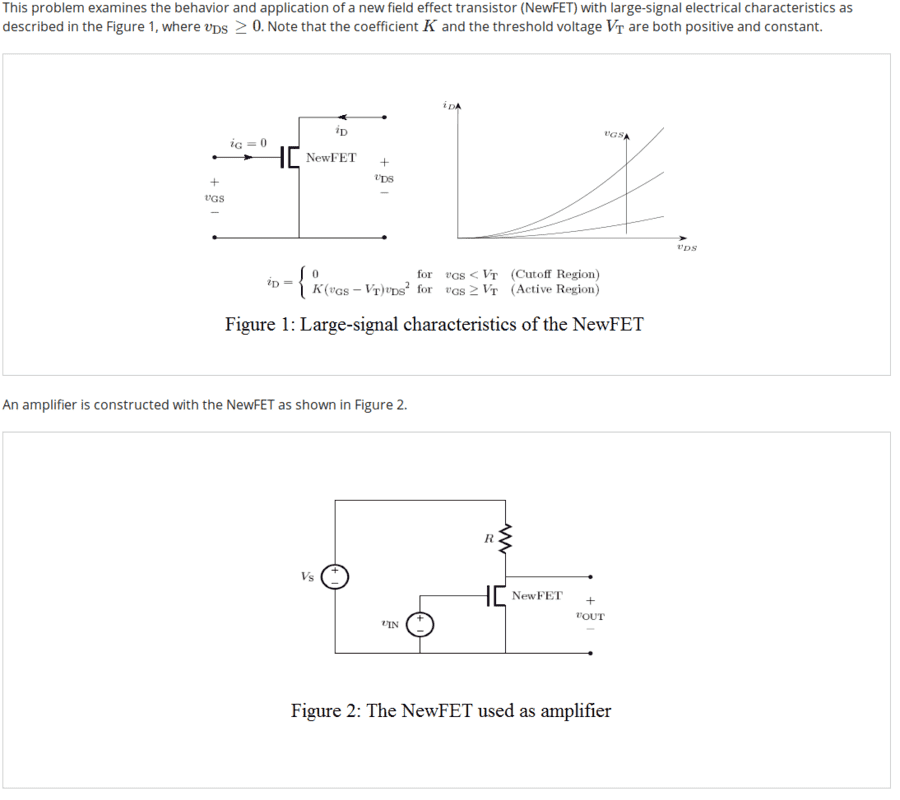
Screenshot from 2020-01-20 19-33-27.png


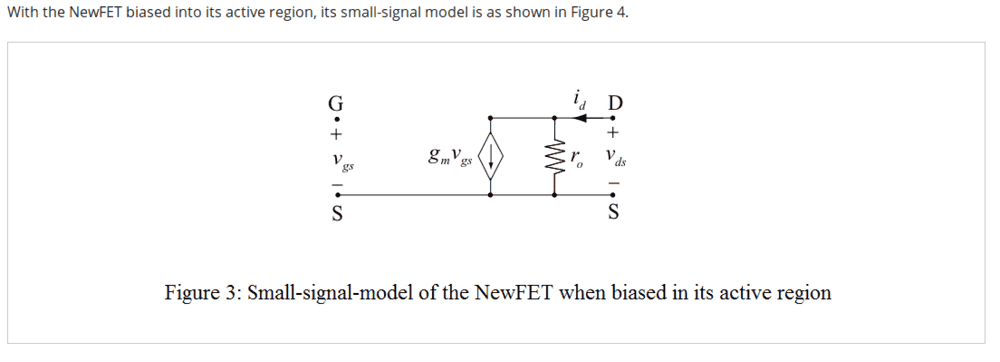
The provided small signal model:

Screenshot from 2020-01-20 19-33-52.png


The question:

Screenshot from 2020-01-20 19-34-06.png

I have been able to obtain gm, which is K*VDS^2

Still, I just can't get the right result for the output resistance (ro). It should be R, but how can I express it as a function of the mentioned variables (notice I can't use VS).
 
Physics news on Phys.org
I don't see any way to avoid referencing the resistance R in your output resistance calculation. It obviously represents a path to (signal) ground via Vs.
 
  • Like
Likes alan123hk
In order to know the exact values of gm and ro in the small signal model, it seems unavoidable that the supply voltage (VS) and bias resistance (R) are involved.
According to the obtained equation gm = K * VDS ^ 2, gm is related to the bias voltage (VDS), so the values of the supply voltage (VS) and the bias resistance (R) should be provided to determine the bias voltage.

Note: Obviously, according to the given equation, the value of ro is also forced to depend on the bias voltage (VDS)
 
Last edited:

Similar threads

  • · Replies 2 ·
Replies
2
Views
3K
Replies
0
Views
2K
  • · Replies 23 ·
Replies
23
Views
4K
  • · Replies 1 ·
Replies
1
Views
2K
  • · Replies 13 ·
Replies
13
Views
6K
Replies
1
Views
2K
  • · Replies 8 ·
Replies
8
Views
2K
  • · Replies 7 ·
Replies
7
Views
5K
  • · Replies 1 ·
Replies
1
Views
2K
  • · Replies 13 ·
Replies
13
Views
2K