Finding the length of a metre stick from a moving frame of reference

Click For Summary

Discussion Overview

The discussion revolves around the interpretation of the length of a metre stick as observed from a moving frame of reference, particularly in the context of special relativity. Participants explore the implications of Lorentz transformations and the representation of events in spacetime diagrams, focusing on how simultaneity differs between stationary and moving observers.

Discussion Character

  • Exploratory
  • Technical explanation
  • Conceptual clarification
  • Debate/contested

Main Points Raised

  • One participant questions why the length of the metre stick in the moving frame is determined by the intersection of the lines x = 1 and t' = 0, suggesting uncertainty about the measurement process.
  • Another participant asserts that the length is defined by simultaneous measurements at t' = 0, indicating that the end of the metre stick cannot be at any other point on the t' = 0 line.
  • A participant seeks clarification on whether the x-axis corresponds to the horizontal line labeled t = 0, indicating a potential misunderstanding of the spacetime diagram.
  • Further clarification is provided that the lines x' = 0 and t' = 0 represent points that transform to the primed frame, with intersections indicating corresponding coordinates in the moving frame.
  • One participant explains that the metre stick represents a row of events in four-dimensional spacetime, emphasizing the distinction between measurements in different frames.
  • Another participant notes the confusion regarding the representation of the metre stick's length as the distance between two dots in the moving frame, highlighting the complexity of visualizing events across different coordinate systems.

Areas of Agreement / Disagreement

Participants express varying levels of understanding and confusion regarding the interpretation of the spacetime diagram and the concept of simultaneity in different frames. There is no clear consensus on the best way to visualize or understand the measurements involved.

Contextual Notes

Participants mention the complexity of Minkowski geometry and the challenges of visualizing events in four-dimensional spacetime, indicating that the discussion may involve unresolved assumptions about the nature of simultaneity and measurement in relativity.

etotheipi
Suppose we have a stationary metre stick with one end positioned at the origin of a stationary frame of reference, pointing along the positive x axis.
The world lines of both ends of the metre stick are consequently vertical. Now consider another primed frame moving at velocity v relative to the stationary frame, calibrated such that both frames measure a time of 0 when the origins coincide.

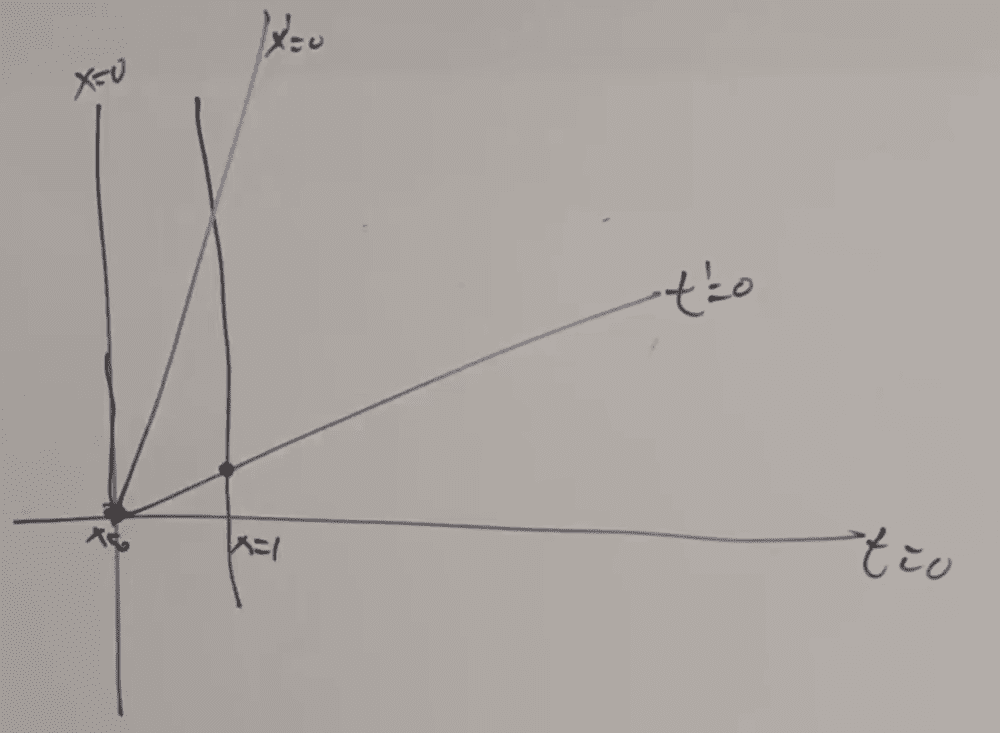
The lines corresponding to x' = 0 and t' = 0 are drawn on the spacetime diagram below (from the Theoretical Minimum lecture series)

He says that the length of the metre stick in the moving frame of reference is represented by the distance from the origin to the intersection of the lines x = 1 and t' = 0 (between the two dots). I can't understand why this is the case.

It makes some sense to imagine that the length of the metre stick in the primed frame will be obtained from setting t' = 0 and measuring the x' coordinate at the end of the metre stick, but what has intersection with the x = 1 line got to do with this - that is, what is stopping us from labelling the position of the end of the metre stick anywhere else along the t' = 0 line?
Screenshot 2019-08-03 at 17.38.50.png
 
Physics news on Phys.org
etotheipi said:
Suppose we have a stationary metre stick with one end positioned at the origin of a stationary frame of reference, pointing along the positive x axis.
The world lines of both ends of the metre stick are consequently vertical. Now consider another primed frame moving at velocity v relative to the stationary frame, calibrated such that both frames measure a time of 0 when the origins coincide.

The lines corresponding to x' = 0 and t' = 0 are drawn on the spacetime diagram below (from the Theoretical Minimum lecture series)

He says that the length of the metre stick in the moving frame of reference is represented by the distance from the origin to the intersection of the lines x = 1 and t' = 0 (between the two dots). I can't understand why this is the case.

It makes some sense to imagine that the length of the metre stick in the primed frame will be obtained from setting t' = 0 and measuring the x' coordinate at the end of the metre stick, but what has intersection with the x = 1 line got to do with this - that is, what is stopping us from labelling the position of the end of the metre stick anywhere else along the t' = 0 line?

View attachment 247571

The vertical line at ##x=1## represents the worldline of one end of the metre stick. The dot represents the event corresponding to where that end is at time ##t' =0##. The origin represents the event corresponding to the other end at time ##t' =0##.

The length of the metre stick in the primed frame is, by definition, the distance beween simultaneous measurements of the position of each end: in this case at ##t' =0##.

The end of the metre stick is not at any other point on the line ##t' =0##, so you cannot use any other point in a measurement of the length of the stick.
 
  • Like
Likes   Reactions: etotheipi
etotheipi said:
Suppose we have a stationary metre stick with one end positioned at the origin of a stationary frame of reference, pointing along the positive x axis.
Am I correct in assuming the x-axis is the horizontal line labeled t = 0?
 
  • Like
Likes   Reactions: etotheipi
PeroK said:
The vertical line at ##x=1## represents the worldline of one end of the metre stick. The dot represents the event corresponding to where that end is at time ##t' =0##. The origin represents the event corresponding to the other end at time ##t' =0##.

The length of the metre stick in the primed frame is, by definition, the distance beween simultaneous measurements of the position of each end: in this case at ##t' =0##.

The end of the metre stick is not at any other point on the line ##t' =0##, so you cannot use any other point in a measurement of the length of the stick.

Thank you for your reply, that makes a lot of sense.

I'm still slightly confused about the whole procedure. As far as my understanding goes, the line x' = 0 represents all the (x,t) points in our reference frame which 'Lorentz transform' (so to speak) to x' = 0, and similarly for the line t' = 0. So where the line t' = 0 intersects the line x = 1, for some value of t in our reference frame, the corresponding coordinates in the primed frame are (x', 0)? Is this the right way to interpret the primed lines in the diagram?

Sorry if I'm making absolutely no sense, it seems as though this should be really straightforward but for some reason it won't click.
 
David Lewis said:
Am I correct in assuming the x-axis is the horizontal line labeled t = 0?

I think so
 
etotheipi said:
I'm still slightly confused about the whole procedure. As far as my understanding goes, the line x' = 0 represents all the (x,t) points in our reference frame which 'Lorentz transform' (so to speak) to x' = 0, and similarly for the line t' = 0. So where the line t' = 0 intersects the line x = 1, for some value of t in our reference frame, the corresponding coordinates in the primed frame are (x', 0)? Is this the right way to interpret the primed lines in the diagram?
That's right. So what's still confusing you? Is it the notion that the observer at rest in the unprimed frame and the observer at rest in the primed frame don't agree on what "at the same time" means?
 
  • Like
Likes   Reactions: etotheipi
vela said:
That's right. So what's still confusing you? Is it the notion that the observer at rest in the unprimed frame and the observer at rest in the primed frame don't agree on what "at the same time" means?
 

Attachments

  • Screenshot 2019-08-03 at 20.32.30.png
    Screenshot 2019-08-03 at 20.32.30.png
    7.3 KB · Views: 426
etotheipi said:
For some reason PF is not letting me type a response, so sorry about the image!

I don't understand how the metre stick is represented by the line between the two dots in the moving frame.
It has been going wonky on me lately also. It is intermittent.

The meter stick at a point in time is a row of events. For instance, the meter stick at t=0 is a row of points where the left end was at t=0, where the 1 cm mark was at t=0, where the 2 cm mark was at t=0 and so on. This is a row of events in four dimensional space-time.

The meter stick at t'=0 is a different row of events. The left hand end event is the same. But it also contains the event where the 1 cm mark was at t'=0, where the 2 cm mark was at t'=0, etc. This is a different row of events.

Both rows are straight lines in four dimensional space. Both rows start at the same event. The two rows end at two different events. We can eliminate two out of the four coordinates and project the two lines in 4-space onto a single two dimensional sheet of paper. [It's Minkowski (hyperbolic) geometry rather than Euclidean, so there is still weirdness to deal with. Rotations are hyperbolic rather than spherical]
 
  • Like
Likes   Reactions: David Lewis and etotheipi
jbriggs444 said:
It has been going wonky on me lately also. It is intermittent.

If you're using Firefox, a recent update might have made third-party content blocking more aggressive, and since a lot of the supporting media for this site comes from a different domain (bernhardtmedia.com IIRC), to Firefox it looks like third-party content. I was able to fix the wonky behavior by disabling content blocking for physicsforums.com. You should be able to do that by clicking on the icons to the left of the site address in the address bar, and then clicking "Turn off Blocking for this site".
 
  • #10
Ahh, I think I mostly understand now.

The world lines of both ends of the metre stick show the path of the metre stick relative to both different coordinate systems. That is, at t = 0 for the stationary frame, the two ends are simply 1 unit apart on the x axis. Conversely, when t' = 0 for the moving frame of reference, the length of the metre stick is given by the distance between the two dots where the world lines intersect the x' axis.

I think my confusion was due to somehow thinking of the world lines as only part of the stationary reference frame, whilst in reality they correspond to paths through spacetime, each point of which is measured slightly differently by the two different coordinate systems.

Am I now thinking about this the right way?
 
  • Like
Likes   Reactions: vela

Similar threads

  • · Replies 12 ·
Replies
12
Views
2K
  • · Replies 33 ·
2
Replies
33
Views
2K
  • · Replies 2 ·
Replies
2
Views
2K
  • · Replies 20 ·
Replies
20
Views
2K
  • · Replies 22 ·
Replies
22
Views
2K
  • · Replies 15 ·
Replies
15
Views
1K
  • · Replies 14 ·
Replies
14
Views
2K
  • · Replies 28 ·
Replies
28
Views
3K
  • · Replies 11 ·
Replies
11
Views
2K
  • · Replies 5 ·
Replies
5
Views
2K