Finding the net field strength due to a line of charge

Click For Summary

Homework Help Overview

The discussion revolves around calculating the net electric field strength due to a line of charge, with specific parameters provided for charge density and distance. The problem involves integrating to find the electric field contributions from differential elements of the charge distribution.

Discussion Character

  • Mathematical reasoning, Assumption checking

Approaches and Questions Raised

  • Participants explore the integration of electric field contributions, questioning the coordinate system and its implications on the sign of the results. There are discussions about the correct setup for the problem and the handling of variables in the equations.

Discussion Status

Some participants have provided guidance on defining the coordinate system, while others express confusion regarding the signs of their results. There is an ongoing exploration of the steps taken in the integration process, with some participants reflecting on their initial assumptions and calculations.

Contextual Notes

Participants note the importance of the coordinate system and the potential for different interpretations of the problem setup. There is mention of a prior conversation with a professor that influenced the understanding of the problem.

Ocasta
Messages
40
Reaction score
0
I want to apologize ahead of time for my apparent inability to get LaTeX to display properly.
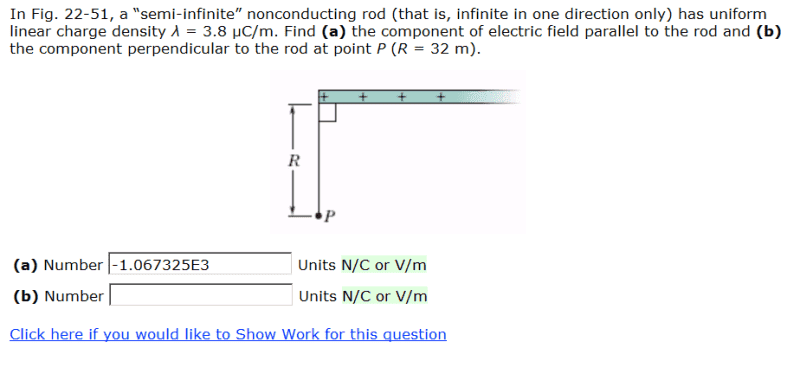
Homework Statement


prob2-33.png


λ = 3.8 x 10^(-6) C/m

R = 32m

r = magnitude of the hypotenuse (the book's convention, a poor choice IMHO)
r = \sqrt{R^2 + x^2}

k = 8.988 x 10^9

P:(0,-32)

cosθ = x/r

a→∞

Homework Equations


dE = λk \int_0^a \frac{dx}{r^2}

The Attempt at a Solution


We're supposed to figure out the overall field strength, which is finite.

dE = λk \int_0^a \frac{dx}{r^2}

dE_x = λk \int_0^a \frac{dx}{r^2} cosθ

dE_x = λk \int_0^a \frac{dx}{r^2} \frac{x}{r}

<br /> dE_x = λk \int_0^a \frac{xdx}{r^3}<br />

<br /> u = R^2 + x^2 → \frac{du}{2} = xdx<br />

<br /> dE_x = λk \int_0^a (u)^{-3/2} du<br />

<br /> dE_x = λk [ -2 u^{-1/2} ]_0^a<br />

<br /> dE_x = -2λk [ (R^2 + x^2)^{-1/2} ]_0^a<br />

<br /> dE_x = -2λk [ \frac{1}{\sqrt{R^2 + x^2}} ]_0^a<br />

<br /> dE_x = -2λk [ \frac{1}{\sqrt{R^2 + \inf^2}} - \frac{1}{\sqrt{R^2}} ]<br />

<br /> dE_x = -2λk [ 0 - \frac{1}{\sqrt{R^2}} ]<br />

<br /> dE_x = -2λk [ \frac{1}{R} ]<br /><br /> dE_x ≈ -2.13465 x 10^3<br />
 
Last edited:
Physics news on Phys.org
Looks good, though the sign is important to how you're defining your coordinate system. Make sure your coordinate system is the one the program is looking for.
 
I literally pasted all the information I was given. >.< Do you have any guidance as to how to figure out what coordinate system I should use?
 
I mean, typically we would define y is being up and x as being right. But you could do any permutation of those. I guess I don't understand what your questions about the problem are.
 
So I talked to my Physics professor, and he took a look at it. Evidently I forgot to carry over an x.

Ocasta said:
dE = λk \int_0^a \frac{dx}{r^2}

dE_x = λk \int_0^a \frac{dx}{r^2} cosθ

dE_x = λk \int_0^a \frac{dx}{r^2} \frac{x}{r}

<br /> dE_x = λk \int_0^a \frac{x dx}{r^3}<br />

<br /> dE_x = λk \int_0^a \frac{x dx}{(R^2 + x^2)^{3/2}}<br />

<br /> dE_x = λk [ \frac{-1}{\sqrt{R^2 + x^2}} ]_0^a<br />

<br /> dE_x = λk [ \frac{-1}{\sqrt{R^2 + ∞^2}} - \frac{-1}{\sqrt{R^2 + 0^2}} ]<br />

<br /> dE_x = λk [ 0 + \frac{+1}{\sqrt{32^2}} ]<br />

<br /> dE_x = λk \frac{1}{\sqrt{32^2}}<br />

<br /> dE_x ≈ 1.0673 * 10^3 \frac{N}{C}<br />

Why the solution is positive still confounds me.
 
Last edited:
Ah, whoops, that is easy to do. Yeah, I didn't really check all your steps, just that the integration was correct.
 
Mindscrape said:
Ah, whoops, that is easy to do. Yeah, I didn't really check all your steps, just that the integration was correct.

The most frustrating part is that I apparently was correct the first time, but the answer they wanted was positive rather than negative. But looking at the problem, the vector is clearly negative in the X and Y directions!
 

Similar threads

  • · Replies 9 ·
Replies
9
Views
2K
Replies
3
Views
2K
  • · Replies 103 ·
4
Replies
103
Views
14K
  • · Replies 18 ·
Replies
18
Views
1K
  • · Replies 1 ·
Replies
1
Views
1K
Replies
11
Views
2K
  • · Replies 5 ·
Replies
5
Views
3K
Replies
7
Views
3K
Replies
64
Views
6K
  • · Replies 5 ·
Replies
5
Views
1K