Finding the voltage of the circuit (resistor ladder)

  • Thread starter Thread starter deskochan
  • Start date Start date
  • Tags Tags
    Circuit Voltage
Click For Summary
SUMMARY

The discussion centers on understanding the voltage in a resistor ladder circuit, specifically addressing the use of Kirchhoff's laws and the concept of equivalent resistance. The key formula discussed is gamma (γ) = R2/(R1 + R3), which simplifies calculations in the analysis. The voltage drop is identified as exponential, derived from differential equations resulting from Kirchhoff's Voltage Law (KVL) and Kirchhoff's Current Law (KCL). Participants emphasize the necessity of a solid grasp of these laws and transmission line theory for effective problem-solving.

PREREQUISITES
  • Understanding of Kirchhoff's Voltage Law (KVL)
  • Understanding of Kirchhoff's Current Law (KCL)
  • Familiarity with differential equations
  • Basic knowledge of resistor networks and equivalent resistance
NEXT STEPS
  • Study Kirchhoff's laws in detail to apply them effectively in circuit analysis
  • Learn about transmission line theory and its applications in electrical circuits
  • Explore differential equations and their solutions in the context of electrical engineering
  • Investigate resistor ladder circuits and their voltage characteristics
USEFUL FOR

Electrical engineering students, circuit designers, and anyone interested in advanced circuit analysis and voltage behavior in resistor networks.

deskochan
Messages
6
Reaction score
1
Homework Statement
Finding the voltage of the circuit (resistor ladder)
Relevant Equations
Resistor Ladder?
The answer is B.
My question:
(a) What is the basic approach to start to think about this problem: Equivalent resistance? ohm's law?
(b) What is the purpose of gamma = R2/(R1+R3) because I have no idea how it uses?
(c) Why the answer is an exponential drop of voltage?
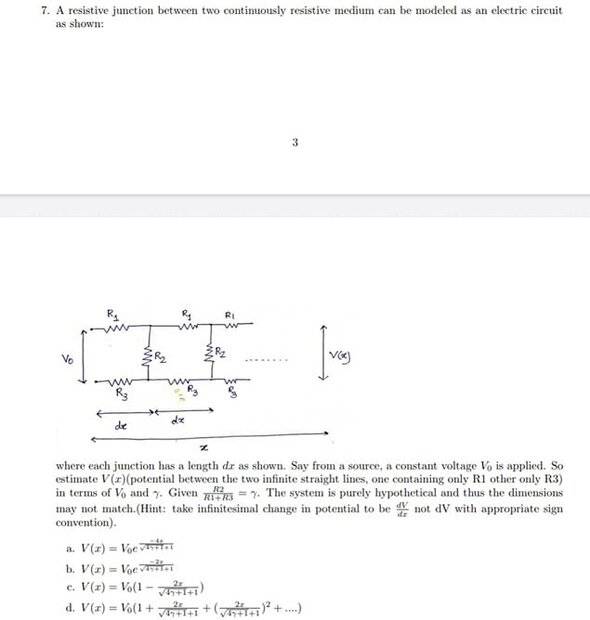
1.jpg
 
Last edited:
Physics news on Phys.org
This reminisces me of transmission line theory. You basically have to choose an infinitesimal loop and use KCL and KVL to analyze it. If all go well you ll get one differential equation for Voltage ##V(x)## and one for the current ##I(x)##
 
Delta2 said:
This reminisces me of transmission line theory. You basically have to choose an infinitesimal loop and use KCL and KVL to analyze it. If all go well you ll get one differential equation for Voltage ##V(x)## and one for the current ##I(x)##
I have only GCE A level physics background. How can I start to think about it? I do not expect to solve this question but at least how can I start to think from A level physics.
 
Hello @deskochan,
:welcome:
Picture is rather unsharp. Nice to know that b (not: B) is the answer, but
1626196686870.png
is illegible for me.

deskochan said:
(a) What is the basic approach to start to think about this problem: Equivalent resistance? ohm's law?
That is rather obvious: they even give a hint ! What do you do with that hint ?

(b) What is the purpose of gamma = R1/(R1+R3) because I have no idea how it uses?
I don't see that definition. I do see ##\gamma = {R_2/R_1+R_3}##. It comes back in the answer, so it seems to be useful. And it reduces the amount of writing needed.

(c) Why the answer is an exponential drop of voltage?
Because that is what comes out ? :rolleyes:
Probably some infinite sum, but from the hint it can also be the solution of a differential equation ...

##\ ##
 
deskochan said:
I have only GCE A level physics background. How can I start to think about it?
Not sure how good can be a GCE A level physics background. Are you familiar with Kirchhoff's laws, Kirchhoff's Voltage Law (KVL) and Kirchhoff's Current Law (KCL)?
 
BvU said:
Hello @deskochan,
:welcome:
Picture is rather unsharp. Nice to know that b (not: B) is the answer, but View attachment 285911is illegible for me.That is rather obvious: they even give a hint ! What do you do with that hint ?I don't see that definition. I do see ##\gamma = {R_2/R_1+R_3}##. It comes back in the answer, so it seems to be useful. And it reduces the amount of writing needed.Because that is what comes out ? :rolleyes:
Probably some infinite sum, but from the hint it can also be the solution of a differential equation ...

##\ ##
Sorry for the poor resolution. it is -2x/(sqrt (4*gamma+1)+1).
What is the hint? Sorry for this question but I really have an interest.
Would you tell me more and I just have GCE A level physics and I think this question is out of A level.
 
Delta2 said:
Not sure how good can be a GCE A level physics background. Are you familiar with Kirchhoff's laws, Kirchhoff's Voltage Law (KVL) and Kirchhoff's Current Law (KCL)?
A little bit for self-study but not familiar because GCE A level seldom use it.
 
Ok well, if you have not seen a treatment on transmission line theory, and you are not familiar with Kirchhoff's laws then probably this problem is beyond your level of knowledge. The differential equations I get by properly applying KVL and KCL are :
$$\frac{dV(x)}{dx}=-I(x)(R_1+R_3)$$
$$\frac{dI(x)}{dx}=-\frac{V(x)}{R_2}$$
But these have a bit different solution for ##V(x)## than the B) of the answer. I get $$V(x)=V_0e^{-\frac{x}{\sqrt{\gamma}}}$$
 
  • Like
Likes   Reactions: deskochan
Delta2 said:
Ok well, if you have not seen a treatment on transmission line theory, and you are not familiar with Kirchhoff's laws then probably this problem is beyond your level of knowledge. The differential equations I get by properly applying KVL and KCL are :
$$\frac{dV(x)}{dx}=-I(x)(R_1+R_3)$$
$$\frac{dI(x)}{dx}=-\frac{V(x)}{R_2}$$
But these have a bit different solution for ##V(x)## than the B) of the answer. I get $$V(x)=V_0e^{-\frac{x}{\sqrt{\gamma}}}$$
Yes, you are right. It is beyond my level. Thank you very much.
 
  • Like
Likes   Reactions: berkeman
  • #10
https://www.pravega.org/events/science_eve/decoherence/Decoherence_Prelims__Objective_.pdf

1626200116912.png
 
  • #11
BvU said:
https://www.pravega.org/events/science_eve/decoherence/Decoherence_Prelims__Objective_.pdf

View attachment 285914
Yep.
 

Similar threads

  • · Replies 3 ·
Replies
3
Views
2K
Replies
3
Views
2K
  • · Replies 10 ·
Replies
10
Views
2K
Replies
2
Views
931
Replies
2
Views
2K
  • · Replies 3 ·
Replies
3
Views
2K
  • · Replies 6 ·
Replies
6
Views
2K
Replies
9
Views
1K
Replies
5
Views
2K
  • · Replies 11 ·
Replies
11
Views
2K
