Force from Water Entering a Pressurized Tank with No Relief Valve

Click For Summary

Discussion Overview

The discussion revolves around the forces exerted on the walls of a pressurized tank as water enters, particularly focusing on the dynamics of air compression and the resulting pressure differentials. Participants explore theoretical models and equations related to fluid dynamics and pressure changes in a rigid tank without a relief valve.

Discussion Character

  • Exploratory
  • Technical explanation
  • Debate/contested
  • Mathematical reasoning

Main Points Raised

  • One participant proposes a force equation based on jet discharge propulsion, suggesting that the force can be expressed as $$ F = 2 A \left( P_{depth} - P_{atm} \right) $$ but questions how to incorporate the inward rushing water that compresses the air.
  • Another participant seeks clarification on the definitions of variables and the reasoning behind the factor of 2 in the proposed equation.
  • A participant explains that initially there is no compressed air, but as water enters, atmospheric air becomes compressed, and the area considered is the wall area.
  • One participant describes a hypothetical scenario involving a submarine to illustrate the dynamics of pressure waves and the effects of a sudden opening in a wall, emphasizing the rapid acceleration of water and air compression.
  • Another participant notes that as the pressure differential decreases, the infiltration of water will slow down, and the water level will eventually cover the orifice, introducing aerodynamic drag from the air.
  • Some participants discuss the potential for numerical modeling to calculate remaining air volume, instant pressure, and temperature, providing equations for these calculations.
  • One participant expresses surprise at the drag force from air counteracting the propulsive force from hydrostatic pressure.

Areas of Agreement / Disagreement

Participants express various viewpoints and hypotheses regarding the dynamics of the system, with no clear consensus reached on the correct approach or outcomes. Disagreements exist regarding the application of proposed equations and the implications of different scenarios.

Contextual Notes

Limitations include assumptions about the rigidity of walls, the nature of the pressure differential, and the effects of drag forces, which remain unresolved in the discussion.

Nauticale
Messages
5
Reaction score
3
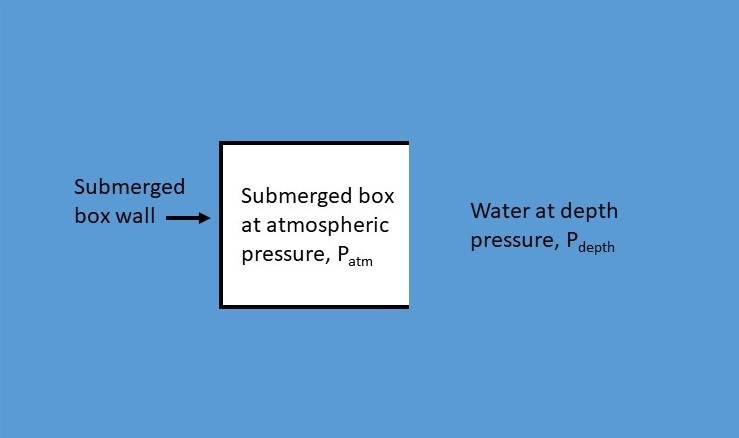
Hello all, I am trying to understand how a force at the opposite wall from water entering a pressurized air (atmospheric pressure) tank, and for this discussion it is rigid, with no relief valve to displace the compressed air can be deduced. I have created a simple illustration and believe this is similar to a failed air relief valve for a water lock in a submarine or other submerged vehicle. I think an approximate force from the water could be expressed using the jet discharge propulsion equation:
$$ F = 2 A \left( P_{depth} - P_{atm} \right) $$
However, I do not understand how to define the water rushing inward that compresses the atmospheric air into this equation? Any insight provided is much appreciated! And thanks to all!

Water_Rushing.jpg
 
Last edited:
Engineering news on Phys.org
Hello and :welcome: !

Before others can understand this, I suppose some clarification is needed:
Where is the compressed air ?
What is ##A ##?
And if ##F## is the force on the left wall and ##A## is its area, why do you write a factor 2 ?

##\ ##
 
Thank you, and good questions that I did not address.

Initially, there is no compressed air, so that might have been a misnomer, but as the water rushes into the submerged box the atmospheric air becomes compressed.

The area ##A## is the square area between the water and air interface, which in this case is also the same area as the wall.

Yes, ##F## would be the force on the left wall.

##A## is multiplied by 2 following this proof for the water jet equation. Where the velocity of a jet is
$$ v = \left(\frac {2\left(P_{depth}-P_{atm}\right)} {\rho} \right)^{1/2} $$
And the propulsive force may be estimated with
$$ F = {\rho}Av^{1/2} $$
Substituting the two results in the propulsive jet force determined using the pressure differential. Though I do not think this application is correct for this approach. I thought it might be a good place to start reasoning from.
$$ F = 2A\left(P_{depth}-P_{atm}\right) $$
 
First replace the box with a horizontal tube, with flat end walls of area, a. Let's call it a submarine. You are standing in the tube with your back against the left hand wall. You cast a spell to double the strength of all end walls, but get it wrong and the right hand wall instantly disappears. You are lucky and will not have to explain what happened to the Coronor.

The tube was axially compressed by the pressure on the opposed end walls. At the instant the right end wall became an aperture, a tension wave traveled from right to left along the tube. When the wave reaches the intact left wall, the forces are unbalanced and so the external pressure can accelerate that wall to the right, hitting you hard in the back of the head. The tube then continues to accelerate towards the aperture.

At the instant the end wall disappeared, the water began to accelerate into the tube as a liquid piston. The volume of air is being reduced by the movement of the vessel to the right and by the liquid piston to the left. The velocity of both increases, until the pressure in the air is equal to the hydrostatic pressure at depth. At that point the air will have been heated by the compression to maybe 1000 °C. But it cannot stop there, the momentum of the vessel and liquid piston continues to compress and heat the air until it stops and settles back to the balance point.

As the liquid piston entered, it demolished any infrastructure that may have been in the tube. That liquid piston and all that wreckage approaches and reaches you in less than one tenth of a second. You have no time to realize that you got the spell wrong.

In the unlikely event that your body was recovered, the coroner might identify your burnt hair as evidence of an implosive failure at depth. If you recorded the spell you cast, intending it for social media, then the Coroner will have only you to blame you.
 
  • Informative
Likes   Reactions: Nauticale
Progressively, less pressure differential will induce less infiltration, and the jet will slowdown.
The level of water will eventually cover the orifice.
While traveling within the pocket of air, the initial jet will suffer some additional aerodynamic drag due to increased density of air, but it should not be significative.
 
  • Like
Likes   Reactions: Nauticale
Baluncore said:
First replace the box with a horizontal tube, with flat end walls of area, a. Let's call it a submarine. You are standing in the tube with your back against the left hand wall. You cast a spell to double the strength of all end walls, but get it wrong and the right hand wall instantly disappears. You are lucky and will not have to explain what happened to the Coronor.

The tube was axially compressed by the pressure on the opposed end walls. At the instant the right end wall became an aperture, a tension wave traveled from right to left along the tube. When the wave reaches the intact left wall, the forces are unbalanced and so the external pressure can accelerate that wall to the right, hitting you hard in the back of the head. The tube then continues to accelerate towards the aperture.

At the instant the end wall disappeared, the water began to accelerate into the tube as a liquid piston. The volume of air is being reduced by the movement of the vessel to the right and by the liquid piston to the left. The velocity of both increases, until the pressure in the air is equal to the hydrostatic pressure at depth. At that point the air will have been heated by the compression to maybe 1000 °C. But it cannot stop there, the momentum of the vessel and liquid piston continues to compress and heat the air until it stops and settles back to the balance point.

As the liquid piston entered, it demolished any infrastructure that may have been in the tube. That liquid piston and all that wreckage approaches and reaches you in less than one tenth of a second. You have no time to realize that you got the spell wrong.

In the unlikely event that your body was recovered, the coroner might identify your burnt hair as evidence of an implosive failure at depth. If you recorded the spell you cast, intending it for social media, then the Coroner will have only you to blame you.
I enjoyed the write-up and coverage of all physical phenomenon in the event of an implosion. This made me realize that I am very poor at defining the problem at hand and would like to identify that the walls are rigid. But despite the increase in wall stiffness, I find it likely that I will still be meeting with the Coroner.
 
  • Haha
Likes   Reactions: Tom.G
Lnewqban said:
Progressively, less pressure differential will induce less infiltration, and the jet will slowdown.
The level of water will eventually cover the orifice.
While traveling within the pocket of air, the initial jet will suffer some additional aerodynamic drag due to increased density of air, but it should not be significative.
Thank you, I did not anticipate the drag force from air counteracting the propulsive force from the hydrostatic pressure.
 
  • Like
Likes   Reactions: Lnewqban
If you numerically model the system you will be able to find the remaining air volume. From that the instant pressure and temperature can be calculated.
V0 = initial air volume; V1 = compressed air volume.
P0 = initial air pressure; P1 = compressed air pressure.
T0 = initial absolute air temperature (kelvin); T1 = absolute temperature of compressed air.
P1 = P0 * ( V0 / V1 )^ gamma
T1 = T0 * ( V0 / V1 )^( gamma - 1 )
Where; gamma = 1.4 for air.
 
Baluncore said:
If you numerically model the system you will be able to find the remaining air volume. From that the instant pressure and temperature can be calculated.
V0 = initial air volume; V1 = compressed air volume.
P0 = initial air pressure; P1 = compressed air pressure.
T0 = initial absolute air temperature (kelvin); T1 = absolute temperature of compressed air.
P1 = P0 * ( V0 / V1 )^ gamma
T1 = T0 * ( V0 / V1 )^( gamma - 1 )
Where; gamma = 1.4 for air.
After calculating the instant pressure I am assuming that the force acting on the wall is
$$F=P_1A_{wall}$$
And compression of the air volume is assumed to be symmetric similar to that of a piston compressing air in a cylinder.
 

Similar threads

Replies
2
Views
2K
  • · Replies 4 ·
Replies
4
Views
2K
  • · Replies 4 ·
Replies
4
Views
5K
  • · Replies 20 ·
Replies
20
Views
11K
  • · Replies 1 ·
Replies
1
Views
3K
  • · Replies 45 ·
2
Replies
45
Views
6K
  • · Replies 9 ·
Replies
9
Views
4K
  • · Replies 1 ·
Replies
1
Views
4K
  • · Replies 4 ·
Replies
4
Views
27K
  • · Replies 56 ·
2
Replies
56
Views
6K