Four carbon brushes for a DC Motor- what are they for?

Click For Summary

Discussion Overview

The discussion revolves around the configuration and function of carbon brushes in DC motors, particularly in the context of starter motors for vehicles. Participants explore theoretical versus practical aspects of motor design, including the presence of four brushes instead of the typical two, and the implications for motor operation and design variations.

Discussion Character

  • Exploratory
  • Technical explanation
  • Debate/contested
  • Conceptual clarification

Main Points Raised

  • One participant expresses frustration over the discrepancy between theoretical explanations of DC motors and the practical reality of starter motors, specifically regarding the presence of four carbon brushes.
  • Another participant suggests that the number of brushes corresponds to the number of poles in a lap wound DC motor, indicating a potential design variation.
  • Discussion includes the role of insulation on some brush wires and the implications for electrical connections within the starter motor.
  • Participants propose that the configuration of brushes may relate to the motor's design for delivering high torque, with multiple paths for current flow.
  • Speculation arises about the possibility of the starter motor using a permanent magnet field, with references to asymmetrical brush placement potentially prolonging brush life.
  • One participant mentions the importance of understanding the stator windings and the magnetic flux in relation to the operation of the motor.
  • There is a mention of a patent related to brush placement, suggesting advancements in starter motor design.
  • Clarification is sought regarding the operational role of the starter motor after the engine has started, with a participant noting that in electric vehicles, the starter motor's function may differ.

Areas of Agreement / Disagreement

Participants exhibit a range of views regarding the design and function of starter motors, with no consensus reached on the implications of having four brushes or the specific configurations of the motors discussed. The discussion remains unresolved with multiple competing perspectives on the topic.

Contextual Notes

Participants reference various design configurations, including lap wound versus wave wound armatures, and the potential for different grounding systems in vehicles. There are indications of missing assumptions regarding the specific designs of starter motors and their operational characteristics.

Who May Find This Useful

This discussion may be of interest to automotive engineers, hobbyists working on vehicle electrical systems, and students studying electric motor design and operation.

Hondaboi1729
Hi in every theoretical explanation of any kind of DC motor there's always a split ring commutator and two brushes like in the following pic
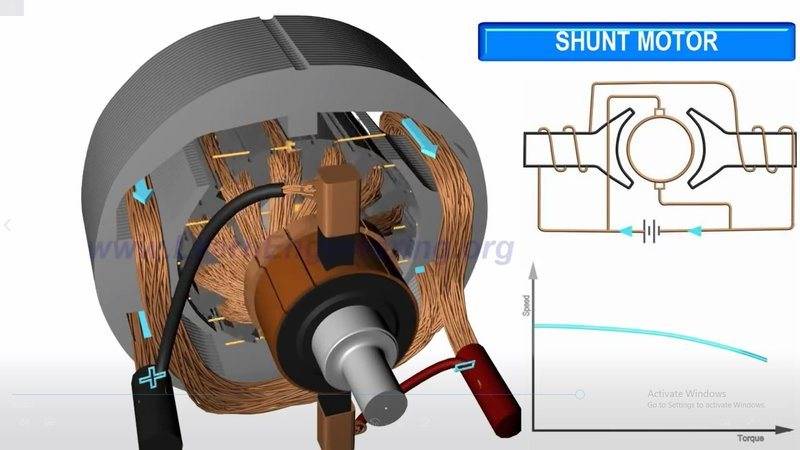
shunt motor.jpg


then when it comes to my motorbike/car starter motor rebuild the real thing in practice is different- see the following pic with four carbon brushes- two of them have insulation on the wires and the other two you see bare wire... what are they for- no one ever tries to give a theoretical explanation of what the real thing is in practice- and what use is the pure theory if that's not what I'm going to actually see when I'm working with these things- it's really frustrating me.
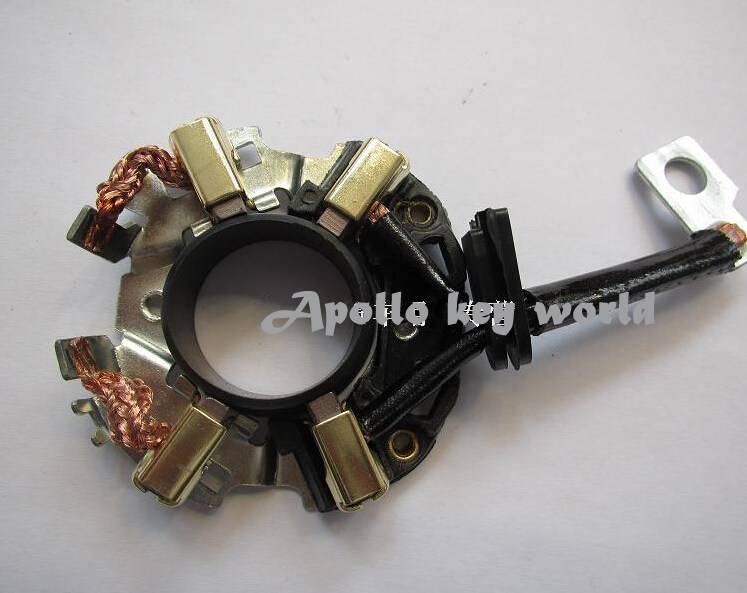
carbon brushes.jpg

there's no absolutely zero mention of any two more brushes in any explanation of any DC motor.

also do starter motors work with a field coil or a permanent magnet. if one where is it in a pic, if the other where is it in a pic...
 
Last edited by a moderator:
Engineering news on Phys.org
  • Like
Likes   Reactions: Asymptotic
This would be a good question to ask Old Jim Hardy.
 
yeah Jim is so clever and knowledgeable I know- he's replied to my threads before- but how do I ask a forum user specifically?
 
Hondaboi1729 said:
there's no absolutely zero mention of any two more brushes in any explanation of any DC motor.
Looks like the motor is lap wound with four poles. In a lap wound dc motor, number of poles=number of brushes.
Edit: I see jambaugh has already provided a video.
 
  • Like
Likes   Reactions: Asymptotic and jim hardy
Hondaboi1729 said:
when it comes to my motorbike/car starter motor rebuild the real thing in practice is different- see the following pic with four carbon brushes- two of them have insulation on the wires and the other two you see bare wire... what are they for- no one ever tries to give a theoretical explanation of what the real thing is in practice
There are all kinds of ways to slice and dice the general idea of an electric machine into a physically realized product.

Is the starter in a negative ground or positive ground vehicle? The brushes with bare wire shunts are connected to a common metallic plate which bolts onto the starter frame, thence to the vehicle frame, and eventually to one side of the battery. The other two brush holders are riveted to an insulator with their brush shunts connected to a common terminal, and (through the starter relay) eventually to the other side of the battery.

Hondaboi1729 said:
also do starter motors work with a field coil or a permanent magnet. if one where is it in a pic, if the other where is it in a pic...
In your photo only the brush rig is shown.

Carefully study your stator windings. This illustration copped from School Science Lessons shows one possible configuration for a starter motor with two (-) brushes and two (+) brushes that employs three series fields and a wound shunt field.

series_shunt_starter_winding.jpg
 
  • Like
Likes   Reactions: jim hardy
Starters for cars are made to deliver LOTS of torque, for obvious reasons. They usually are four brush so there's two paths for current so as to let plenty of it through. .
from a hobbyist page at http://what-when-how.com/automobile/starter-motors-and-circuits-automobile/

upload_2017-10-5_20-26-14.png
What's curious about your photo is the brushes aren't spaced 90 degrees apart, and that I've never encountered before.
Makes me wonder if you have a new variety of starter there with permanent magnet field , and brushes offset a little bit to counter distortion in the flux from large armature current? I don't know, just guessing.

Image from a pretty good slideshow tutorial at https://www.slideshare.net/MrioAlves18/08-starting-systems-for-road-vehicles
(his permanent magnet stator is six pole not four)
upload_2017-10-5_20-46-10.png
I ran across some descriptions of Japanese starters with both a permanent magnet AND windings in its field structure.. I'm thinking maybe that's what you have. Is it a reduction gear drive starter?

I have a lawnmower starter that's permanent magnet, will look inside it next chance i get.

But rest easy - i cannot recall encountering a car starter with fewer than four brushes. That two segment commutator is a teaching aid , suitable for science fair demonstration projects.

Here's a page from a textbook on motors
http://web.eecs.utk.edu/~tolbert/teaching/ece321/handouts/armature.pdf
Don't worry about lap wound versus wave wound armatures, just be aware that all the commutator segments are connected together by the armature wires. So you'll read fraction of an ohm between any two commutator segments, that's normal and it doesn't mean your armature is shorted.
An armature that's in trouble is usually burned to a crisp and reads short circuit between commutator and the shaft..

To understand starters look down the bore, figure out where is the flux from field(image up above should help) , then imagine yourself a unit of charge moving along inside one of the armature conductors and apply right hand rule. What force do you feel ?
That sort of anthropomorphizing can help electric machines become intuitive for you .

If you're in school, it's Q V cross B which is a vector multiplication so gives a direction to the force felt by the moving charge.
 
Last edited:
  • Like
Likes   Reactions: Dr.D, dlgoff, Asymptotic and 1 other person
Aha ! Found a patent describing asymmetrical brush placement.

US 8395297

us
upload_2017-10-5_22-7-51.png


it is claimed to prolong brush life in machines that see unusual numbers of start cycles.

Is your starter from one of these new cars that turns off its engine at traffic lights and stop signs ?
 
  • Like
Likes   Reactions: Asymptotic
  • #10
BTW that picture posted by @Asymptotic in #7 is a good starter.
A powerful series wound DC motor with no load will run away until centrifugal force destroys it. The shunt field limits its RPM should the gear fail to engage flywheel.
I had a mid 60's Opel starter sling the conductors out of the rotor because of that.

The next year i had occasion to take apart my Chrysler starter , upon seeing its shunt field i marveled "Why doesn't everybody do that ? "
 
  • Like
Likes   Reactions: Asymptotic and cnh1995
  • #11
jim hardy said:
A powerful series wound DC motor with no load will run away until centrifugal force destroys it.

electric car, guy floored it in neutral...
overspeddcmotor-jpg.jpg
 
  • Like
Likes   Reactions: sophiecentaur and Asymptotic
  • #12
Oh sorry that was just a generic picture of a starter motor plate I found online because I thought it would't have made a difference... but actually when I look at the Haynes manual for the bike in the "starter motor overhaul" section the motor I have for one of the motorbikes I have (Honda CBR125- the motor in question) has
asymmetrical brush holders and looks exactly like that...

Like most vehicles it has a negatively ground chassis.

I haven't taken the motor apart yet for fear of diving in without understanding of how it works but now that I have some ideas after many videos and this helpful site I'll be a bit braver and can study the stator windings when I do so. I can't comment yet on whether it's a reduction drive starter or not...

Excellent resources all round- where did you find that patent I'm amazed- your googling skills are profoundly superior to mine :-p

as to that ruined motor above when the guy floored it in neutral- I thought once the engine had started- the starter motor had no more role to play and isn't spinning- what does it matter how hard he revs in neutral?
 
  • Like
Likes   Reactions: dlgoff
  • #13
Hondaboi1729 said:
I thought once the engine had started- the starter motor had no more role to play and isn't spinning- what does it matter how hard he revs in neutral?
It was an electric car and that's its 'engine'. Similar to a starter motor but bigger.

Apparently that electric car did not have a rev limiter. .

Glad you're enjoying the thread. One learns a lot working on his 'stuff', especially when he digs into the basic science behind the machinery.
 
  • Like
Likes   Reactions: dlgoff

Similar threads

  • · Replies 15 ·
Replies
15
Views
2K
  • · Replies 7 ·
Replies
7
Views
2K
Replies
5
Views
5K
Replies
9
Views
5K
  • · Replies 5 ·
Replies
5
Views
3K
  • · Replies 13 ·
Replies
13
Views
3K
  • · Replies 14 ·
Replies
14
Views
8K
Replies
11
Views
4K
Replies
1
Views
2K
  • · Replies 1 ·
Replies
1
Views
2K