Friction of a rope around a cylinder

  • Context: Undergrad 
  • Thread starter Thread starter davidgruty
  • Start date Start date
  • Tags Tags
    Cylinder Friction Rope
Click For Summary
SUMMARY

The discussion focuses on calculating the effect of an offset distance "a" on the friction of a rope wrapped around a cylinder, particularly when the cylinder's center of mass is not centered. The key equations derived include the relationship between the weight of the cylinder (P), the reaction force (N), and the static friction coefficient (μ). The capstan equation is referenced to establish the tension relationship between T1 and T2, which is critical for determining when the cylinder will start moving. Participants emphasize the importance of understanding the forces at play, including the moments around the center of the cylinder.

PREREQUISITES
  • Understanding of static and kinetic friction coefficients (μ)
  • Familiarity with the capstan equation and its applications
  • Knowledge of basic mechanics, including forces and moments
  • Ability to solve algebraic equations involving multiple variables
NEXT STEPS
  • Study the capstan equation in detail to understand its implications in tension calculations
  • Learn about the principles of static equilibrium and how they apply to systems with multiple forces
  • Explore examples of frictional forces in mechanical systems, particularly involving ropes and pulleys
  • Investigate the effects of varying the coefficient of friction on the stability of cylindrical systems
USEFUL FOR

Mechanical engineers, physics students, and anyone involved in the design or analysis of systems utilizing ropes and pulleys will benefit from this discussion.

davidgruty
Messages
20
Reaction score
0
Hi,

We have a cylinder held by a rope . The rope holds it around its lower half.

If the center of mass of the cylinder is not in the middle, but towards a side, a distance "a". How does this offset affect to the friction on the rope?

or

How big does "a" have to be so the cylinder starts moving?

The weight of the cylinder "P" goes downwards. But the friction is along the lower half of it. Can one sum the moments around the center?

P*a=N*mue*R {1}

N: reaction force along the rope
mue: static friction coeficient
R: cylinder radius

In general:

P=mue*N {2}

I can't combine these two

How can I calculate "a"?
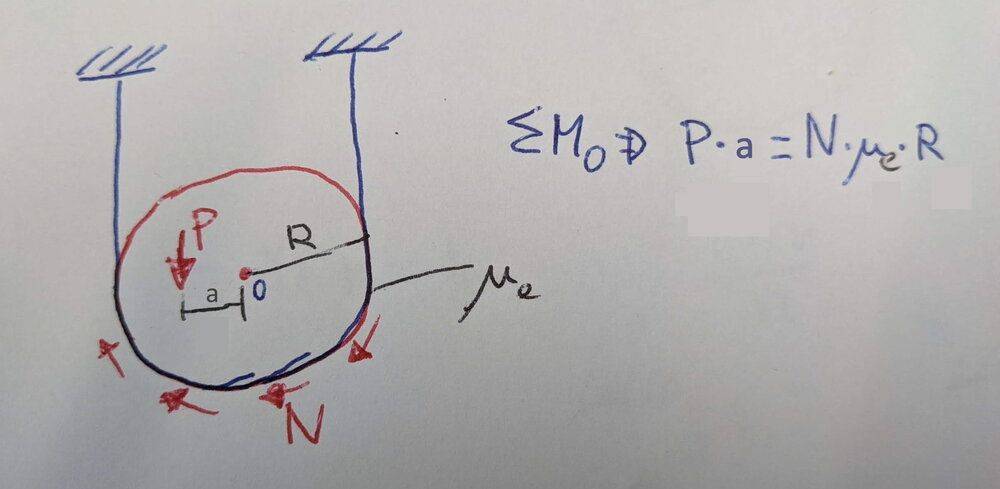
Friction.jpg

thanks
 
Physics news on Phys.org
I can't derive the formula, but remember from a school boy that the frictional resistance obtained by wrapping a rope around a cylinder is as follows:-
Frictional resistance = Highest Tension x e^(mu x theta).
I notice your formula does not include the tension, which will vary along the wrapping.
 
ok, right. I just realized the the tension in both sides of the rope is not the same
 
What is theta? the angle of contact between rope and cylinder? 180º in this case (Pi)

So

N = T2 * e^(mu*PI)

?

There are 4 forces: the two tensions (T1, T2), the friction (N) and the weight (P)

How can I connect them? I can't say that the sum of forces in the vertical axis is zero. N is changing direction

PXL_20210218_112006348.jpg
 
davidgruty said:
If the center of mass of the cylinder is not in the middle, but towards a side, a distance "a". How does this offset affect to the friction on the rope?
The first question to be answered is whether the rope is slipping.

The standard way of doing this is to start by assuming that the rope is not slipping and to then determine the forces that must exist everywhere and the resulting accelerations. If the coefficient of static friction is inadequate to provide the required force of static friction then one concludes that the rope is slipping.

If the rope is slipping, the coefficient of kinetic friction can be used to deduce the pattern of frictional force that must exist and one can then deduce the acceleration that exists.
 
Yes, the rope should not slip.

I want to find the distance "a" maximum before starts slipping.

Using the static friction coefficient
 
Use the formula provided by @tech99 in post #2. If the rope is on the verge of slipping, that formula gives the pattern of tension that must exist. In particular, for a given coefficient of friction, it can be solved for T1 in terms of T2. Or for T2 in terms of T1.

The rest is a matter of writing down equations and solving.
 
I'm not following. What do you mean with T1 in terms of T2? their relation?

Such
T2 = N + T1
?

This is one equation on the rope

Then we have the

N = T2 * e^(mu*theta)

And finally the moments around the center:

P * a + T2 * R = T1 * R + N (xxxx)

I don't know how N contributes in the formula. I am guessing N * R * theta (the force along its contact line times the distance to the center)

I can't find in internet the formula Frictional resistance = Highest Tension x e^(mu x theta)

Could you address me to some theory or examples where it is applied?

thanks

PXL_20210218_134929976.jpg
 
Please, see:
https://en.m.wikipedia.org/wiki/Capstan_equation

Note that as distance a gets bigger, two things also grow: the value of the moment excerted by off-center force P and the difference between tensions of the the rope.
In real life, force P would move the cylinder in the diagram towards the right some, as a state of static balance appears.
 
  • #10
Lnewqban said:
Please, see:
https://en.m.wikipedia.org/wiki/Capstan_equation

Note that as distance a gets bigger, two things also grow: the value of the moment excerted by off-center force P and the difference between tensions of the the rope.
In real life, force P would move the cylinder in the diagram towards the right some, as a state of static balance appears.
I agree with the use of the capstan equation. I disagree that there will be any rightward slant. Consider that in a state of static equilibrium if both tensions had a rightward component and the downward force of gravity were still purely vertical, this would give a net rightward force, contradicting the claim that we have a static equilibrium.

I hesitate to give a full solution to this homework-like problem. It is dead easy.
 
  • #11
ahá,

I see now well the equation. So I have the relation between T1 and T2.

Now I need to plug it in the equilibrium equations, but I don't see them yet.

How does the friction force affect the cylinder??
 
  • #12
davidgruty said:
ahá,

I see now well the equation. So I have the relation between T1 and T2.

Now I need to plug it in the equilibrium equations, but I don't see them yet.

How does the friction force affect the cylinder??
It is most convenient to pretend that the section of cord between the two attachment points is part and parcel of the cylinder. That segment will be negligibly massive and will move with the cylinder, so this interpretation does not change the problem in any meaningful way.

[You use the capstan equation to determine the ratio of the tensions first, then apply this re-interpretation].

With this new interpretation in hand, the cylinder is subject to three external forces and friction is no longer relevant.
 
  • #13
ok!

So sum of moments respect to the center and I already have it.

Like this:
PXL_20210218_112006348.jpg
 
  • #14
or just sum of forces in the vertical direction:

T1 + T2 = P
 

Similar threads

  • · Replies 3 ·
Replies
3
Views
1K
  • · Replies 22 ·
Replies
22
Views
5K
  • · Replies 3 ·
Replies
3
Views
3K
  • · Replies 4 ·
Replies
4
Views
2K
  • · Replies 13 ·
Replies
13
Views
2K
  • · Replies 4 ·
Replies
4
Views
4K
  • · Replies 18 ·
Replies
18
Views
3K
  • · Replies 3 ·
Replies
3
Views
7K
  • · Replies 7 ·
Replies
7
Views
6K
  • · Replies 32 ·
2
Replies
32
Views
3K