Is Force Truly a Scalar in Rope Friction Problems?

  • Context: Undergrad 
  • Thread starter Thread starter Happiness
  • Start date Start date
  • Tags Tags
    Force Scalar
Click For Summary

Discussion Overview

The discussion centers around the nature of force in the context of rope friction problems, specifically whether force can be treated as a scalar or a vector when analyzing the tension in a rope wrapped around a pole. Participants explore the implications of static friction and the resulting tension on the rope, examining both theoretical and practical aspects of the problem.

Discussion Character

  • Debate/contested
  • Technical explanation
  • Mathematical reasoning

Main Points Raised

  • Some participants assert that the tension at the other end of the rope can be expressed as ##T=T_0 e^{\mu\theta}##, leading to the conclusion that static friction allows for significantly increased weight support.
  • Others argue that treating friction as a vector leads to a different conclusion, suggesting that the vector sum of friction around the loop could be zero, which would imply that the maximum tension remains ##T=T_0##.
  • One participant emphasizes that the analysis should focus on string tension rather than forces, suggesting that the direction of tension varies based on the cross-section of the string.
  • Another participant questions the validity of the vector-sum model, asking why the vector sum of friction is not zero and pointing out that friction is not constant around the loop.
  • Some participants note that the exponential dependence on the coefficient of friction ##\mu## is significant, with one suggesting that even a low coefficient could still allow for substantial weight support with multiple wraps.
  • There is a mention of practical limitations, such as the structural integrity of the pole or rope, which could prevent the lifting of extremely heavy weights.
  • One participant discusses the local differential force balance approach to derive the change in tension, indicating a more complex analysis involving normal and tangential forces.
  • Another participant highlights that the tension in the rope is distinct from the total force sum acting on the rope or pole, suggesting a need for clarity in definitions.
  • A later reply introduces a generalized approach to the problem, involving equilibrium conditions for forces acting on the rope, indicating a broader mathematical framework for understanding the tension dynamics.

Areas of Agreement / Disagreement

Participants express multiple competing views regarding the treatment of force as a scalar or vector in this context. The discussion remains unresolved, with no consensus on which model is correct.

Contextual Notes

Participants note that the assumptions regarding the constancy of friction and the nature of tension can significantly affect the outcomes of their analyses. The discussion also reveals a dependence on the definitions used for tension and force in this context.

Happiness
Messages
686
Reaction score
30
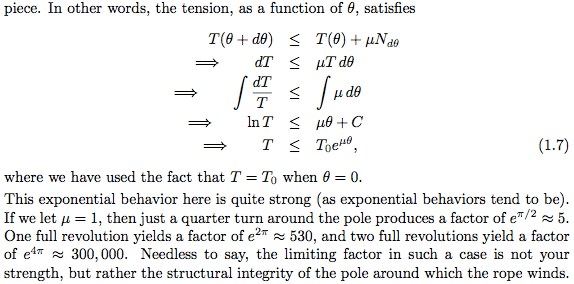
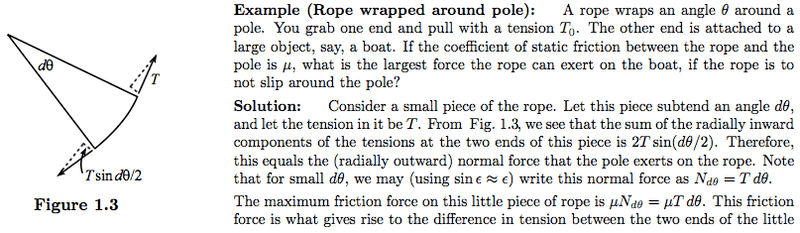
Consider a rope wraps an angle ##\theta## around a pole with a coefficient of static friction ##\mu##. You pull one end with a tension ##T_0##. The force that the other end can support is given by ##T=T_0e^{\mu\theta}##(derivation below). For ##\mu=1## and ##\theta=2\pi##, ##T=530T_0##. That means with the help of static friction, you can wrap a rope one round around a pole to hold up a weight 530 times ##T_0##! Suppose I can carry a maximum weight of 50 kg tied to a rope. By wrapping the rope once around a pole, I'll be able to support ##530\times50=26500##kg! That's the weight of an aeroplane! Doesn't this sound dubious? But this is what is claimed by the book below.

Next, let's explain why force is a scalar here. The reason why the tension at the other end is ##530T_0## is because static friction is always acting in the same direction along the rope, say anticlockwise. This static friction at different parts of the rope is being summed up as a scalar to give a value of ##529T_0##. Then add this to the ##T_0## you exert, we get ##T=530T_0##.

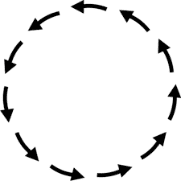
If we treat friction as a vector instead, we will say that the friction at different parts of the rope is in different directions. When the rope is wrapped once, the vector sum of friction is zero since vectors arranged in a circle go back to the same point.
Screen Shot 2016-07-16 at 4.26.37 am.png

Then, we will conclude ##T=T_0##. After wrapping the rope once around a pole, the maximum weight I can support remains the same.

Which is correct? The scalar sum or the vector sum?
Screen Shot 2016-07-16 at 1.52.08 am.png

Screen Shot 2016-07-16 at 1.52.24 am.png
 
Last edited:
Physics news on Phys.org
It is not forces that are being considered, it is the string tension. Depending on how you make across section of the string, you will get different directions. What matters is getting an expression for the tension as a function of the angle and this is what is done.

Of course, a constant of friction of one is huge and the result depends exponentially on ##\mu##.
 
Orodruin said:
It is not forces that are being considered, it is the string tension. Depending on how you make across section of the string, you will get different directions. What matters is getting an expression for the tension as a function of the angle and this is what is done.

Of course, a constant of friction of one is huge and the result depends exponentially on ##\mu##.

Could you explain why the vector-sum model is wrong? That is, why isn't the vector sum of friction zero?

If the friction are the vectors shown below, then shouldn't they add up to zero?
Screen Shot 2016-07-16 at 4.26.37 am.png
 
Happiness said:
Could you explain why the vector-sum model is wrong? That is, why isn't the vector sum of friction zero?

If the friction are the vectors shown below, then shouldn't they add up to zero?
View attachment 103277

The friction is not constant around the loop.
 
  • Like
Likes   Reactions: Happiness
Orodruin said:
Of course, a constant of friction of one is huge and the result depends exponentially on ##\mu##.

But even with a constant of friction of ##0.1##, I only need to wrap the rope around the pole ten times to lift an aeroplane. That's still very incredible!
 
The rope or the pole will break before you can lift an aeroplane.
"Needless to say, the limiting factor in such a case is not your strength, but the structural integrity of the pole around which the rope winds."
 
Of course, there is also a reason you find constructions such as these on sailing boats:
cutcaster-photo-100240388-Pulling-the-rope-tight-on-a-sailboat-winch.jpg
 
The analysis involves performing a local differential force balance on a tiny section of the rope (not the entire wrap of rope), and applying force equilibrium to the tiny section of rope in the local directions normal and tangent to the pole. This is similar to what we do when we consider a particle motion in which forces are acting normal and tangent to the particle trajectory. In the case of the rope, the local normal force per unit length of rope (from the force balance in the normal direction) is n=T/R. In the tangential direction, the force balance gives:

$$T(\theta + d\theta)-T(\theta)=\mu (nR\Delta \theta)$$

If we divide this equation by ##\Delta \theta## and take the limit as ##\Delta \theta## approaches zero, we obtain:
$$\frac{dT}{d\theta}=\mu nR=\mu T$$
 
Orodruin said:
The friction is not constant around the loop.

The derivation starts with ##dT=\mu N##, which means the change in tension is equal to the friction on the little piece of rope. Then integration is performed on both sides. That means the total change in tension is equal to the scalar sum of all the friction on the little pieces. But why is it a scalar sum? For example, ##W=\int\mathbf{F}\cdot d\mathbf{s}## is a scalar sum.

Since the friction is not constant, the vector sum of all the friction is not zero. But because some of the friction partially cancels out, the vector sum should be less than the scalar sum. But why is this not taken into account?

EDIT: I've found the reason. I think it's because the LHS ##\int dT## is also a scalar sum.
 
Last edited:
  • Like
Likes   Reactions: Chestermiller
  • #10
Happiness said:
Since the friction is not constant, the vector sum of all the friction is not zero. But because some of the friction partially cancels out, the vector sum should be less than the scalar sum. But why is this not taken into account?
You are looking at the tension in the rope, not the total force sum on the rope or pole. These are different concepts.
 
  • #11
Orodruin said:
Of course, there is also a reason you find constructions such as these on sailing boats:

Indeed. If anyone ever asks you to help tie up a boat and throws you a rope never just stand there holding it - way too easy to get pulled in. Always put a turn around a suitable post or ring etc. You don't have to tie it, just put a turn around and hold the end. I'm not at all surprised you gain a factor or 500 advantage.
 
  • #12
CWatters said:
Always put a turn around a suitable post or ring etc.
And by "suitable" we mean a post that will be able to hold the boat without breaking ...
 
  • #13
CWatters said:
Indeed. If anyone ever asks you to help tie up a boat and throws you a rope never just stand there holding it - way too easy to get pulled in. Always put a turn around a suitable post or ring etc. You don't have to tie it, just put a turn around and hold the end. I'm not at all surprised you gain a factor or 500 advantage.

Actually, the magic number is three turns. See http://dickandlibby.blogspot.com/2014/02/the-magic-number-three.html
One is too little. More than three (as shown in the picture in post #7) are prone to fouling. Three turns will let you hold any force up to the strength of the line using only slight force on the tailing end.
 
  • #14
Actually these are forces and vectors. Perhaps the authors of the text that is cited in OP should be little bit precise and formal. This problem can easily be generalized. Assume that the pole is a convex oval in its horizontal section (shaded area in the picture) :

ac15214fbaca.png


The ends of the rope are pulled with forces ##\boldsymbol G## and ##\boldsymbol F##. Then the system remains in equilibrium provided
$$ e^{-\mu\alpha}\le \frac{|\boldsymbol F|}{|\boldsymbol G|}\le e^{\mu\alpha},$$ here ##\alpha## is an angle from the vector ##-\boldsymbol F## to the vector ##\boldsymbol G## (clockwise ).
To prove this theorem it is convenient to expand the equations of equilibrium for the small arc of the rope by the Frenet frame
 

Similar threads

  • · Replies 6 ·
Replies
6
Views
2K
  • · Replies 13 ·
Replies
13
Views
3K
Replies
1
Views
1K
  • · Replies 7 ·
Replies
7
Views
2K
  • · Replies 3 ·
Replies
3
Views
3K
  • · Replies 11 ·
Replies
11
Views
2K
  • · Replies 3 ·
Replies
3
Views
7K
  • · Replies 16 ·
Replies
16
Views
3K
  • · Replies 19 ·
Replies
19
Views
15K
Replies
46
Views
7K