Gap between introductory physics & solid state physics?

Click For Summary

Discussion Overview

The discussion revolves around the differences between introductory physics and solid state physics, particularly in the context of how metals behave under an electric field. Participants explore various models and representations of charge distribution in conductors, questioning the validity of different depictions and the underlying assumptions.

Discussion Character

  • Debate/contested
  • Technical explanation
  • Conceptual clarification

Main Points Raised

  • Some participants question whether two different depictions of a metal under an electric field are contradictory and seek clarification on which model is correct.
  • There is a discussion about the assumptions behind the drawings, particularly regarding the behavior of electrons and positive ions in a conductor.
  • One participant argues that in the introductory physics model, positive and negative charges are on the surface of the conductor, while in the solid state model, the presence of positive ions inside the conductor suggests a non-zero electric field, which contradicts the idea of zero electric field inside a conductor.
  • Another participant suggests that even with a strong electric field, the displacement of electrons is minimal, supporting the continuum model for conductors.
  • There is a contention regarding the treatment of electrons and ions, with some asserting that electrons will neutralize positive ions while others question the dynamics of this interaction under an electric field.
  • One participant criticizes the reliance on the Drude model, suggesting that mixing classical and quantum treatments is problematic, while another insists they are using classical physics only.

Areas of Agreement / Disagreement

Participants express multiple competing views regarding the behavior of charges in conductors under electric fields, with no consensus reached on the validity of the different models presented.

Contextual Notes

Participants highlight limitations in the models discussed, including assumptions about charge distributions, the behavior of electrons and ions, and the applicability of classical versus quantum mechanical treatments.
feynman1
Messages
435
Reaction score
29
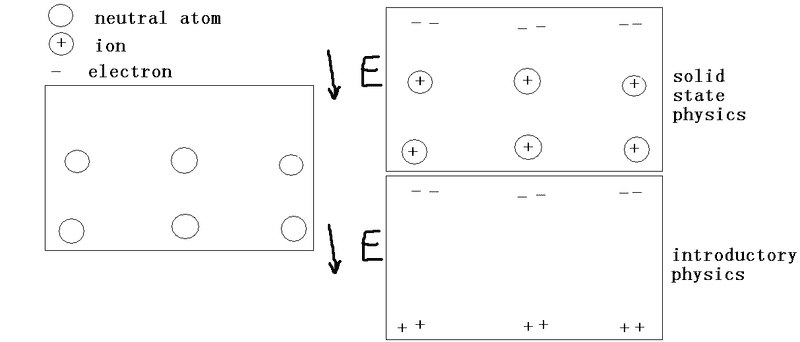
The left pic is the initial state and the right pics are 2 different descriptions for a metal under electric field E. Are the 2 on the right contradictory and which is correct?
1626012208840.png
 
  • Skeptical
Likes   Reactions: Motore
Physics news on Phys.org
Can you post links to the references where you read about those models? Thanks.
 
berkeman said:
Can you post links to the references where you read about those models? Thanks.
The bottom pic can be seen in any introductory physics textbook. The top is drawn by myself, no reference.
 
That's not very helpful I'm afraid. What motivated you to draw the bottom picture? What equations are you assuming while making the drawings?
 
berkeman said:
That's not very helpful I'm afraid. What motivated you to draw the bottom picture? What equations are you assuming while making the drawings?
The bottom pic means that electrons are pushed by E to the top, leaving the bottom boundary carrying positive charge. Equations can be coulomb forces.
 
feynman1 said:
The bottom pic can be seen in any introductory physics textbook. The top is drawn by myself, no reference.
Ok, so you drew the top left picture labeled "solid state physics" yourself. Can you explain how, according to that picture, the electric field inside the conductor is zero? In the "introductory physics" picture, it's easy. The positive and negative charges are on the surface of the conductor. The negative charges "stop" the electric field lines at one surface and "start" them at the other. This does not seem to be the case in the "solid state" picture. If one draws a Gaussian surface around the positive charges, there will be net electric flux out of it which means there is an electric field inside the conductor under static conditions. That is turn means that the conductor is not an equipotential.
 
kuruman said:
Ok, so you drew the top left picture labeled "solid state physics" yourself. Can you explain how, according to that picture, the electric field inside the conductor is zero? In the "introductory physics" picture, it's easy. The positive and negative charges are on the surface of the conductor. The negative charges "stop" the electric field lines at one surface and "start" them at the other. This does not seem to be the case in the "solid state" picture. If one draws a Gaussian surface around the positive charges, there will be net electric flux out of it which means there is an electric field inside the conductor under static conditions. That is turn means that the conductor is not an equipotential.
I thought of what you say and totally agree all along. But the ions in the middle of a solid should be fixed in place so where can they go?
 
caz said:
In a real conductor, there are so many electrons that even for a strong E field, there is not a lot of displacement so the continuum model for a conductor is valid.
I don't get what you mean. Do you think the right pics are correct or not?
 
feynman1 said:
I thought of what you say and totally agree all along. But the ions in the middle of a solid should be fixed in place so where can they go?
Yes, the positive ions are indeed fixed but the electrons are not. Electrons will be attracted to the fixed positive ions and neutralize them. In the "solid state" drawing the row in the middle should have neutral atoms, not charged ions.
 
  • Like
Likes   Reactions: feynman1
  • #10
kuruman said:
In the "solid state" drawing the row in the middle should have neutral atoms, not charged ions.
Gauss' law will require this to happen. But from the opinion of force analysis, why would electrons be attracted to the ions in the middle and end up staying there rather than driven by E all the way to the top boundary?
 
  • #11
feynman1 said:
Gauss' law will require this to happen. But from the opinion of force analysis, why would electrons be attracted to the ions in the middle and end up staying there rather than driven by E all the way to the top boundary?
Electrons move in response to external electric fields. The electric field inside the conductor is the vector sum of the external electric field ##\vec E_{ext.}## and the induced field ##\vec E_{ind.}## that is produced by the movement of electrons to the surface. These two fields cancel each other inside the conductor. The cancellation occurs because the free electrons will move and keep on moving until they have no more reason to move which happens when the field everywhere inside the conductor goes to zero. The solid state physics drawing that you drew has positive ions inside the conductor which means that there is a non-zero field in their vicinity. Therefore electrons will move to neutralize these as well as any other positive ions inside the surface of the conductor. This leaves positive ions only on the surface.
 
  • Like
Likes   Reactions: hutchphd and feynman1
  • #12
kuruman said:
The solid state physics drawing that you drew has positive ions inside the conductor which means that there is a non-zero field in their vicinity. Therefore electrons will move to neutralize these as well as any other positive ions inside the surface of the conductor. This leaves positive ions only on the surface.
The ions in the middle want to absorb the electrons, but what if E successfully drives the electrons upwards with a larger force without letting them reach and neutralize the ions in the middle?
 
  • #13
caz said:
I think the first picture is misleading. It over emphasizes the number of electrons at the surface compared to the actual number of electrons.
Then how should a better pic look like?
 
  • #14
caz said:
There should be a bunch of nuclei with electrons in the middle so that the “surface like” charge is apparent.
I drew only a few ions for illustration, not accurate.
 
  • #15
(1) About that user name. I met Feynman. You're no Feynman.

(2) The fact that you couldn't give an answer to @berkeman 's entirely reasonable question of where you read this is telling. It suggests the misunderstanding lies with you can not the textbooks. I know of no textbook that says positive ions in a metal move in an electric field (your bottom drawing). If you know of one, say so, not just the vague and unactionable (and likely incorrect) "any introductory physics textbook."

(3) You keep groping towards the century-discredited Drude model, where electrons behave as a classical gas. As we said in your last thread on this, a classical theory of electromagnetism, where charge is treated as a continuous fluid will work (in its domain of validity). A quantum-mechanical treatment of electrons will work. Mixing the two, as you are trying to do, will not work. A classical treatment of electrons, inherently a quantum mechanical object, cannot give the right answer.
 
Last edited:
  • Like
Likes   Reactions: vanhees71, jasonRF and hutchphd
  • #16
Vanadium 50 said:
(1) About that user name. I met Feynman. You're no Feynman.

(2) The fact that you couldn't give an answer to @berkeman 's entirely reasonable question of where you read this is telling. It suggests the misunderstanding lies with you can not the textbooks. I know of no textbook that says positive ions in a metal move in an electric field (your bottom drawing). If you know of one, say so, not just the vague and unactionable (and likely incorrect) "any introductory physics textbook."

(3) You keep groping towards the century-discredited Drude model, where electrons behave as a classical gas. As we said in your last thread on this, a classical theory of electromagnetism, where charge is treated as a continuous fluid will work (in its domain of validity). A quantum-mechanical treatment of electrons will work. Mixing the two, as you are trying to do, will not work. A classical treatment of electrons, inherently a quantum mechanical object, cannot give the right answer.
I didn't mix classical with quantum. I use classical only.
 
  • #17
feynman1 said:
I didn't mix classical with quantum. I use classical only.
You're talking about charged particles moving within a solid. That is quantum, not classical.

There is a classical model, valid with its domain of applicability, in which the charge behaves like a continuous fluid... but in that model there are no electrons and ions.
 
  • Like
Likes   Reactions: vanhees71 and Vanadium 50
  • #18
Nugatory said:
There is a classical model, valid with its domain of applicability, in which the charge behaves like a continuous fluid... but in that model there are no electrons and ions.
Why is there no ions or electrons? Electrons flow in such a fluid and collide with ions?
 
  • #19
feynman1 said:
Why is there no ions or electrons? Electrons flow in such a fluid and collide with ions?
Of course electrons and ions are physically present, but the relevant classical theory treats the charge distribution as continuous so there are no electrons and ions in the classical description. The charge distribution is a fluid in this theory, insted of a collection of charged particles.

Any attempt to describe the behavior of the charge distribution in terms of the motion of point particles gets us into quantum mechanics.
 
Last edited:
  • Like
Likes   Reactions: vanhees71, kuruman, Vanadium 50 and 1 other person
  • #20
Nugatory said:
Of course electrons and ions are physically present, but the relevant classical theory treats the charge distribution as continuous so there are no electrons and ions in the classical description. The charge distribution is a fluid in this theory, insted of a collection of charged particles.
Did this fluid theory mention what happens when such a fluid (electrons) hits the metal boundary? Will the fluid immediately lose its velocity?
 
  • Sad
Likes   Reactions: Motore

Similar threads

  • · Replies 1 ·
Replies
1
Views
2K
  • · Replies 1 ·
Replies
1
Views
3K
  • · Replies 4 ·
Replies
4
Views
6K
  • · Replies 11 ·
Replies
11
Views
3K
  • · Replies 6 ·
Replies
6
Views
3K
  • · Replies 6 ·
Replies
6
Views
2K
  • · Replies 3 ·
Replies
3
Views
2K
  • · Replies 5 ·
Replies
5
Views
2K
  • · Replies 0 ·
Replies
0
Views
823
  • · Replies 7 ·
Replies
7
Views
2K