Getting structure data from a partition function?

Click For Summary
SUMMARY

The discussion centers on the limitations of the partition function in classical statistical physics, specifically regarding its inability to reconstruct detailed information about individual particles from macroscopic averages. Michel asserts that the partition function, denoted as Z(β), is not a mathematical transformation with an inverse, unlike the Fourier transform. Instead, it serves as a means of averaging over phase space, providing insights into macroscopic properties rather than specific configurations of a system.

PREREQUISITES
  • Understanding of classical statistical physics concepts
  • Familiarity with the partition function Z(β)
  • Knowledge of Hamiltonian mechanics
  • Basic grasp of phase space and ensemble theory
NEXT STEPS
  • Research the mathematical properties of the partition function in statistical mechanics
  • Study Hamiltonian dynamics and its implications for particle systems
  • Explore the differences between macroscopic and microscopic descriptions in statistical physics
  • Learn about Fourier transforms and their applications in physics
USEFUL FOR

This discussion is beneficial for physicists, particularly those specializing in statistical mechanics, as well as students seeking to deepen their understanding of the partition function and its implications for particle systems.

maajdl
Gold Member
Messages
391
Reaction score
29
Hello,

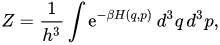
From wikipedia, this is the partition function for a "classical continuous system":
1563798282228.png


This is the pillar of classical statistical physics, but it can be seen as a mere kind of "mathematical transform" .
It can be used even without thinking to statistics or temperature.
If we focus only on the potential energy part of this integral, then

H = V(q)

is a function of q and the "positions of all other particles" of the system.

I question myself:
Would the full knowledge of Z(β) contain the full information about the "other particles".
And therefore, could the knowledge of Z(β) be traced back (inverted) to the positions of the atoms?

I hope this question doesn't look too fancyful.
I find it interresting because it would cast geometrical data in a 1-variable function Z(β) !

Thanks for your suggestions!

Michel
 
Physics news on Phys.org
Certainly no. Partition function is not a mathematical transformation (like Fourier) which has an inverse. It's more like averaging with weight given by the Hamiltonian. If you know the average, you cannot reconstruct the numbers that were averaged.

Moreover, partition function doesn't describe one particular configuration of the system. It is averaging through a domain in the phase space. Consider for example an ensemble of identical particles that have momenta but otherwise do not interact. Then the Hamiltonian has only kinetic part

##H = \sum\limits_i \frac{p_i^2}{2\, m}##

Then integral over dq gives just a trivial constant. Partition function does not serve to reconstruct details about microscopic quantities, only macroscopic ones.
 

Similar threads

  • · Replies 9 ·
Replies
9
Views
3K
  • · Replies 1 ·
Replies
1
Views
2K
  • · Replies 5 ·
Replies
5
Views
2K
Replies
2
Views
3K
  • · Replies 1 ·
Replies
1
Views
3K
  • · Replies 4 ·
Replies
4
Views
2K
  • · Replies 3 ·
Replies
3
Views
2K
  • · Replies 6 ·
Replies
6
Views
3K
  • · Replies 9 ·
Replies
9
Views
3K
Replies
5
Views
2K