(Heat Flow) Find the Temperature and Cooling Rate

Click For Summary

Discussion Overview

The discussion revolves around the process of modeling heat flow and cooling rates in a rod using differential equations. Participants explore the formulation of the problem, the assumptions involved, and the implications of their mathematical derivations.

Discussion Character

  • Technical explanation
  • Mathematical reasoning
  • Debate/contested

Main Points Raised

  • One participant expresses uncertainty about their calculation process and seeks confirmation.
  • Another suggests framing the problem as a differential equation, emphasizing a lumped mass approach.
  • A participant points out that the temperature is uniform throughout the wire due to the absence of a thermal gradient.
  • Discussion includes the formulation of energy equations, equating heat loss to the rate of change of internal energy.
  • One participant presents a derived equation for temperature as a function of time but is challenged on the correctness of their heat flow expression.
  • Concerns are raised about the linearity of the temperature function and its implications for physical realism in cooling scenarios.
  • A later reply corrects the expression for heat flow, emphasizing the need for the instantaneous temperature difference in calculations.
  • Another participant revises their equation to reflect the correct relationship between temperature and time, leading to an exponential decay model for temperature over time.

Areas of Agreement / Disagreement

Participants do not reach a consensus, as there are competing views on the correct formulation of the heat flow equation and its implications for the cooling process.

Contextual Notes

Participants discuss various assumptions, such as the uniform temperature throughout the wire and the nature of heat loss, which may affect the validity of their equations. The discussion highlights the dependence on boundary conditions and the need for careful consideration of the physical context.

abstracted6
Messages
37
Reaction score
0
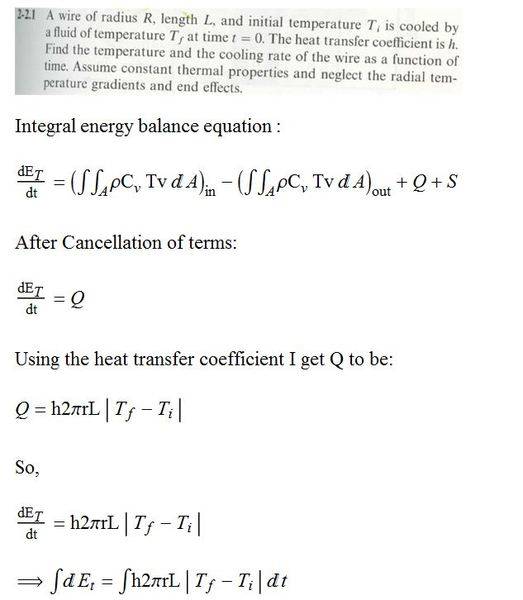
I'm really not sure, have I gone through the right process here?

221_zpsab8400e5.jpg


I didn't actually finish the calculation, I'm just curious about the process.
 
Physics news on Phys.org
Pose the problem as a differential equation rather than integrals.

Equate the rate of heat loss due to convection from the radial surface to the rate of change of internal energy of the rod. This problem is considered a lumped mass situation. You should end up with a first order differential equation with temperature as the dependent variable and time as the independent variable.
 
Would you care to elaborate some more?

For your convenience, the photo at the bottom is from the main part of the section this problem is from:


int_zpsfc6cce03.jpg
 
According to the problem, there is no thermal gradient in the radial (or any) direction. Therefore at any point in time, the temperature is uniform throughout the volume of the wire.

The heat loss is h*area*(T - Tinf). Units are energy per unit time

The heat loss equals the rate of change of energy in the wire. The energy in the wire is expressed as density*specific heat*volume*T. The unit is energy.

The rate of change of internal energy is

density*specific heat*volume*dT/dtheta, where theta is time. The units are energy per unit time.

Equate them and solve the ODE.
 
In Equation 2.2-8, the only terms that apply here are dE/dt and Q. The rest are zero. There is no mass entering or leaving the control volume, and there is no heat generation.
 
I think I got it now, It didn't occur to me to actually write out the thermal energy in the control volume.

\frac{dE_T}{dt}=\frac{∂}{∂t}\int\int\int_\Omega \rho C_vTd\Omega
\frac{∂}{∂t}\int\int\int_\Omega \rho C_vTd\Omega=(\int\int_A \rho C_vTvdA)_{in}-(\int\int_A \rho C_vTvdA)_{out}+Q+S

From cancellation, simplification of terms:
\rho C_v\Omega\frac{dT}{dt}=Q
Also,
Q=h2\pi rL(T_i-T_f)

Combination/expansion of last two eqn's.
\rho C_v\pi r^2L\frac{dT}{dt}=h2\pi rL(T_i-T_f)

Simplify, solve for dT/dt
\frac{dT}{dt}=\frac{2h}{\rho C_vr}(T_i-T_f)

\implies\int dT=\frac{2h}{\rho C_vr}(T_i-T_f)\int dt

\implies T=\frac{2h}{\rho C_vr}(T_i-T_f)t+c_1

Initial condition, T(0)=T_i
T_i=0+c_1\implies c_1=T_i

So,
T(t)=\frac{2h}{\rho C_vr}(T_i-T_f)t+T_i
And,
\frac{d}{dt}T(t)=\frac{2h}{\rho C_vr}(T_i-T_f)

Look right?
 
Last edited:
No. Q = 2πRL h (Tf - T ), not 2πRL h (Tf - Ti )
 
Whenever you solve an engineering-type problem, look at your result to see if it makes sense with what you perceive to be reality. You have determined the temperature as a function of time. According to your result, the temperature change over any time interval is the same because your function is linear in time. Think of a cup of hot coffee at 200 F. In 20 seconds it will have cooled somewhat. Its mean temperature will have dropped x degrees. Now think about the coffee over the time interval of 5 minutes and 5 minutes plus 20 seconds. Would you expect the temperature drop to be the same? Suppose you go 10 minutes and 10 minutes plus 20 seconds. Would you again expect the temperature drop over that interval to be the same?

The linearity of your function indicates such would be the case. But we all know it isn't. The boundary condition is what drives this problem. Its strength depends on the difference between the object's temperature and the ambient temperature (and also some constants). Therefore its strength lessens in time because the temperature difference vanishes. Your result should reflect this.
 
LawrenceC said:
Whenever you solve an engineering-type problem, look at your result to see if it makes sense with what you perceive to be reality. You have determined the temperature as a function of time. According to your result, the temperature change over any time interval is the same because your function is linear in time. Think of a cup of hot coffee at 200 F. In 20 seconds it will have cooled somewhat. Its mean temperature will have dropped x degrees. Now think about the coffee over the time interval of 5 minutes and 5 minutes plus 20 seconds. Would you expect the temperature drop to be the same? Suppose you go 10 minutes and 10 minutes plus 20 seconds. Would you again expect the temperature drop over that interval to be the same?

The linearity of your function indicates such would be the case. But we all know it isn't. The boundary condition is what drives this problem. Its strength depends on the difference between the object's temperature and the ambient temperature (and also some constants). Therefore its strength lessens in time because the temperature difference vanishes. Your result should reflect this.

This is what I was trying to convey quantitatively in my post #7. The OP used an incorrect expression for calculating the heat flow rate. The heat flow rate is determined by the instantaneous temperature driving force between the cooling fluid and the wire.
 
  • #10
So I will return to this step:

\frac{dT}{dt}=\frac{2h}{\rho C_vr}(T_i-T_f)

Which was supposed to be:

\frac{dT}{dt}=\frac{2h}{\rho C_vr}(T_f-T)

Since the last T now depends on time, I will need to move it over to the left of the equation.

\frac{dT}{dt}+\frac{2h}{\rho C_vr}T=\frac{2h}{\rho C_Vr}T_f

To make this easier to type I'm going to let,
n=\frac{2h}{\rho C_vr}
So,
T'(t)+nT(t)=nT_f

Use an integrating factor:
\mu T'(t)+\mu nT(t)=\mu nT_f

By inspection,
\frac{d}{dt}(T(t)e^{nt})=e^{nt}nT_f

T(t)e^{nt}=e^{nt}T_f+c_1
T(t)=T_f+e^{-nt}{c_1}

Initial condition: T(0)=T_i
T_i=T_f+c_1\implies c_1=T_i-T_f

So,
T(t)=T_f+e^{-\frac{2h}{\rho C_vr}t}(T_i-T_f)

Which looks like it makes since, as the temperature now varies as the inverse of the exponential function. Also as t goes to infinity, T(t) goes to T_f. And T(0) is T_i
 
  • #11
That's it.
 

Similar threads

Replies
22
Views
4K
Replies
1
Views
2K
  • · Replies 56 ·
2
Replies
56
Views
6K
Replies
10
Views
3K
  • · Replies 3 ·
Replies
3
Views
4K
  • · Replies 2 ·
Replies
2
Views
3K
  • · Replies 3 ·
Replies
3
Views
6K
  • · Replies 3 ·
Replies
3
Views
2K
  • · Replies 15 ·
Replies
15
Views
3K
  • · Replies 10 ·
Replies
10
Views
3K