Help finding Thevenim Equivalent - Circuit Analysis

Join the discussion
Ask a follow-up here, or get your own question answered by working scientists, mathematicians and engineers — people, not an autocomplete.
Real named experts · corrections over time · the nuance an AI answer skips
8 replies · 2K views
Xiao Xiao
Messages
30
Reaction score
3
Summary:: So I found Vth=1.19 using Nodal analysis and I'm not sure if that's right, I'm trying to find Rth now but I'm confused as to what to do, any tip that tells me at least from where to start is appreciated.

Edit: so I did 12||60 so Rth=10 ohm, is that correct? Is Vth correct too?
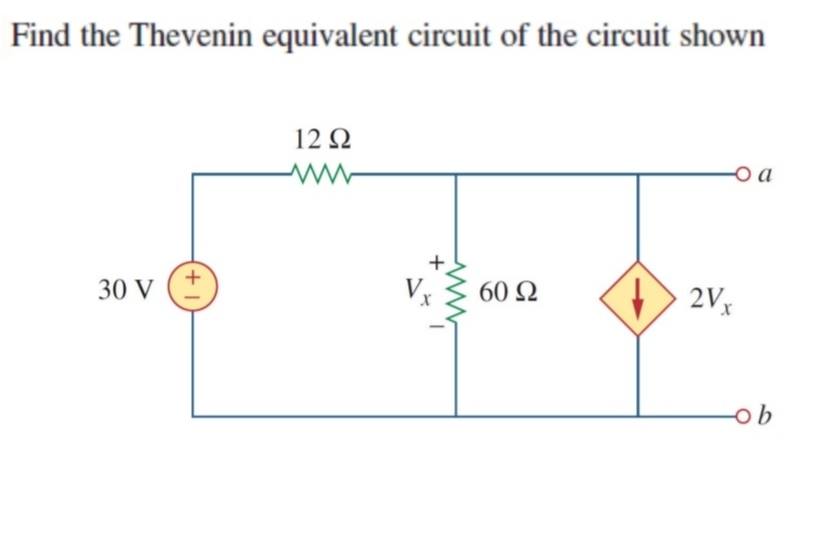
Screenshot_20210404_131456.jpg
 
Physics news on Phys.org
Yes, 10 ohms is correct for Rth, now just find the voltage from a to b. You can use either nodal analysis or loop analysis.
 
  • Like
Likes   Reactions: Xiao Xiao
phinds said:
Yes, 10 ohms is correct for Rth, now just find the voltage from a to b. You can use either nodal analysis or loop analysis.
Thank you for replying, I did Vab=Vx=Vth=1.19V using Nodal analysis.

$$\frac{30-Vth}{12}=\frac{Vth}{60}+2Vth$$

This is what I did, do you know if its correct or not?
 
phinds said:
Looks good to me EXCEPT that your 2Vth should be 2Vx
Thanks a lot, I appreciate it.
 
  • Like
Likes   Reactions: berkeman
Your Vth value looks good, an exact value being 25/21 V. However I disagree with the value of 10 Ohms for Rth.

Consider what happens if you place a short circuit across the output. In that event Vx is forced to zero and so the current source produces zero current and the 60 Ohm resistor, having no potential difference across it, also passes zero current. All available current will pass through the shorted output. What will that current be? Call it Iss.

Given a value for that current and the value for Vth, then Rth = Vth/Iss .
 
  • Like
Likes   Reactions: Xiao Xiao
gneill said:
Your Vth value looks good, an exact value being 25/21 V. However I disagree with the value of 10 Ohms for Rth.

Consider what happens if you place a short circuit across the output. In that event Vx is forced to zero and so the current source produces zero current and the 60 Ohm resistor, having no potential difference across it, also passes zero current. All available current will pass through the shorted output. What will that current be? Call it Iss.

Given a value for that current and the value for Vth, then Rth = Vth/Iss .
I see, thanks a lot, I'll try to solve it again.
 
Note that the dependent current source also has a voltage Vx across it. So the current out of the current source is 2 times the voltage across it (taking care of the sign). What kind of two terminal electronic component has the property of passing a current proportional to the voltage across itself? You could replace the current source with such a component of the proper value and then calculating Rth becomes a triviality.
 
  • Like
Likes   Reactions: Xiao Xiao