Help with a Rigid Pendulum Calculation please

  • Context: Undergrad 
  • Thread starter Thread starter babu9000
  • Start date Start date
  • Tags Tags
    Calculation Pendulum
Click For Summary

Discussion Overview

The discussion revolves around calculating the force or energy imparted by a rigid body pendulum striking a stationary object. Participants explore various methods and formulas related to momentum, energy conservation, and the dynamics of collisions, with a focus on the complexities involved in measuring and estimating these quantities.

Discussion Character

  • Technical explanation
  • Conceptual clarification
  • Debate/contested
  • Mathematical reasoning

Main Points Raised

  • One participant suggests using the formula P=MV to calculate the force based on the velocity of the pendulum, but others argue that this is insufficient without additional information about the collision.
  • Another participant mentions that observing the pendulum's rebound could help determine momentum transfer, referencing the concept of a ballistic pendulum.
  • Several participants discuss the conservation of momentum during the collision, noting that energy will be lost in an inelastic collision.
  • One participant emphasizes the difficulty in determining force due to the nature of the materials involved and the time duration of the collision.
  • Another participant provides formulas for calculating rotational kinetic energy and angular momentum, suggesting a more complex analysis involving these concepts.
  • One participant expresses frustration about the accuracy of measurements, stating that poor input values lead to unreliable results.
  • A participant recommends checking the Izod impact strength test for materials as a potential resource for understanding impact dynamics.

Areas of Agreement / Disagreement

Participants express differing views on how to approach the calculation of force and energy, with no consensus on a single method or formula. The discussion remains unresolved regarding the best approach to accurately determine the impact force.

Contextual Notes

Limitations include the challenge of measuring recoil height accurately, the dependence on the moment of inertia of the pendulum, and the complexities introduced by the materials involved in the collision.

babu9000
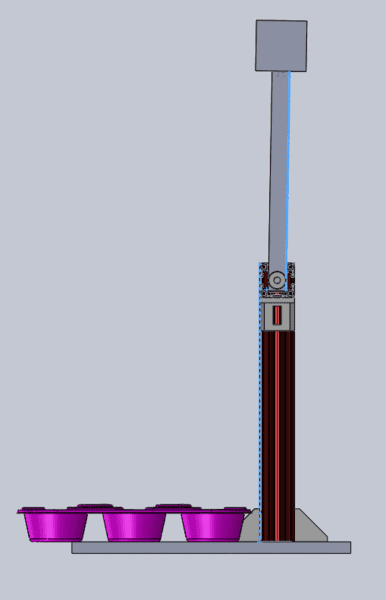
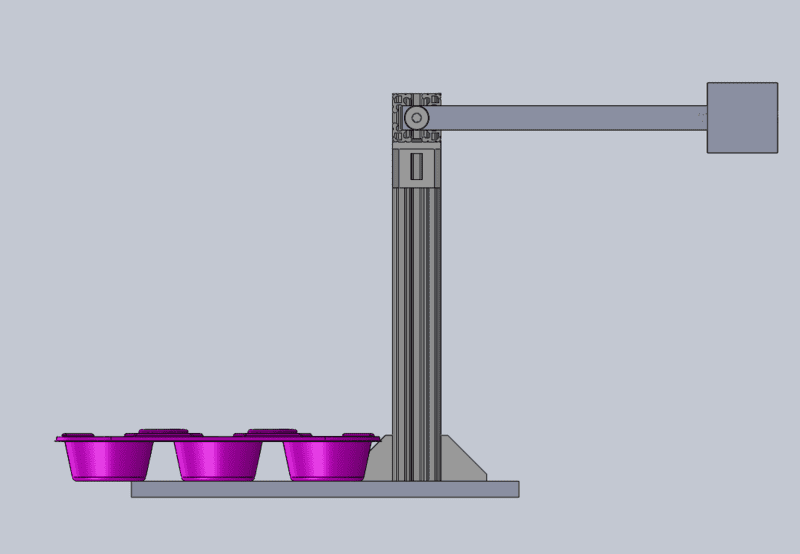
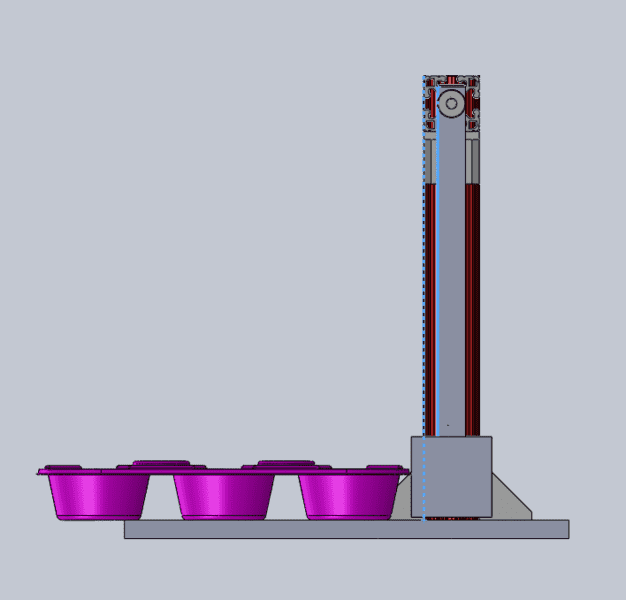
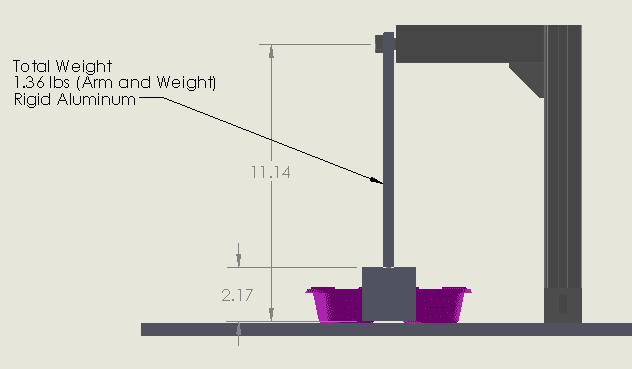
I have a rigid body pendulum that is used to strike an object at the bottom of its swing. Ultimately I would like to know how much forced is the object being struck with. Could I do this with just knowing the velocity of the weight? I was thinking then I could get P=MV. Can someone please help e figure this out. Please see the attached diagrams.
Setup Dims.PNG
180 degrees Object.PNG
90 degrees Object.PNG
0 degrees Object.PNG
 
Last edited by a moderator:
Physics news on Phys.org
No, knowing the velocity and mass of the rigid pendulum is not sufficient to determine the force with which it will strike a stationary object. Nor is it sufficient to tell you how much momentum is transferred from pendulum to target during the collision.

If, however, you are able to observe how far the pendulum rebounds, you could make a determination of how much momentum was transferred. That is the essential idea behind a ballistic pendulum.
 
Is there a formula I can use to determine force or energy?
 
babu9000 said:
Is there a formula I can use to determine force or energy?
Energy will be lost in the inelastic collision. But momentum will be conserved(*). Do you know the formula for momentum?

You know the momentum of the target prior to the collision. That's zero. If you know the momentum of the pendulum before and after the collision, you can calculate how much momentum winds up in the target afterward. If you know how much momentum winds up in the target afterward and you know its mass then you can determine its velocity. If you know the target's velocity and its mass then you can determine its kinetic energy.

(*) The axle about which the pendulum turns will exert a force during the collision. A proper analysis of the problem would involve angular momentum as well as linear momentum.

Force is more problematic. If the materials are soft, the collision could take place over a longer interval and involve smaller forces. If the materials are hard, the collision would take place over a shorter interval and involve larger forces. Force is not usually an easy thing to determine for a collision. Nor is it very useful.

You seem to want to calculate a number. But it is not clear that you will know what to do with any number that you calculate. What is the actual goal of this exercise?
 
I am trying to figure out force or energy imparted on the stationary object. I don't have a good way to measure the height on recoil and the material is plastic and soft.

I was trying fine Velocity and Force and make an assumption of .1s for time. I tried setting up a standard force gauge, but it cannot capture the impulse.

Mass= .594kg

Length (L) = .283m

Gravity(g) = 9.8m/s2

Pe = Ke

(Mass*Gravity*Height) = (½mv^2)

Re-written for pendulum as

V=sqrt(2*g*L(1-cosθ)

Force is calculated as [Mass*(Change in Velocity /Change in Time)]

F= m*(ΔV/ΔT)

at 90 degrees I got 2.93 lbf
at 179 degrees I got 4.11 lbf
 
babu9000 said:
I am trying to figure out force or energy imparted on the stationary object. I don't have a good way to measure the height on recoil and the material is plastic and soft.

I was trying fine Velocity and Force and make an assumption of .1s for time.
Garbage in, garbage out. You cannot get accurate numbers out if you do not have accurate numbers to put in.

Since this is a pendulum on an axle, we are talking rotational kinetic energy given by ##KE = \frac{1}{2}I \omega^2## where I is the moment of inertia of the pendulum and ##\omega## is its rotation rate (e.g. in radians/sec).

You can obtain the moment of inertia for a long thin uniform beam about an axis at one end from Google. Your pendulum may be neither a uniform beam nor a mass on the end of a beam of negligible mass -- that complicates things. You may have to work to get a good number for its moment of inertia. [Treat it as a beam plus a mass and add the two moments of inertia -- that would work]

The relevant angular momentum L will be ##L = I \omega##.

The angular impulse (change in angular momentum) is given by the difference between angular momenta before and after the collision. It is also given by torque multiplied by time. And torque is given by force times length of the moment arm.

So you start with potential energy. You use that as rotational kinetic energy just prior to impact. You try to measure final potential energy. You use that as rotational kinetic energy just after impact. You use the two rotational energies to determine angular velocities just before and after impact. That gives you the change in angular momentum. That is the rotational impulse that is delivered by/to the target. You divide by the length of the moment arm to get the associated linear impulse.

If you are smart you stop there.

Otherwise, you divide by the estimated time of collision to get the estimated force of impact.
 
Last edited:

Similar threads

  • · Replies 1 ·
Replies
1
Views
2K
  • · Replies 10 ·
Replies
10
Views
3K
  • · Replies 2 ·
Replies
2
Views
1K
  • · Replies 39 ·
2
Replies
39
Views
6K
  • · Replies 11 ·
Replies
11
Views
6K
  • · Replies 8 ·
Replies
8
Views
2K
  • · Replies 2 ·
Replies
2
Views
3K
  • · Replies 11 ·
Replies
11
Views
2K
  • · Replies 1 ·
Replies
1
Views
2K
  • · Replies 8 ·
Replies
8
Views
2K