Help with relaxation oscillator

  • Thread starter Thread starter JFS321
  • Start date Start date
  • Tags Tags
    Oscillator
Join the discussion
Ask a follow-up here, or get your own question answered by working scientists, mathematicians and engineers — people, not an autocomplete.
Real named experts · corrections over time · the nuance an AI answer skips
6 replies · 2K views
JFS321
Messages
75
Reaction score
6
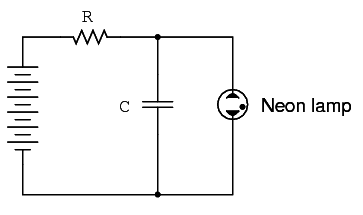
All, I am confused as to exactly how the capacitive relaxation oscillator works.
upload_2015-2-22_18-37-10.png

From the diagram above: Because the lamp is in parallel, why is it not immediately receiving the voltage necessary to light instantly? Thanks.
 
Engineering news on Phys.org
hi there

The neon globe has a minimum strike voltage ... let's say ~ 80V ( 75 - 90V common)
This is the neon's threshold voltage. That voltage will only be reached when the capacitor is charged to that threshold voltage
The neon will then conduct with a flash of light and the voltage across the capacitor will drop to well below the threshold voltage.
The capacitor will then start charging again till that voltage is reached and the neon then discharges again.
this cycle continues on and on ...

The cap doesn't charge instantly ( or near) because of the series resistor limiting current to the capacitor causing it to take time to charge
but when threshold is reached it discharges almost instantly ... ie. it oscillates with a sawtooth pattern

cheers
Dave
 
Ahhh ok...so a capacitor acts like a voltage sink of sorts...instead of this being like a regular parallel circuit, the voltage across both legs is initially zero because the capacitor must first charge? Or maybe to reword, the battery voltage does not initially reach the bulb because it is being taken by the capacitor? Thanks-
 
  • Like
Likes   Reactions: davenn
Yes, initially, at time T=0, the capacitor "looks" like a short circuit, charge is flowing onto one plate and out of the other plate
as the charge builds up, the voltage potential difference across the capacitor also does. Only when that voltage potential equals the
discharge ( threshold ) voltage of the neon globe will current flow across the gap in the neon

JFS321 said:
Or maybe to reword, the battery voltage does not initially reach the bulb because it is being taken by the capacitor? Thanks-

The same voltage that is across the capacitor is also across the neon globe, from the time the capacitor starts charging,
that voltage slowly rises as the capacitor charges up
have a look at this ...

relaxation oscillation.jpg
cheers
Dave
 
Curiously, there is a semiconductor component that behaves like this, the DIAC.
http://en.wikipedia.org/wiki/DIAC

Unfortunately, it lakes the charming flash-flash-flash of the neon bulb.