Homework about plane engineering drawing

Click For Summary
SUMMARY

The discussion centers on the challenges faced by a student in completing a homework assignment related to engineering drawing, specifically the construction of an isosceles triangle using orthographic projections. The student seeks clarification on the correct horizontal projection of point O, which was initially noted as (-,50) but confirmed to be (50,50). Key concepts discussed include the identification of projection planes and the relationship between vertical and horizontal projections, emphasizing the importance of understanding these fundamentals for successful completion of the assignment.

PREREQUISITES
  • Understanding of orthographic projections in engineering drawing
  • Familiarity with isometric drawing techniques
  • Knowledge of projection planes and their significance
  • Basic skills in geometric construction and representation
NEXT STEPS
  • Study the principles of orthographic projection in engineering drawing
  • Learn how to construct isometric drawings accurately
  • Research the significance of projection planes in 3D representation
  • Practice geometric constructions involving triangles and other shapes
USEFUL FOR

Students in engineering drawing courses, educators teaching technical drawing, and anyone interested in mastering the fundamentals of geometric representation in engineering.

A dummy progression
Messages
23
Reaction score
1
Homework Statement
We give :

Frame: 150 × 180 (units in mm)

The line a and the point O.

Vertical projection of line a is (0 , 60) ; (150 , 170)
Horizontal projection of line a is (0 ,140) ; (150 , 40)
Vertical projection of point O (50 , 140)
Horizontal projection of point O (- ; 50)

We ask:

To build in the plan (O , a) the isocele triangle OAB ; the main vertex of this triangle is O and the base AB = 40 mm knowing that the AB side is carried by a and that A is the lowest vertex on the line a.

Note : Do all this using changes of projection plane
Relevant Equations
Real measure of a plabe figure using changes of projection plane
Hello, i wasn't in enginnering drawing class since 2 weeks because i was sick and my high school teacher told me to do this homework.
This is what I've done so far
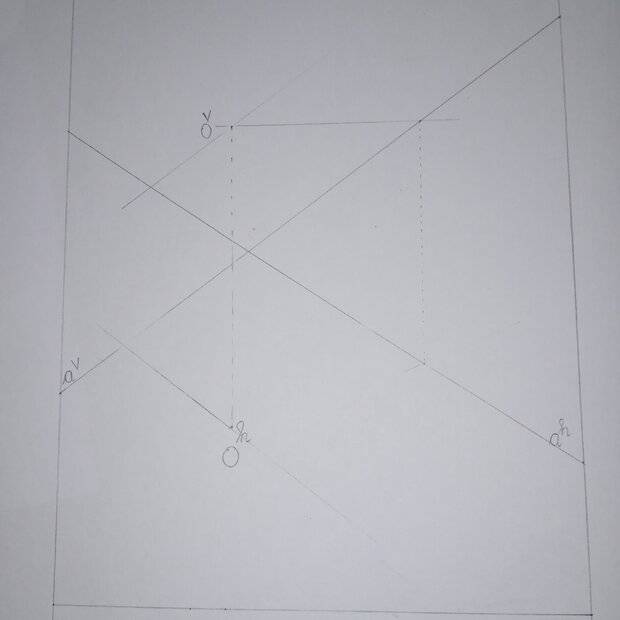
16439224582243697066318953829075.jpg


I did not build the triangle 'cause i am not sure.
Please, i just want that someone accompanies me with steps by steps explanation because its the only one work that will decide if i fail class this period and we'll have semester exam next week.

But I've an idea about this homework :
1) drawing a frontal line of plan (O,a) crossing O and using it as a generatrice of the plan
2) find point B

And then i am puzzled about using changes of projection planes to build the isocele triangle.

Your help is welcome.
 
Physics news on Phys.org
Where is line a named?
Are the 150 mm vertical or horizontal?
What is the first value for the horizontal projection of point O?
 
Lnewqban said:
Where is line a named?
Are the 150 mm vertical or horizontal?
What is the first value for the horizontal projection of point O?
O(-,50)
Frame : 150 mm horizontal , 210 mm vertical
The two longest lines are the projections of line a and their names are close the frame
 
Regarding this problem, what have you learned so far in that enginnering drawing class?

Sorry, what is the first value for the horizontal projection of point O?
The minus sign in (-,50) seems to be a typo.
According to your drawing, it should be (50,50); could you confirm?
 
Last edited:
Lnewqban said:
Regarding this problem, what have you learned so far in that enginnering drawing class?

Sorry, what is the first value for the horizontal projection of point O?
The minus sign in (-,50) seems to be a typo.
According to your drawing, it should be (50,50); could you confirm?
Yes it's (50,50)
 
A dummy progression said:
Yes it's (50,50)
Thank you.
Do you understand the meaning of these two orthographic projections?

Orthographic projections.jpg


Orthographic projections (2).jpg
 

Attachments

Last edited:
The top yellow rectangle represents the vertical plane on which the horizontal projection is drawn.
The bottom yellow rectangle represents the horizontal plane on which the vertical projection is drawn.

As you can see in the isometric drawing, the line joining both, vertical and horizontal planes, is the x-y line about which they are pivoted or opened from the normal 90-degree angle to each other.

That is the most universal way of representation, but perhaps your course teaches a different way; therefore, my previous question about what you have learned so far.
 
Last edited:
  • Like
Likes   Reactions: A dummy progression

Similar threads

  • · Replies 2 ·
Replies
2
Views
2K
  • · Replies 4 ·
Replies
4
Views
3K
  • · Replies 19 ·
Replies
19
Views
1K
  • · Replies 22 ·
Replies
22
Views
5K
  • · Replies 6 ·
Replies
6
Views
3K
  • · Replies 7 ·
Replies
7
Views
2K
Replies
23
Views
3K
  • · Replies 9 ·
Replies
9
Views
3K
Replies
41
Views
7K
  • · Replies 7 ·
Replies
7
Views
4K