How can conformal mapping be used to convert curves between different maps?

Click For Summary

Discussion Overview

The discussion revolves around the application of conformal mapping to convert curves between different coordinate systems, specifically from Cartesian to polar and log-polar maps. Participants explore the mathematical transformations involved and the challenges associated with expressing functions in these different forms.

Discussion Character

  • Technical explanation
  • Mathematical reasoning
  • Debate/contested

Main Points Raised

  • One participant seeks clarification on how to convert a linear function defined in Cartesian coordinates to its equivalent in polar and log-polar coordinates.
  • Another participant suggests defining the function properly and transforming the coordinates directly, providing a mathematical expression for the transformation.
  • A different participant emphasizes the need to express the relationship in polar coordinates as a function of radius and angle, indicating technical difficulties in doing so.
  • One participant discusses the relationship between radius and angle, noting that in logarithmic coordinates, only the radius is affected.
  • Another participant argues that functions cannot be expressed in "polar mode," but rather points can be represented in different coordinate systems.
  • One participant provides a mathematical derivation for the radius in terms of Cartesian coordinates and discusses potential solutions for expressing the function in polar coordinates.
  • A later reply highlights the challenge of expressing a single value of radius for multiple angles, suggesting that paths should be parameterized using a separate parameter.

Areas of Agreement / Disagreement

Participants express differing views on the feasibility of expressing functions in polar coordinates, with some suggesting it is not possible while others propose methods for transformation. The discussion remains unresolved regarding the best approach to achieve the desired conversions.

Contextual Notes

Limitations include the complexity of expressing implicit functions in polar or log-polar coordinates and the potential for multiple radius values corresponding to the same angle.

Bruno Tolentino
Messages
96
Reaction score
0
I know the concepts of conformal mapping and complex mapping but I didn’t see none explanation about how apply this ideia and formula for convert a curve, or a function, between different maps.

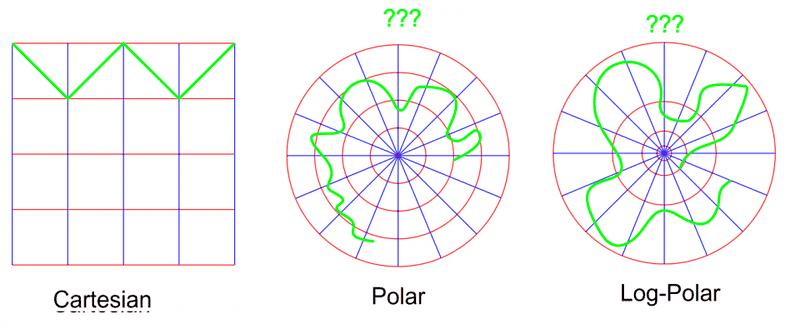
Look this illustration…
Duvida.png

In the Cartesian map, I basically drew a liner function f(x) = ax+b (defined by part). Which would be the graph curve and the algebraic expression equivalent in the polar map and log-polar map?
 
Physics news on Phys.org
Why don't you define ##f## properly and simply transform the coordinates?

##(x,f(x)) = (\sqrt{x^2+f(x)^2}, \arccos \frac{x}{\sqrt{x^2+f(x)^2}}) = (\log \sqrt{x^2+f(x)^2}, \arccos \frac{x}{\sqrt{x^2+f(x)^2}})##
 
fresh_42 said:
Why don't you define ##f## properly and simply transform the coordinates?

##(x,f(x)) = (\sqrt{x^2+f(x)^2}, \arccos \frac{x}{\sqrt{x^2+f(x)^2}}) = (\log \sqrt{x^2+f(x)^2}, \arccos \frac{x}{\sqrt{x^2+f(x)^2}})##

Because I want (actually, I need, due the technical difficulties) to express ##r = r(\theta)##

EDIT: I can't to express an implicit funcion in polar or log polar mode...
 
Radius and angle are related by ##\cos θ = \frac{x}{r}## or ##\sin θ = \frac{f(x)}{r}## and ##r = \sqrt{x^2 + f(x)^2}.## Of course you will have to keep an eye on signs, resp. the range of the angle. In the logarithmic version in my understanding only the radius will be affected, i.e. the coordinate becomes ##\log (r)##
Maybe I didn't get what you meant.
 
Bruno Tolentino said:
EDIT: I can't to express an implicit funcion in polar or log polar mode...
You don't express functions in "polar mode", implicit or not. You can only express points in coordinates.
Therefore you write ##(x,y) = (x,f(x))## or ##(x,y) = (r(x,y), θ(x,y))##. A function expresses how a value ##y = f(x)## varies if ##x## does. The ##x-##axis is already an interpretation and a graph ##(x,f(x))## a visualization.
 
##r = \sqrt{x^2 + y^2}## ... ##(y = ax+b)##

##r = \sqrt{x^2 + (a x + b)^2}## ... ##(x = r \cos(\theta))##

##r = \sqrt{(r \cos(\theta))^2 + (a (r \cos(\theta)) + b)^2}##

https://www.wolframalpha.com/input/?i=r+=+sqrt((r+cos(t))²+++(a+r+cos(t)+++b)²)+solve+for+r

"r = sqrt((r cos(t))² + (a r cos(t) + b)²) solve for r"

solutions:

##r = - \frac{b}{a \cos(t) - \sin(t)}##

##r = - \frac{b}{a \cos(t) + \sin(t)}##

ploting:

final.png


So...

This answer is, of course, too much interesting! But, it doesn't the answer that I'm looking for...

I want that the straight of the Cartesian map becomes a curve in the polar and log polar mapping.
 
Last edited:
No more answers??
 
Bruno Tolentino said:
Because I want (actually, I need, due the technical difficulties) to express ##r = r(\theta)##
In general, that can not be done. There can be many r values associated with the same ##\theta## value. In the example you give, if the origin is at the center point of the first diagram, then there are entire path segments with the same ##\theta## value.

Paths should be parameterized using a separate parameter, t, in [0,1].
 

Similar threads

  • · Replies 3 ·
Replies
3
Views
3K
  • · Replies 7 ·
Replies
7
Views
5K
  • · Replies 51 ·
2
Replies
51
Views
5K
  • Poll Poll
  • · Replies 1 ·
Replies
1
Views
5K
  • · Replies 2 ·
Replies
2
Views
2K
  • · Replies 5 ·
Replies
5
Views
2K
Replies
5
Views
47K
  • · Replies 5 ·
Replies
5
Views
5K
  • Poll Poll
  • · Replies 3 ·
Replies
3
Views
7K
  • · Replies 7 ·
Replies
7
Views
2K