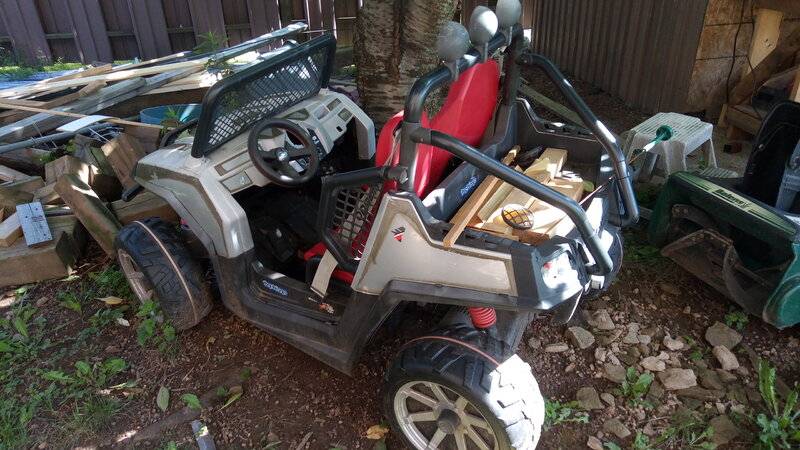
How can I (safely) test this "toy" machine?

  • Thread starter Thread starter DaveC426913
  • Start date Start date
Click For Summary
SUMMARY

The discussion revolves around troubleshooting a Peg Perego Polaris Ranger RZR 24V electric toy vehicle that has been sitting unused for months. The user initially attempts to test the motor by connecting it to two 12V car batteries in series, but later discovers that the vehicle contains a single 24V battery pack made up of two 12V batteries. After charging the battery, the motor briefly operates but fails to run continuously, indicating possible issues with the battery or the gear shift switch. The conversation highlights the importance of using the correct charger and suggests testing the continuity of wires and connections to diagnose electrical issues.

PREREQUISITES
  • Understanding of 24V battery systems and configurations
  • Basic knowledge of electric motor operation and troubleshooting
  • Familiarity with multimeters for continuity testing
  • Experience with soldering and electrical connections for repairs
NEXT STEPS
  • Research proper charging techniques for 24V battery packs
  • Learn how to test electric motors for functionality
  • Investigate replacement options for momentary DPDT switches
  • Study wiring diagrams for electric toy vehicles to understand circuit layouts
USEFUL FOR

This discussion is beneficial for hobbyists, DIY enthusiasts, and parents looking to repair or maintain electric toy vehicles, particularly those with experience in basic electronics and troubleshooting techniques.

DaveC426913
Gold Member
Messages
24,146
Reaction score
8,267
TL;DR
This toy ATV came untested. I want to make sure the motor works before bothering with anything else.
I picked this up for free for my grand-child. It allegedly worked when the previous owners last tried, but it's been sitting outside for at least many months.

It did not come with the charger. No idea of the condition of the batteries. I assume they're dead. I do have a battery charge for my car. Nevertheless, Before I put any effort into it, I should find out if the motor works at all. I want to separate any battery troubles from any motor troubles, so it seems to me I can just hook it up to my car batter(ies).

I found it here online: it says it is 24V.
https://goldtex.ca/products/peg-perego-polaris-ranger-rzr-green-shadow-24-volt-green

So ... I hook up two car batteries in series, right?

Any special precautions? Other than don't electrocute myself, or 'splode it in my face?
P_20230828_151155v2.jpg
P_20230828_151206.jpg
 
Engineering news on Phys.org
Two car batteries in series should work fine to test. You understand that the issue with car batteries is not electrocution (volts) but the fact that they can dump lots of amps if shorted causing lots of heat. Wear goggles/face shield and stout gloves when you first check it out.
Charge the old batteries slowly when you attempt their resuscitation. Good toy!
 
  • Like
Likes   Reactions: Averagesupernova, russ_watters and phinds
A fairly stout older battery charger should test the motor unloaded. I'd say if it turns unloaded at twelve volts with no squeals or other noises indicating mechanical issues, the motor is good.
 
  • Like
Likes   Reactions: sophiecentaur, DaveE, berkeman and 1 other person
Progress report:

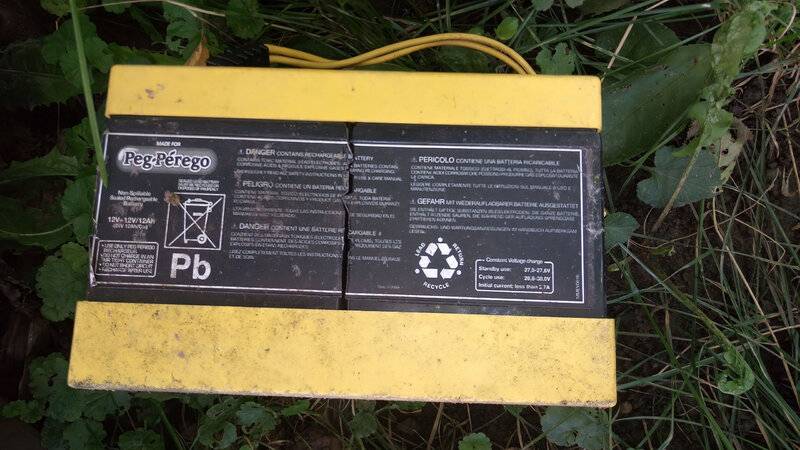
  1. As far as I can tell, there is only one battery in this machine. For some reason I thought there were two. I guess it has a 12v > 24v transformer?
  2. I charged the battery for a few minutes. My charger said 'charging' for about 15 seconds and then said 'charged'. I am very skeptical. This battery has sat in weather for at least a year and probably hasn't been charged in much longer than that. What is the most likely scenario with my charger telling me it's charged?
  3. All that said, I tried it. As God is my witness, it turned over for one second. When I pressed on the gas, it zizzed like electric motors do and the wheels turned a fraction.

And then it died and will not restart. I charged the battery again for an hour but no joy. My first thought is it burned out a component on the PCB.​

The PCB:​

circuit boardv2.jpg
 
Looks like a couple of PTC self resetting fuses and some relays on that board. Unless a circuit board trace blew open, I'd think there's little to go wrong there. Don't give up on this. I think it can be brought back.
-
Oh one last thing, when you get it running please post a pic with you driving it? 😆
 
You bet I will!

I've found the manual online, which includes the wiring diagram, so I can start tracing connections.
 
  • Like
Likes   Reactions: Averagesupernova
DaveC426913 said:
As far as I can tell, there is only one battery in this machine. For some reason I thought there were two. I guess it has a 12v > 24v transformer?
Dave the add showed a 24V battery!! It definitely shows 24V
The behavior of the 12V charger is consistent with trying to charge a 24 V battery. As soon as it sees 13-14V it declares "charged".
The battery is not being charged and the behavior is consistent with a 24V battery just barely charged. You need the correct charger.
There would not likely be a transformer on the cart. What does your battery look like?
 
  • Like
Likes   Reactions: DaveE
hutchphd said:
Dave the add showed a 24V battery!! It definitely shows 24V
Oh. That's what 12v+12v means. Duh.

(That must have been what fooled me into looking for a 2nd battery.)

hutchphd said:
The behavior of the 12V charger is consistent with trying to charge a 24 V battery. As soon as it sees 13-14V it declares "charged".
Of course. That's makes sense now.

So maybe there isn't anything wrong with the PCB. Maybe the battery had just enough juice to kick it over but no more - no matter how long I try to charge it.
 
Thats my guess.....hope this works out.
 
  • #10
DaveC426913 said:
As far as I can tell, there is only one battery in this machine.
On the first picture above it is one piece of battery pack consisting of two standard 12V 12Ah batteries :smile:
You might be able to get new batteries and rebuild the pack DIY.

Also, though it's not advised for regular use, you might be able to charge the batteries one-by-one with a 12V charger, just for a test run. Be careful with dismantling the pack.

DaveC426913 said:
I tried it ... it turned over for one second.
That means it'll likely move with a single 12V car battery too: it'll be enough for a quick test.
Mind the polarity.
 
  • Like
Likes   Reactions: sophiecentaur and DaveE
  • #11
Charger arrived today. Charged the battery for an hour, and gave it a shot.
It worked* !
*mostly

Drove it around for a few minutes (it's too small for me to get in. I have to stand.) Then charged for another hour.

It is pretty faulty. I have to jiggle and jam the gear shift to get any action, and even then it goes in fits and starts. It feels very much like a bad connection (either mechanical or electrical) right in the gear shift.

So after a mere ten minutes, it's stopped. Won't budge for love nor money.

First thing I want to do is test continuity of the wires; look for crimps & stuff. Never mind figuring out what is hooked up to power or whatever, can I use a multimeter to just test continuity of wires and connections?
 
  • Like
Likes   Reactions: Rive
  • #12
Well, yeah ... I suppose you Could ... just keep in mind you have a good chance of letting all of the "Magic Smoke" out of the meter.
 
  • Haha
Likes   Reactions: DaveC426913
  • #13
DaveC426913 said:
It allegedly worked when the previous owners last tried,

View attachment 331143
I've heard the expressions "Start them young" and "Ran when parked" before, but never together!

tps%3A%2F%2Ftse3.explicit.bing.net%2Fth%3Fid%3DOIP.jpg

ekkpq5pachm01.png
 
  • Haha
Likes   Reactions: DaveC426913
  • #14
DaveC426913 said:
Charger arrived today. Charged the battery for an hour, and gave it a shot.
It worked* !
*mostly

Drove it around for a few minutes (it's too small for me to get in. I have to stand.) Then charged for another hour.

It is pretty faulty. I have to jiggle and jam the gear shift to get any action, and even then it goes in fits and starts. It feels very much like a bad connection (either mechanical or electrical) right in the gear shift.

So after a mere ten minutes, it's stopped. Won't budge for love nor money.

First thing I want to do is test continuity of the wires; look for crimps & stuff. Never mind figuring out what is hooked up to power or whatever, can I use a multimeter to just test continuity of wires and connections?
Good stuff - you are fully committed now!!
So you can say that the original fault was not the battery. Can you look at the brushes on the motor? How is the speed control achieved? A huge variable resistor or something more sophisticated?
 
  • #15
sophiecentaur said:
So you can say that the original fault was not the battery.
It was just a dead battery and no charger.

I will find out this morning if the battery is effed.

sophiecentaur said:
How is the speed control achieved? A huge variable resistor or something more sophisticated?
There's a pedal, but I'm not sure it has any granularity beyond 'Go' and 'Don't Go'. I won't know that until I can get it to run continuously for more two seconds at a time.
 
  • #16
DaveC426913 said:
There's a pedal, but I'm not sure it has any granularity beyond 'Go' and 'Don't Go'. I won't know that until I can get it to run continuously for more two seconds at a time.
Just be careful where you go driving it... :wink:
berkeman said:
Bad boys, bad boys, whatcha' gonna do...
 
  • #17
No joy after another hour or two of charging. Which means I've jostled loose or fried something since the first test.

:pulls sleeves up: Time to get bizzy.
 
  • #18
I've narrowed it down to this switch (as I originally suspected). At least for now.

It works in the REVERSE (i.e momentary ON position), but does not work in FORWARD (default OFF position).

I want to bypass the switch itself to see if I can get the FORWARD to work, but I'm not sure which pin(s) to jump.

1696013991143.png
 
Last edited:
  • #19
You have an error on your drawing: Numbers 2 and 5 notations are interchanged. (The middle connections go to the motors and the left connections go to the battery.)

The following figure shows the internal connections depending on the switch position:

?u=https%3A%2F%2Ftse2.mm.bing.net%2Fth%3Fid%3DOIP.jpg

So connecting 1&2 and 3&5 together should bypass the switch in the forward direction. 1&3 and 2&5 should be the reverse direction.
 
  • #20
jack action said:
You have an error on your drawing: Numbers 2 and 5 notations are interchanged. (The middle connections go to the motors and the left connections go to the battery.)
Nope.

(5) runs directly to a fuse then to the battery terminal.

Here's a better pic:
1696018995117.png
In the little research I've done I can see that you are correct - it is not the conventional/correct way to do it. But for now, it is what it is.
 
Last edited:
  • #21
Question:
This is what the switch actually does, yes?
1696019731826.png
It seems to me, I can
- disconnect the two ON (REVERSE) pins, then
- jump the OFF (FORWARD) pins.
If the motor works, then the switch itself is toast.

I wish I could just replace the switch, and guarantee it's working. Problem is, it's riveted in to the gear shift mechanism.Oh. I just saw this diagram:
1696020062421.png
 
Last edited:
  • #22
DaveC426913 said:
Nope.

(5) runs directly to a fuse then to the battery terminal.
I know they go where you say they go, but:

  • On the switch, 5 is on the left and 2 is in the middle;​
  • On the drawing, 5 is in the middle and 2 is on the left.​
 
  • #23
jack action said:
I know they go where you say they go, but:

  • On the switch, 5 is on the left and 2 is in the middle;​
  • On the drawing, 5 is in the middle and 2 is on the left.​
Oh. Right. Fixed.

1696023132833.png


Now it makes a little more sense. Its still wired up backwards, but at least it's symmetrically backwards. :smile:
 
Last edited:
  • #24
Well there's yer problem mister...

1696111994601.png


Looks like I'll be hard-wiring this puppy in forward gear...
 
  • #25
:oldbiggrin:
 
  • Like
Likes   Reactions: Rive
  • #27
Tom.G said:
A Google search finds many replacement switches, many <$10:
Just make sure they are rated for DC, and preferably for inductive load (hard to find though).

https://www.google.com/search?sca_e...t+50A+rocker+switch&oq=dpdt+50A+rocker+switch

Cheers,
Tom
Yes, I have Googled them muchly.

The catch is that the gear shift is designed to mechanically push on the switch - switch and gear shift are affixed in a framework so they come together just right. I don't think there's a lot of margin for error, so it has to be virtually the exact switch.

(The switch button itself is flat, not concave - not curved or notched - and it is opaque red, not transparent. Too bad I can't just point to a Google pic to show you what I mean...)

Also, it's 2-position, temporary-on. Most of those are 3-position.I have yet to find anything similar online.
 
Last edited:
  • Like
Likes   Reactions: Tom.G
  • #28
OK.
Try inserting the word Momentary between 'dpdt' and '50A'.
 
  • Like
Likes   Reactions: DaveC426913
  • #29
Alas...

Even dpdt momentary 20A rocker switch 6 pin 12v brings only tears and heartbreak.
 
  • Care
Likes   Reactions: Tom.G
  • #30
OhGodNo. An adapter to convert our rack of Ryobi batteries to work with the Peg Perego...

1696132613966.png
"...and that was the last glimpse of her - magazine of full Ryobi batteries in the passenger seat next to her - as she headed for the horizon, still going pedal to the metal... Our little Sarah Connor..."
1696133092557.png
 
  • Haha
Likes   Reactions: Rive

Similar threads

  • · Replies 5 ·
Replies
5
Views
4K
Replies
6
Views
5K
  • · Replies 4 ·
Replies
4
Views
2K
  • · Replies 40 ·
2
Replies
40
Views
5K
  • · Replies 23 ·
Replies
23
Views
17K
Replies
11
Views
2K
  • · Replies 3 ·
Replies
3
Views
4K
Replies
6
Views
2K
  • · Replies 16 ·
Replies
16
Views
3K
  • · Replies 2 ·
Replies
2
Views
6K