How circuit breaker electrical system clears ground faults.

Click For Summary
SUMMARY

The discussion focuses on the operation of circuit breakers in clearing ground faults, specifically when a fault occurs at the X2 terminal of a transformer. Participants clarify that the fault current does indeed pass through the circuit breaker (CB) by traveling from the X2 terminal to the load and back through the ground wire to the transformer’s center tap. It is established that while the circuit breaker protects downstream equipment, a ground fault at the transformer will not trip the CB directly; instead, it will trip the fuses protecting the primary winding of the transformer. The conversation also explores alternative bonding configurations for enhanced protection.

PREREQUISITES
  • Understanding of electrical systems and circuit breakers
  • Knowledge of transformer operation and grounding techniques
  • Familiarity with fault current paths and load resistance
  • Basic principles of electrical bonding and protection systems
NEXT STEPS
  • Research "Transformer grounding methods" to understand various configurations.
  • Study "Circuit breaker operation and fault clearing" for detailed mechanisms.
  • Learn about "Ground fault protection systems" and their applications.
  • Examine "Electrical bonding techniques" to explore alternative safety measures.
USEFUL FOR

Electrical engineering students, electricians, and professionals involved in designing or maintaining electrical systems, particularly those focusing on transformer safety and circuit protection.

newbie2231
Messages
5
Reaction score
0
Hi I am taking generals now but I will eventually take EE degree. I am studying electrical systems now. Can somebody help me on system configuration regarding circuit breakers clearing ground faults?

In this picture (the bottom figure), if X2 faults at the transformer, would the fault current ever trip the breaker? I know that it should but I just don't see how. The fault by X2 in the picture will travel through a bonding jumper (the short green horizontal piece between the transformer and the disconnect panel), then to the disconnect, then eventually to the X0 of the transformer. The current will cycle like that but will not travel through the breaker. From reading the web page where this picture came from, I know the bonding jumper will make the breaker trip when the X2 faults at the transformer. But I just don't see how. Any help is appreciated.
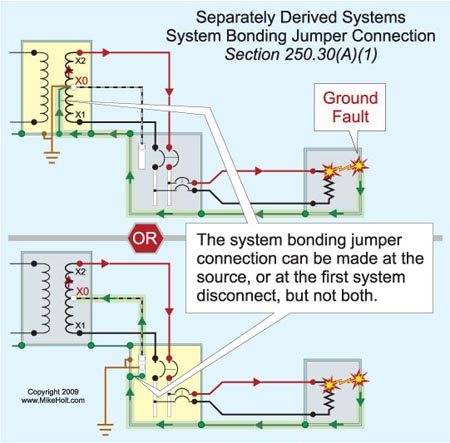
250-30A102web.jpg
 
Engineering news on Phys.org
newbie2231 said:
Hi I am taking generals now but I will eventually take EE degree. I am studying electrical systems now. Can somebody help me on system configuration regarding circuit breakers clearing ground faults?

In this picture (the bottom figure), if X2 faults at the transformer, would the fault current ever trip the breaker? I know that it should but I just don't see how. The fault by X2 in the picture will travel through a bonding jumper (the short green horizontal piece between the transformer and the disconnect panel), then to the disconnect, then eventually to the X0 of the transformer. The current will cycle like that but will not travel through the breaker. From reading the web page where this picture came from, I know the bonding jumper will make the breaker trip when the X2 faults at the transformer. But I just don't see how. Any help is appreciated.
250-30A102web.jpg

The fault current DOES go through the CB. The current will go from the X2 terminal to the CB, to the load, to the ground wire and then back to the center tap of the transfromer. This completes the circuit.
 
david90 said:
The fault current DOES go through the CB. The current will go from the X2 terminal to the CB, to the load, to the ground wire and then back to the center tap of the transfromer. This completes the circuit.

Why does the fault current take the path that has the load resistance when another path with virtually no resistance now became available?
 
newbie2231 said:
Why does the fault current take the path that has the load resistance when another path with virtually no resistance now became available?

I'm not sure what you mean. Under normal condition, current flows through the load (represented by the resistor symbol). Under a ground fault condition, current flows through the ground wire. In the picture below, I drew the path of the ground fault current. Very very little current will flow through the load during a ground fault because the ground wire has almost no resistance.

250-30A102web_zps43453f54.jpg
 
david90 said:
I'm not sure what you mean. Under normal condition, current flows through the load (represented by the resistor symbol). Under a ground fault condition, current flows through the ground wire. In the picture below, I drew the path of the ground fault current. Very very little current will flow through the load during a ground fault because the ground wire has almost no resistance.

250-30A102web_zps43453f54.jpg

My apologies. I used the picture for describing the involved equipments but not for the situation illustrated in the picture. In my situation, the fault happens not at the load, but at the transformer enclosure.
 
In my situation, the fault happens not at the load, but at the transformer enclosure.

So the pictures don't go with the question in first post?
if X2 faults at the transformer,

Circuit breakers protect downstream equipment...

Dave90 did a good job with the pictures given.
 
newbie2231 said:
My apologies. I used the picture for describing the involved equipments but not for the situation illustrated in the picture. In my situation, the fault happens not at the load, but at the transformer enclosure.

I see. If a ground fault occurs at the transformer, then no the CB will not trip. However, the ground fault will trip the CB or fuse ( Not shown in your picture) that protects the primary winding of the transformer.
 
So the primary winding's fuses open. Okay I see. Now, what if I got rid of the green wire that electrically bonds the transformer enclosure to the disconnect panel. And then I bond the transformer enclosure to the X0. Would that not produce the same protection, same result?
 

Similar threads

Replies
29
Views
2K
Replies
12
Views
721
  • · Replies 12 ·
Replies
12
Views
2K
  • · Replies 38 ·
2
Replies
38
Views
8K
  • · Replies 42 ·
2
Replies
42
Views
4K
  • · Replies 79 ·
3
Replies
79
Views
7K
  • · Replies 10 ·
Replies
10
Views
5K
  • · Replies 23 ·
Replies
23
Views
4K
  • · Replies 2 ·
Replies
2
Views
2K
  • · Replies 8 ·
Replies
8
Views
3K