How Do Electron Energy Levels in Mercury Atoms Produce Line Spectra?

Click For Summary

Homework Help Overview

The discussion revolves around the electron energy levels in mercury atoms and their relation to line spectra. Participants explore the implications of energy transitions, particularly focusing on the movement of electrons between energy levels and the effects of collisions with electrons and photons.

Discussion Character

  • Exploratory, Conceptual clarification, Assumption checking

Approaches and Questions Raised

  • Participants attempt to calculate energy changes and wavelengths associated with electron transitions. Questions arise regarding the outcomes of collisions between electrons and mercury atoms, as well as the effects of photon interactions.

Discussion Status

Some participants have made calculations related to energy transitions, while others express uncertainty about the implications of these interactions. There is a mix of attempts to clarify concepts and explore different interpretations of the results.

Contextual Notes

Participants note the lack of information in textbooks regarding specific scenarios presented in the problem, particularly concerning the effects of collisions with electrons and photons. The discussion includes references to energy levels and excitation without reaching a definitive conclusion.

Spruance
Messages
33
Reaction score
0
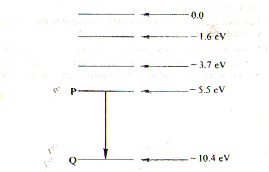
The diagram shows some of the energy levels of an electron in a mercury atom. Level Q represents the lowest possible energy level.
bilde.png


(a)Explain why a line spectrum results from an atom with such energy levels.

(b) Calculate the energy change in joules when the electron moves from level P to level Q and determine the wavelength of the spectral line associated with this transition.

(c)Explain what is likely to happen if a moving electron of energy 7.0eV collides with an isolated mercury atom in the ground state.

(d)Explain what is likely to happen if a photon, also of energy 7.0eV were to be incident on the atom.

Planck’s constant = 6.6 x 10⁻³⁴ Js,
speed of light = 3.0 x 10⁸m/s,
charge on an electron = 1.6 x 10 -19 C

Thanks in advance
 
Physics news on Phys.org
I have at least tried to solve b)

-10,4 - (-5,5) = -4,9 eV = -7,84 * 10^-19J


f = E/h = (- 7.84 * 10^-19)/(6.63 * 10^-34) = - 1.18 * 10^15

lamba = (3 * 10^8)/(-1.18 * 10^15) = - 2.54 * 10^-7
 
Have I done something wrong?
 
Spruance said:
I have at least tried to solve b)

-10,4 - (-5,5) = -4,9 eV = -7,84 * 10^-19J


f = E/h = (- 7.84 * 10^-19)/(6.63 * 10^-34) = - 1.18 * 10^15

lamba = (3 * 10^8)/(-1.18 * 10^15) = - 2.54 * 10^-7

Nope, this looks correct to me.

~H
 
Hi

1) is not that important, I can always find some information on internet on it.

However, I didn't find any information in my textbook on c) and d). Anyone able (wanting? ...) to help me out?
 
Last edited:
Think in terms of 'if the electron / photon collides with an electron from a mercury nucleous'. With electron-electron collisions, the collision can either be elastic or inelastic. With a photon, all the energy is always absorbed by the electron. What happens if an electron gains energy?

~H
 
I'm not completely sure
 
Spruance said:
I'm not completely sure

Think about energy levels, excitation...

~H
 
I believe that the mercury atom would be excitated if it collides with a moving electron.
 
  • #10
Spruance said:
I believe that the mercury atom would be excitated if it collides with a moving electron.

You would need to consider the energy of the electron, in relation to the energy levels of the mercury atom.

~H
 
  • #11
I don't think the mercury atom would be ionized
 
  • #12
Spruance said:
I don't think the mercury atom would be ionized

No it wouldn't, what I'm getting at is you should make reference to the energy of the electron / photon in your asnwer and compare it to the energy levels. Excitation is a key word you should use.

~H
 
  • #13
10.4 - 7 = 3.4 eV
 
  • #14
Spruance said:
10.4 - 7 = 3.4 eV

Correct, so it would be excited to the -3.7eV energy level.

~H
 
  • #15
Thanks

What would then happen in d?
 
  • #16
As, I stated previously;

Hootenanny said:
With a photon, all the energy is always absorbed by the electron. What happens if an electron gains energy?

~H
 

Similar threads

  • · Replies 2 ·
Replies
2
Views
2K
  • · Replies 8 ·
Replies
8
Views
2K
Replies
37
Views
7K
  • · Replies 8 ·
Replies
8
Views
2K
  • · Replies 12 ·
Replies
12
Views
3K
  • · Replies 7 ·
Replies
7
Views
3K
  • · Replies 4 ·
Replies
4
Views
3K
  • · Replies 1 ·
Replies
1
Views
2K
  • · Replies 3 ·
Replies
3
Views
2K
  • · Replies 15 ·
Replies
15
Views
3K