How Do Velocity and Pressure Relate in Linear Sound Wave Equations?

Click For Summary

Discussion Overview

The discussion centers around the relationship between velocity and pressure in the context of linear sound wave equations. Participants explore the mathematical derivations and underlying principles, including the continuity equation and Euler's equation, while examining the implications of these relationships in fluid dynamics.

Discussion Character

  • Technical explanation
  • Mathematical reasoning
  • Debate/contested

Main Points Raised

  • One participant questions the transition between equations (8.5) and (8.6) and (8.7), seeking clarification on the relationship between velocity and pressure.
  • Another participant notes a mathematical identity regarding the divergence of the velocity field and its time derivative, suggesting a potential connection to pressure.
  • Some participants propose that the continuity equation, which expresses mass conservation, is relevant to the relationship between density, velocity, and pressure.
  • A later reply asserts that the continuity equation is inherently satisfied and suggests that velocity and pressure can be related through Euler's equation.

Areas of Agreement / Disagreement

Participants express differing views on the specific relationships between velocity, pressure, and density, with no consensus reached on the implications of these equations or the nature of their interconnections.

Contextual Notes

Participants reference various equations and principles, such as the continuity equation and Euler's equation, but the discussion remains open regarding the assumptions and definitions involved in these relationships.

unscientific
Messages
1,728
Reaction score
13
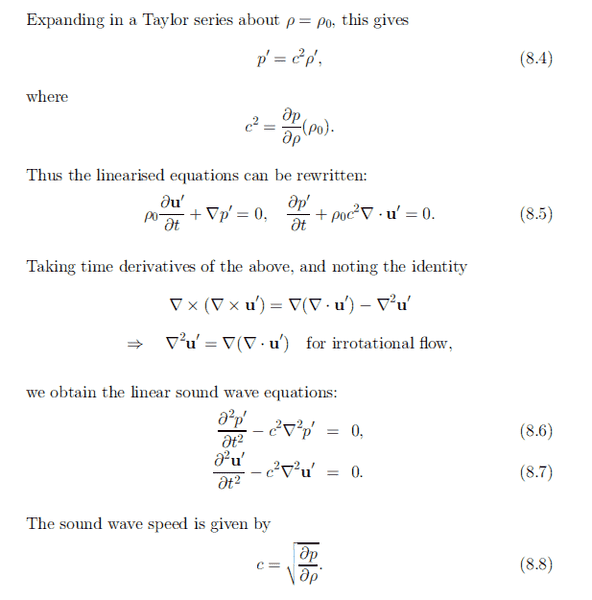
Taken from my lecturer's notes, how did they make the jump from 8.5 to 8.6 and 8.7?
sound1.png


Even after differentiating (8.5) with time I get

[tex]\rho_0 \frac{\partial^2 \vec u'}{\partial t^2} + \nabla \frac{\partial p '}{\partial t} = 0[/tex]
[tex]\frac{\partial^2 p'}{\partial t^2} + \rho_0 c^2 \nabla \cdot \frac{\partial \vec u'}{\partial t} = 0[/tex]

Is there a relation between ##\vec u## and ##p## I am missing?
 
Physics news on Phys.org
Note that
$$\vec{\nabla} \cdot \partial_t \vec{u}=\partial_t \vec{\nabla} \cdot \vec{u}.$$
 
vanhees71 said:
Note that
$$\vec{\nabla} \cdot \partial_t \vec{u}=\partial_t \vec{\nabla} \cdot \vec{u}.$$

Is ##\nabla \cdot \vec u ## somehow related to pressure?
 
It's somewhat related to density. Using the continuity equation, which expresses mass conservation (valid in non-relativistic physics from very basic principles)
$$\partial_t \rho + \vec{\nabla} (\rho \vec{v})=0.$$
 
vanhees71 said:
It's somewhat related to density. Using the continuity equation, which expresses mass conservation (valid in non-relativistic physics from very basic principles)
$$\partial_t \rho + \vec{\nabla} (\rho \vec{v})=0.$$

[tex]\frac{\partial m}{\partial t} = - \int \rho \vec v \cdot d\vec S[/tex]
[tex]\int \frac{\partial \rho}{\partial t} dV = -\int \rho \nabla \cdot \vec v dV[/tex]

This implies that ##\frac{\partial \rho}{\partial t} + \nabla \cdot (\rho \vec v) = 0 ##.
 
Well yes that equation is satisfied by default, as it is the continuity equation.

You can relate the velocity and pressure through Euler's equation.
 
  • Like
Likes   Reactions: unscientific

Similar threads

  • · Replies 4 ·
Replies
4
Views
2K
  • · Replies 3 ·
Replies
3
Views
2K
  • · Replies 1 ·
Replies
1
Views
2K
  • · Replies 4 ·
Replies
4
Views
2K
  • · Replies 5 ·
Replies
5
Views
1K
  • · Replies 32 ·
2
Replies
32
Views
4K
  • · Replies 12 ·
Replies
12
Views
3K
  • · Replies 7 ·
Replies
7
Views
2K
  • · Replies 0 ·
Replies
0
Views
3K
  • · Replies 4 ·
Replies
4
Views
4K