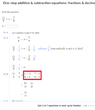
We expand the fractions in that way so that the two fractions get the same denominator, in order to be able to calculate the subtraction, since it is not possible to subtract fractions with different denominators.
The denominator of the first fraction is $6$ and the of the second one it is $9$. We expand both fractions to make their denominators the same as the least common denominator.
The Least Common Multiple of $6$ and $9$ is $18$. It holds that $6\cdot 3=18$ and $9\cdot 2=18$. Therefore we expand the first fraction by $3$ : $\frac{11}{6}=\frac{11\cdot 3}{6\cdot 3}=\frac{33}{18}$ and the second fraction by $2$: $\frac{7}{9}=\frac{7\cdot 2}{9\cdot 2}=\frac{14}{18}$.
Now we can do the subtraction by subtracting the numerators: $$\frac{11}{6}-\frac{7}{9}=\frac{33}{18}-\frac{14}{18}=\frac{19}{18}$$