How Do You Calculate Apparent and Reactive Power in AC Circuits?

  • Context: Engineering 
  • Thread starter Thread starter charger9198
  • Start date Start date
  • Tags Tags
    Ac Ac circuits Circuits
Click For Summary

Discussion Overview

The discussion revolves around calculating apparent and reactive power in AC circuits, specifically focusing on a circuit with a given power factor and power dissipation. Participants explore various methods to compute apparent power, reactive power, current, and impedance, while addressing potential errors and clarifying concepts related to complex numbers in electrical engineering.

Discussion Character

  • Technical explanation
  • Mathematical reasoning
  • Debate/contested
  • Homework-related

Main Points Raised

  • One participant calculates apparent power using the formula S = P/pf, arriving at approximately 520.83 VA.
  • Reactive power is computed using the formula VAR = SQRT(S^2 - P^2), yielding around 361.44 VAR.
  • Another participant questions the method used to determine total impedance, suggesting that impedance has real and imaginary components that should be considered.
  • There is a discussion on the phase angle, with some participants calculating it in radians while others prefer degrees, leading to confusion about the representation of the angle.
  • Participants explore the representation of complex current and impedance, with one participant attempting to clarify how to retain real and imaginary components in their calculations.
  • There is a debate on whether the impedance should be calculated as Vs/I, with some suggesting that the presence of inductance or capacitance would increase the impedance beyond the resistance value.
  • Complex arithmetic is discussed, with participants expressing difficulty in understanding how to manipulate complex numbers for impedance calculations.

Areas of Agreement / Disagreement

Participants do not reach a consensus on the best method for calculating impedance and the handling of complex numbers. There are multiple competing views on how to approach the calculations, and some participants express confusion about the underlying concepts.

Contextual Notes

Participants mention limitations in their course materials regarding complex arithmetic, indicating that some of the methods discussed may not align with their current understanding or educational resources.

charger9198
Messages
60
Reaction score
0
For the circuit given in the power factor is 0.72 lagging and
the power dissipated is 375 W.
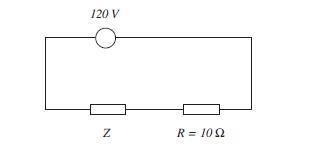
12.jpg


Determine the:
(1) apparent power
(2) reactive power
(3) the magnitude of the current flowing in the circuit
(4) the value of the impedance Z and state whether circuit is inductive or
capacitive.

(1) Apparent power = True power / Power Factor (S=P/pf)

= 375 / 0.72

= 520.8333 VA

(2) Reactive Power = SQRT (apparent power^2) - (True Power^2)

= SQRT (520.8333^2)-(375^2)

= SQRT (130642.3264)

= 361.4448 VAR

(3) Magnitude of Current

Power= Voltage*Current *Power factor (P=V*I*pf)

375 = 120*I*0.72
I = P/(V*pf)
I = 375/(120*0.72)
I = 4.34 A

(4) Total ohms = Voltage/Current
= 120/4.34
=27.6498 ohms (minus 10)
z = 17.65 ohms

The power factor is lagging within the circuit therefore the the virvuit is inductive


Am i on the right lines here? or is there a better way of calculating the above results
 
Physics news on Phys.org
I find your calculation of total ohms (part 4) to be a bit dubious. Where you've made the assumption that you can just subtract the resistor value from the impedance magnitude to leave the impedance Z of the "mystery component" is also suspect. Impedance will have real and imaginary parts.

I'd be more inclined to use the current magnitude and its known phase angle obtained from the power factor to construct the complex current: i = I (cos(\phi) - j\;sin(\phi)), and then find the total (complex) impedance of the circuit:

Z_{tot} = \frac{120 V}{i} = (19.91 + j 19.19) \Omega

Then subtract the given resistor from the real part of that to leave the impedance Z.
 
Ok thanks gneill

so ill use

ϕ=acos(power factor)
=acos (.72)
= 0.76699

then;

i = 4.34(cos(0.76699)-jsin(0.76699))
i = 4.339566
Zt=120/4.339566
=27.28723 (minus 10)
=17.28723
 
charger9198 said:
Ok thanks gneill

so ill use

ϕ=acos(power factor)
=acos (.72)
= 0.76699

then;

i = 4.34(cos(0.76699)-jsin(0.76699))
i = 4.339566 <---- This should be a complex value (real + imaginary components)
Zt=120/4.339566
=27.28723 (minus 10)
=17.28723

The complex current should retain real and imaginary components so that the impedance value obtained will also have real and imaginary components. These correspond to the resistance and reactance of the circuit.
 
Think I've got it;

i=4.34(cos(0.76699)-jsin(0.76699)

i = 4.34(0.720003-0.693971)
i = (3.12481-3.01183j)

So

Z=120/(3.12481-3.01183j)

Z=19.9079 + 19.1882j

Minus ten from real gives

9.9079 ohms

This better? Are my answers ok for the other parts of the question?
 
Yes, that looks better. So the "mystery component" has both resistance and inductance.

The other answers look fine to me; nicely calculated. :smile:
 
Thanks for you help as always :)
 
charger9198 said:
Thanks for you help as always :)

You're very welcome!
 
gneill said - I'd be more inclined to use the current magnitude and its known phase angle obtained from the power factor to construct the complex current: , and then find the total (complex) impedance of the circuit:


Charger said - ϕ=acos(power factor)
=acos (.72)
= 0.76699

I work the phase angle out at 43.95, where does this 0.76699 come from? I'm having a real problem getting my head round this 'imaginary' thing.
 
  • #10
stemurdo said:
Charger said - ϕ=acos(power factor)
=acos (.72)
= 0.76699

I work the phase angle out at 43.95, where does this 0.76699 come from? I'm having a real problem getting my head round this 'imaginary' thing.

0.76699 is the angle in radians. You can work in degrees or radians as long as you're consistent.
 
  • #11
ok so i use cos-1 x power factor, gives me a phase angle of 43.95 degrees.

i=I(cos(43.95)-jsin(43.95))
=4.34(cos(43.95)-jsin(43.95))
=4.34(0.7199-j0.694)
=(3.1244-j3.012)

is this right so far? this is where I'm getting a bit lost and not sure of the next step
 
  • #12
am i right in saying that the jvalue is a negative value?
so it would actually be (3.1244 - (-3.012))
giving 120/6.134 = 19.555 for the real value? then how do you get the second jvalue?
 
  • #13
stemurdo said:
am i right in saying that the jvalue is a negative value?
so it would actually be (3.1244 - (-3.012))
giving 120/6.134 = 19.555 for the real value? then how do you get the second jvalue?

You don't add the real and imaginary components of a complex number, they are separate entities. Take a look at post #5 in this thread. The impedance will have real and imaginary components, too.
 
  • #14
sorry gneill, i can only ask for patience here. i appreciate the time.
i'm obviously missing something here, or just not grasping the concept at all!
if you don't add or subtract the jvalue then what purpose does it serve? how do you divide 120 by 3.124 and come up with 19.9 or whatever? my brain has packed up and gone home. :-)
 
  • #15
stemurdo said:
sorry gneill, i can only ask for patience here. i appreciate the time.
i'm obviously missing something here, or just not grasping the concept at all!
if you don't add or subtract the jvalue then what purpose does it serve? how do you divide 120 by 3.124 and come up with 19.9 or whatever? my brain has packed up and gone home. :-)

You should review the manipulation of complex numbers; how to add, subtract, multiply, and divide them. http://www.allaboutcircuits.com/vol_2/chpt_2/6.html to get you started.

If you enter "Complex number arithmetic" into a Google search you'll get more information, and even links to online complex number calculators.
 
  • #16
Should the impedance be Vs/I which is 27.63 ohms. If there is an Inductance or Capacitance in the circuit the Z will be higher than R?
 
  • #17
terrytibbs said:
Should the impedance be Vs/I which is 27.63 ohms. If there is an Inductance or Capacitance in the circuit the Z will be higher than R?

27.63 Ω represents the magnitude of the impedance. Impedance is a complex value comprised of a real (resistive) and an imaginary (reactive) part. In this sense, yes, the magnitude will be greater than the size of the individual components: ##|Z| = \sqrt{R^2 + X^2}## . So for X nonzero, |Z| > R.
 
  • #18
charger9198 said:
Think I've got it;

i=4.34(cos(0.76699)-jsin(0.76699)

i = 4.34(0.720003-0.693971)
i = (3.12481-3.01183j)

So

Z=120/(3.12481-3.01183j)

Z=19.9079 + 19.1882j

Minus ten from real gives

9.9079 ohms

This better? Are my answers ok for the other parts of the question?

i don't understand how get from Z=120/(3.12481-3.01183j) to Z=19.9079 + 19.1882j

can anyone explain this please if possible followed the link at the end but can understand from that how it get to Z=19.9079 + 19.1882j
 
  • #19
mattyh3 said:
i don't understand how get from Z=120/(3.12481-3.01183j) to Z=19.9079 + 19.1882j

can anyone explain this please if possible followed the link at the end but can understand from that how it get to Z=19.9079 + 19.1882j

It's basic complex arithmetic. You can convert the denominator to polar form (magnitude + angle) then do the division, convert the result back to rectangular form. Or, clear the imaginary term from the denominator by multiplying numerator and denominator by the complex conjugate of the denominator.

A web search on "complex arithmetic" will likely turn up a tutorial.
 
  • #20
gneill said:
It's basic complex arithmetic. You can convert the denominator to polar form (magnitude + angle) then do the division, convert the result back to rectangular form. Or, clear the imaginary term from the denominator by multiplying numerator and denominator by the complex conjugate of the denominator.

A web search on "complex arithmetic" will likely turn up a tutorial.

you see none of this is in the lesson book for this course the only way i can find is z=v/i

there is polar form but nothing like what's on this page.. i still can't understand what your trying to tell me

just tried a complex arithmetic calculator online and i don't get them answers
 
  • #21
mattyh3 said:
you see none of this is in the lesson book for this course the only way i can find is z=v/i

there is polar form but nothing like what's on this page.. i still can't understand what your trying to tell me

just tried a complex arithmetic calculator online and i don't get them answers

Your course may assume that you've studied complex arithmetic in another course; It's generally taught in a mathematics course. If you haven't taken such a class, then you should find an online tutorial on complex numbers.
 
  • #22
terrytibbs said:
Should the impedance be Vs/I which is 27.63 ohms. If there is an Inductance or Capacitance in the circuit the Z will be higher than R?

well i thought it would be z=v/i but looks different on here and inductance because p.f is lagging
 
  • #23
gneill said:
Your course may assume that you've studied complex arithmetic in another course; It's generally taught in a mathematics course. If you haven't taken such a class, then you should find an online tutorial on complex numbers.

i did a maths course before been aloud on this and there is nothing in there on this or how to do it
 
  • #24
mattyh3 said:
well i thought it would be z=v/i but looks different on here and inductance because p.f is lagging

Z = V/I is correct, assuming that V and I are complex values (well, here V is assumed to be the reference for the phasor angles, so V's imaginary component will be zero making V a real value). The I is determined from the given information using the power factor to determine the apparent current in complex form.
 
  • #25
still can't find anything of any use that i can understand where the 120 goes and you end up with 19.9079+19.1882j
 
  • #26
mattyh3 said:
still can't find anything of any use that i can understand where the 120 goes and you end up with 19.9079+19.1882j

It's just division. A real number, 120, is being divided by the complex number 3.12481-3.01183j .
 
  • #27
gneill said:
It's just division. A real number, 120, is being divided by the complex number 3.12481-3.01183j .

if i divide them into 120 it get 38.402+39.843j i don't understand any other way of doing it as am not great with maths
 
  • #28
mattyh3 said:
if i divide them into 120 it get 38.402+39.843j i don't understand any other way of doing it as am not great with maths

You'll have to find a complex number / complex arithmetic tutorial to learn about it. Or make use of an online complex arithmetic calculator (although that won't help you in tests or exams!).

Here's an example online calculator (found with via google with a couple of seconds effort):

http://www.1728.org/compnumb.htm
 
  • #29
gneill said:
You'll have to find a complex number / complex arithmetic tutorial to learn about it. Or make use of an online complex arithmetic calculator (although that won't help you in tests or exams!).

Here's an example online calculator (found with via google with a couple of seconds effort):

http://www.1728.org/compnumb.htm

thanks for the help but i can't even use the calculator it gives me weird answers nothing like what's on here

this is what i get 19.408277013161786 + i*19.70643553618951
 
  • #30
mattyh3 said:
thanks for the help but i can't even use the calculator it gives me weird answers nothing like what's on here

this is what i get 19.408277013161786 + i*19.70643553618951

Yes, and that's the correct result for the impedance. It's a complex number with real and imaginary parts.
 

Similar threads

  • · Replies 5 ·
Replies
5
Views
2K
  • · Replies 16 ·
Replies
16
Views
3K
  • · Replies 5 ·
Replies
5
Views
2K
  • · Replies 7 ·
Replies
7
Views
2K
  • · Replies 7 ·
Replies
7
Views
3K
  • · Replies 4 ·
Replies
4
Views
2K
  • · Replies 8 ·
Replies
8
Views
4K
Replies
1
Views
5K
  • · Replies 2 ·
Replies
2
Views
2K
  • · Replies 9 ·
Replies
9
Views
2K