How Does the Rotational Inertia Affect Rolling Motion on an Inclined Plane?

Click For Summary
SUMMARY

The discussion focuses on the effects of rotational inertia on the rolling motion of a uniform wheel on an inclined plane. The wheel, with a mass of 14.0 kg and a rotational inertia of 0.600 kg·m², rolls down a 30.0° incline without slipping. Key equations used include Mgh = 1/2Iω² + 1/2mv² for energy conservation and v = ωR for the relationship between linear and angular velocity. The confusion regarding the radius (R) is clarified, emphasizing that it refers to the axle's radius, which is 0.200 m, not the wheel's radius.

PREREQUISITES
  • Understanding of rotational inertia and its impact on motion
  • Familiarity with the equations of motion for rolling objects
  • Knowledge of energy conservation principles in physics
  • Basic grasp of angular velocity and its relationship to linear velocity
NEXT STEPS
  • Study the concept of rotational kinetic energy and its calculation
  • Learn about the conditions for rolling without slipping
  • Explore the implications of rotational inertia in different physical systems
  • Investigate the effects of incline angles on rolling motion dynamics
USEFUL FOR

Physics students, mechanical engineers, and anyone interested in the dynamics of rolling motion and rotational mechanics.

ILOVEPHYSIC
Messages
3
Reaction score
0
A uniform wheel of mass 14.0 kg is mounted rigidly on a massless axle through its center, as shown in the figure below. The radius of the axle is 0.200 m, and the rotational inertia of the wheel-axle combination about its central axis is 0.600 kg·m2. The wheel is initially at rest at the top of a surface that is inclined at angle θ = 30.0° with the horizontal; the axle rests on the surface while the wheel extends into a groove in the surface without touching the surface. Once released, the axle rolls down along the surface smoothly and without slipping. The wheel-axle combination moves down the surface by 3.00 m.

(a)Determine its rotational kinetic energy at this point? J

(b) Determine its translational kinetic energy at this point? J
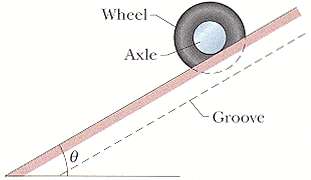
11-61.gif
Mgh= 1/2mw^2 + 1/2mv^2 --(1)
v=wR --(2)
The problem i feel confused is that what is R for since part of the wheel is inside the groove. I am not sure the question is just simply sub (2) into (1) and find the answer.
 
Physics news on Phys.org
ILOVEPHYSIC said:
Mgh= 1/2mw^2 + 1/2mv^2 --(1)
Fix the first term on the right hand side, for rotational KE. (Should be I, not m.)

ILOVEPHYSIC said:
The problem i feel confused is that what is R for since part of the wheel is inside the groove.
What matters is what surfaces are in contact with each other. It's the axle that is touching the surface of the incline. The fact that the part of the wheel is in the groove is irrelevant.
 
Doc Al said:
Fix the first term on the right hand side, for rotational KE. (Should be I, not m.)What matters is what surfaces are in contact with each other. It's the axle that is touching the surface of the incline. The fact that the part of the wheel is in the groove is irrelevant.
Sorry for typing wrong in rotational KE. But the axle and wheel should move with same angular speed. Why don't wheel slow down the rotational motion?
 
ILOVEPHYSIC said:
But the axle and wheel should move with same angular speed.
They do!

ILOVEPHYSIC said:
Why don't wheel slow down the rotational motion?
The wheel does slow down the rotational motion, but that is reflected in the rotational inertia. The relationship v = ωr is the condition for rolling without slipping; the "r" is the distance from the surface to the center, which is the radius of the axle, not the wheel.
 

Similar threads

Replies
67
Views
4K
  • · Replies 10 ·
Replies
10
Views
5K
Replies
24
Views
3K
  • · Replies 4 ·
Replies
4
Views
2K
  • · Replies 10 ·
Replies
10
Views
3K
  • · Replies 4 ·
Replies
4
Views
2K
  • · Replies 20 ·
Replies
20
Views
2K
  • · Replies 6 ·
Replies
6
Views
6K
  • · Replies 21 ·
Replies
21
Views
5K
  • · Replies 6 ·
Replies
6
Views
2K