How far water flows in a tilted oven before evaporating?

Click For Summary

Discussion Overview

The discussion revolves around the evaporation of water in a tilted oven, specifically examining how far water would flow before completely evaporating when introduced at a rate of 10 gallons per minute into an oven maintained at 300°C. The context includes considerations of hydrodynamics, heat transfer, and the practical implications of such a scenario in an industrial setting.

Discussion Character

  • Exploratory
  • Technical explanation
  • Debate/contested
  • Experimental/applied

Main Points Raised

  • One participant inquires about the distance water would flow in the oven before evaporating, expressing a lack of expertise in the area.
  • Another participant questions whether the problem is related to schoolwork and requests context, indicating that it should be posted in a different section if it is.
  • A participant mentions using Newton's cooling equation to estimate evaporation time but struggles to determine a value for the constant K without additional references.
  • Hydrodynamic considerations are raised, including the diameter of the pipe and the method of heating, with a participant noting the pipe's diameter is 10 ft and that it is heated using natural gas.
  • Concerns are expressed about the cooling effect of the cold water on the system, with one participant stating that the problem is not trivial due to large internal temperature gradients and heat flux.
  • Another participant calculates the energy required to heat and vaporize the water, questioning the assumption that the pipe remains at a constant temperature.
  • Discussion includes the scale of the kiln and the potential complexity of the system, with references to the drying of large quantities of material and the need for process control algorithms.

Areas of Agreement / Disagreement

Participants do not reach a consensus, as there are multiple competing views regarding the feasibility of solving the problem analytically and the assumptions about temperature and cooling effects.

Contextual Notes

Limitations include the lack of specific information about the burner and the internal conditions of the pipe, as well as unresolved questions regarding the pressure and heat losses to the atmosphere.

crclayton
Messages
3
Reaction score
0
If I throw 10 gallons/minute of cold water for 4 days into an oven that's 300°C celsius and 300ft long sloped at an angle of 10°, how far would the water make it down the oven before completely evaporating?
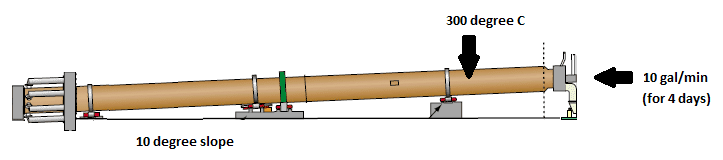
i5Nel.png


Even if you can't solve this directly, I'd love some advice or recommendations of how to approach the problem. I'm an EE student on an internship and this is totally out of my area of expertise.

Thanks in advance.
 
Physics news on Phys.org
crclayton said:
If I throw 10 gallons/minute of cold water for 4 days into an oven that's 300°C celsius and 300ft long sloped at an angle of 10°, how far would the water make it down the oven before completely evaporating?

i5Nel.png


Even if you can't solve this directly, I'd love some advice or recommendations of how to approach the problem. I'm an EE student on an internship and this is totally out of my area of expertise.

Thanks in advance.

Welcome to the PF.

Is this a schoolwork problem? If so, it needs to be posted in the Homework Help section of the PF, and you need to show some effort on the solution. What is the context of the question?
 
berkeman said:
Welcome to the PF.

Is this a schoolwork problem? If so, it needs to be posted in the Homework Help section of the PF, and you need to show some effort on the solution. What is the context of the question?

Thanks! No, it's not a homework problem, I'm on an internship working at a mill and have been asked to look into this. I've looked into Newton's cooling equation, hoping to get a value for the time it would take water to evaporate like so:

To = 10 degrees (cold water)
Tf = 100 degrees (evaporated water)
Ta = 300 degrees (ambiant temperature of oven)

T(t) = Ta + (To-Ta)e-kt = 100 = 300 - 290e-kt

But I'm having a hard time determining a value for K without a second reference. Any guidance or recommendations for how to solve this would be very welcomed.
 
The first thing to do is to focus on the hydrodynamics. What's the diameter of the pipe? If there were no heating, how much of the cross section would be filled? What is the method of heating in the oven?

Chet
 
Chestermiller said:
The first thing to do is to focus on the hydrodynamics. What's the diameter of the pipe? If there were no heating, how much of the cross section would be filled? What is the method of heating in the oven?

Chet

It's 10 ft in diameter. As much as how much is pumped in would remain until boiled off. It's heated using natural gas and it's safe to assume that the pipe doesn't get cooled at all by the water and remains 300 degrees.
 
crclayton said:
It's 10 ft in diameter. As much as how much is pumped in would remain until boiled off. It's heated using natural gas and it's safe to assume that the pipe doesn't get cooled at all by the water and remains 300 degrees.
The pipe is heated from the outside? What about the air(?) inside the pipe. Where does it enter the pipe and where does it exit? The pressure is at 1 atm?

Chet
 
Looks like a cement kiln, and without some information about the burner, you're going to have a tough time figuring out how far down the tube the water might get before being carried back out the top end. Methinks you've been sent for a "left-handed pipe wrench," or "copper fallopian tubes," or some other rookie initiation equivalent.
 
  • Like
Likes   Reactions: berkeman
10 gallons of cold water a minute is going to have an incredibly large cooling effect, and this is not a trivial problem. There will be large internal temperature gradients, and the heat flux will be very large. I'm not convinced there's a reasonable analytic way to solve this.
 
  • Like
Likes   Reactions: billy_joule
cjl said:
the heat flux will be very large
3MW, a small cement kiln.
 
  • #10
Running some numbers here, you're putting in around 0.63 kg/s of water. Assuming the water is at 20C, it'll take 211kW to heat that water up to boiling, and another 1400kW or so to boil it off (it takes a very large amount of energy to vaporize water). Are you still sure that it's safe to assume the pipe doesn't get cooled at all?
 
Last edited:
  • #11
A 300 foot kiln? Thousand tons of material an hour being dried? We'll call it 360, 100 kg/s of presumably light minerals being dried, specific heat about a quarter that of water, another 5 MW on the burner. Residence time in the kiln? Fifteen minutes? Hour? Heat capacity of a "how many" hundred ton steel drum plus how many hundred tons of dried and drying product? Heat losses to atmosphere? Presumably the drum has some sort of lagging/insulation. Bulk materials processing is done in large numbers.
Are you being asked to come up with numbers to shove into process control algorithms to handle a "wet trainload" that comes into the plant?
 

Similar threads

  • · Replies 32 ·
2
Replies
32
Views
12K
Replies
18
Views
4K
  • · Replies 25 ·
Replies
25
Views
8K