Discussion Overview
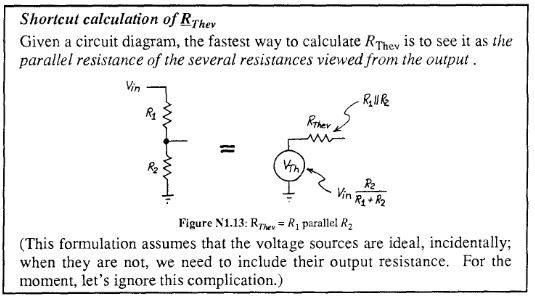
The discussion revolves around the calculation of Thevenin resistance in a circuit configuration where resistor R1 is in parallel with resistor R2. Participants explore the implications of having no load and the conditions under which the resistors are considered in parallel versus series.
Discussion Character
- Technical explanation
- Conceptual clarification
- Debate/contested
Main Points Raised
- One participant questions how Thevenin resistance is derived as R_th = R_1 || R_2 when there is no load, suggesting that R1 and R2 should be in series.
- Another participant proposes that if ground and Vin are treated as having zero impedance, the R1-R2 junction can be viewed as two resistors in parallel.
- A further clarification indicates that R_th is measured across the R1-R2 junction and the ground/Vin node, supporting the parallel interpretation.
- It is noted that when considering an ideal voltage source with zero impedance, the ground and Vin can be treated as the same node for calculating Thevenin resistance.
- In contrast, if an ideal current source is used instead, it is suggested that R_th would only be R2, as the current source would be disconnected due to its infinite impedance.
Areas of Agreement / Disagreement
Participants express differing views on the interpretation of the circuit configuration, particularly regarding the conditions under which R1 and R2 are considered in parallel or series. The discussion remains unresolved as there are competing interpretations of the Thevenin resistance calculation.
Contextual Notes
Participants rely on assumptions about the impedance of the voltage source and the configuration of the circuit, which may affect the interpretation of Thevenin resistance. The discussion does not resolve the implications of these assumptions.