How to analyze band structure and the density of states?

Click For Summary

Discussion Overview

The discussion revolves around analyzing band structure and density of states in the context of material physics, particularly for exam preparation. Participants explore various models, including the free electron model, nearly-free electron model, and tight-binding model, while seeking to understand how to interpret band structure plots and their relation to electron configurations and chemical properties.

Discussion Character

  • Exploratory
  • Technical explanation
  • Homework-related
  • Debate/contested

Main Points Raised

  • One participant asks how to analyze band structure and density of states plots, questioning if crystal structure can be inferred from them and what chemical properties are associated with different structures.
  • Another participant expresses a desire to correlate total density of states (TDOS) with band structure symmetry points and seeks to label peaks in the density of states with specific orbital states (e.g., 2p, 4d).
  • A participant mentions confusion regarding how to relate band structure plots to electronic configurations, seeking guidance on identifying which lines correspond to specific atomic states.
  • Some participants suggest that a deeper understanding of band theory is necessary and recommend specific textbooks for further reading.
  • There are repeated requests for assistance from participants who are new to the forum and seeking help with their projects involving density functional theory (DFT) and band structure analysis.

Areas of Agreement / Disagreement

Participants express varying levels of understanding and familiarity with band theory, with some seeking foundational knowledge while others provide suggestions for improvement. No consensus is reached on specific methods for analyzing band structure or density of states.

Contextual Notes

Some participants indicate a lack of clarity regarding the relationship between electronic configurations and energy bands, highlighting the complexity of interpreting band structure plots. There are also mentions of specific software tools (e.g., Wien2k) used for simulations, but details on their application remain unresolved.

Who May Find This Useful

This discussion may be useful for students and researchers in material physics, particularly those preparing for exams or working on projects involving band structure and density of states analysis.

DemoniWaari
Messages
15
Reaction score
0
Hello!

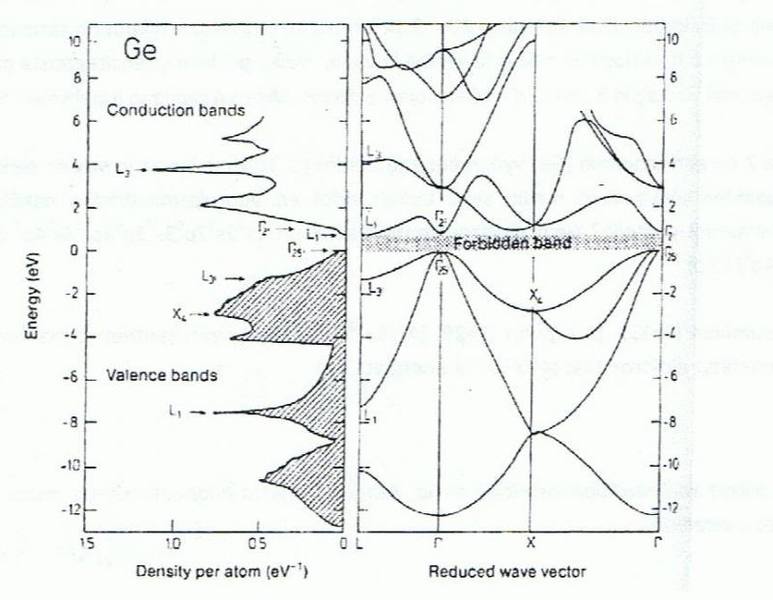
I'm having my materialphysics exam in a few days, and looking some of the older exams I saw that there are many times questions about band structure and density of states. More specifically there might be a picture of some band structure plus the density of states, like this.
10575_1_zps17933ee3.jpg

Then they ask you to analyze this kind of a picture and give as much information as possible (according to the free electron model, nearly-free electron model and tight-binding).

So what I'm asking are some basic ways for me to analyze this. Like can I see the crystal structure from this(fcc, bcc, hcp)? And for extra, what kind of chemical properties do they have? I know that fcc has good catalytic properties, but I have no clue about the others.

Can I see the electron configuration? I know some basics on this, s-band is the parabolic band in around the gamma-point and p-band is a smaller parabole around the X-band (I think). But what about d and f? Also can I see how many electrons there are in a subshell?

Then I'd like to know how to draw a very basic representation of the band structure with only the knowledge of the specific electron structure.

I'm sorry if this should've gone to the homework forum, but this isn't homework per se so I thought to post it here.

Thanks!
 
Physics news on Phys.org
i ma a similar trouble if you have any other then please share i am working on this problem i am a phd student doing project on dft
 
Erum asadi said:
i ma a similar trouble if you have any other then please share i am working on this problem i am a phd student doing project on dft

First of all, you are responding to a post from 2013.

Secondly, what kind of a "trouble" are you having? You need to be very specific, and to show what you have attempted to understand. What exactly do you want to know, and what exactly do you know and had tried to do?

Zz.
 
ZapperZ said:
First of all, you are responding to a post from 2013.

Secondly, what kind of a "trouble" are you having? You need to be very specific, and to show what you have attempted to understand. What exactly do you want to know, and what exactly do you know and had tried to do?

Zz.
actually i joined this forum today so new member and want to say you hellow and thanks for your quick response.
let me introduce briefly i m a Ph.D. student and doing work on dft wien2k simulation software which gives us density of states and band structure plots etc..
i want to correlate both of TDOS with bandstructure symmetry points according to typical shape of different bands s, p, d etc.
and want to know that how we can label peaks of density of states with exact orbital state like 2p,4d, etc.
thanks in advance sir please intoduce yourself also
 
Erum asadi said:
actually i joined this forum today so new member and want to say you hellow and thanks for your quick response.
let me introduce briefly i m a Ph.D. student and doing work on dft wien2k simulation software which gives us density of states and band structure plots etc..
i want to correlate both of TDOS with bandstructure symmetry points according to typical shape of different bands s, p, d etc.
and want to know that how we can label peaks of density of states with exact orbital state like 2p,4d, etc.
thanks in advance sir please intoduce yourself also
Hi!

I'm new here...

I'm going to go right to the point. I know that when you take atoms and get them closer together, the discrete energy levels turn into bands. But when I'm facing a band structure plot, such as this one (band structure of aluminum nitride in wurtzite structure):

http://img191.imageshack.us/img191/8397/image7bp.png

Is there a way for me to say that this line corresponds, for example, to the 2p states, and this other line corresponds to the 3s states?

Namely: how can I read such a plot, and find the correspondance between the electronic configurations of the atoms involved, and the energy bands I see?

Thanks a lot, I'm getting confused here!
 
Last edited by a moderator:
It sounds from your posts as if your knowledge of band theory is really spotty at best. I'd suggest you pick up a good book on introductory solid state physics. The one I used in grad school was "Electronic properties of materials" by Rolf Hummel, but it's not that great. I recently found "Solids and Surfaces" by Roald Hoffmann to be a wonderful read filled with the insight that only a Nobel laureate such as Hoffmann can bring to a topic. It's also really useful if, like me, you're used to thinking of electronic structure in terms of molecules and you need a "dictionary," so to speak, to translate from the language of quantum chemistry to solid state physics.
 
TeethWhitener said:
It sounds from your posts as if your knowledge of band theory is really spotty at best. I'd suggest you pick up a good book on introductory solid state physics. The one I used in grad school was "Electronic properties of materials" by Rolf Hummel, but it's not that great. I recently found "Solids and Surfaces" by Roald Hoffmann to be a wonderful read filled with the insight that only a Nobel laureate such as Hoffmann can bring to a topic. It's also really useful if, like me, you're used to thinking of electronic structure in terms of molecules and you need a "dictionary," so to speak, to translate from the language of quantum chemistry to solid state physics.
thank ou so much for your suggestion i will definitely go & search these books to read again thaks for you nice suggestion.
 
Erum asadi said:
thank ou so much for your suggestion i will definitely go & search these books to read again thaks for you nice suggestion.
can you please refer me to a person who is using wien2k software of DFT for simulating crystalline solids
 

Similar threads

  • · Replies 4 ·
Replies
4
Views
3K
  • · Replies 4 ·
Replies
4
Views
3K
  • · Replies 9 ·
Replies
9
Views
4K
  • · Replies 5 ·
Replies
5
Views
6K
  • · Replies 8 ·
Replies
8
Views
3K
  • · Replies 1 ·
Replies
1
Views
2K
  • · Replies 2 ·
Replies
2
Views
2K
  • · Replies 11 ·
Replies
11
Views
4K
  • · Replies 6 ·
Replies
6
Views
3K
  • · Replies 2 ·
Replies
2
Views
4K