How to calculate the transition temperature in this problem?

Click For Summary

Discussion Overview

The discussion revolves around calculating the transition temperature for the phase change of tin from gray to white under varying pressure conditions. Participants explore the relationship between entropy, volume change, and pressure in the context of thermodynamic equilibrium, specifically focusing on the transition at 100 atm pressure compared to the known equilibrium at 1 atm and 18°C.

Discussion Character

  • Technical explanation
  • Mathematical reasoning
  • Debate/contested

Main Points Raised

  • One participant states the need to calculate the transition temperature under 100 atm pressure, providing initial conditions and values for entropy and densities.
  • Another participant emphasizes the importance of showing an attempt before seeking help and corrects the entropy value from 8.811 K mol to 8.8 J/K mol.
  • A participant presents a formula relating pressure change to temperature change, using the densities of gray and white tin to derive the transition temperature.
  • Another participant agrees with the approach but advises caution regarding the correct sign for volume change and consistency in units.
  • One participant describes their method of calculating enthalpy at equilibrium and how it relates to the transition temperature, noting assumptions about the constancy of internal energy and volume change with pressure.
  • A later reply introduces the concept of Gibbs free energy and its relationship to the transition, providing a differential equation that connects changes in temperature and pressure, while also stressing the need for consistent units.

Areas of Agreement / Disagreement

Participants express differing methods and approaches to the problem, with some corrections and clarifications made regarding values and units. No consensus on a single method or final answer is reached, and multiple viewpoints on the calculation process remain present.

Contextual Notes

Participants highlight the need for careful attention to units and signs in calculations, as well as the assumption that certain thermodynamic properties remain constant under pressure changes. Specific volume is noted as being the reciprocal of density, which may affect calculations.

Sayantan21
Messages
5
Reaction score
0
Thread moved from the technical forums, so no Template is shown
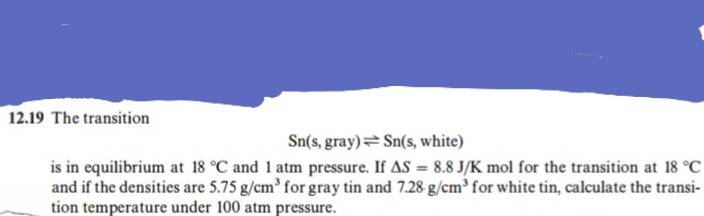
Summary: The transition Sn(s, gray) ⇌ Sn(s, white) is in equilibrium at 18°C and 1 atm pressure. If ΔS = 8.811K mol for the transition at 18°C and if the densities are 5.75 g/cm3 for gray tin and 7.28 g/cm3 for white tin, calculate the transition temperature under 100 atm pressure
20190806_170226.jpg
The transition Sn(s, gray) ⇌ Sn(s, white) is in equilibrium at 18°C and 1 atm pressure. If ΔS = 8.811K mol for the transition at 18°C and if the densities are 5.75 g/cm3 for gray tin and 7.28 g/cm3 for white tin, calculate the transition temperature under 100 atm pressure
 
Physics news on Phys.org
You need to show an attempt of your own before receiving help, this is a forum rule.

There's no point repeating the same paragraph 3 times. And if you're going to, copy it right. ΔS = 8.8 J/K mol, not 8.811K mol.

What quantities determine the transition temperature? How might they vary with pressure?
 
  • Like
Likes   Reactions: berkeman
dp/dT = ΔS /ΔV
dp/dT = ΔS /ΔV

(P2-P1)/(T2-T1) = ΔS/(M/d1-M/d2); where d1 and d2 are densities of gray tin and white tin, M is equal to molecular weight of tin.
P2 = 100 atm ; P1= 1atm T2=? T1= 273+ 18 =291K ;
(100-1)/(T2-291) = 8.811/ (118.71/5.75 - 118.71/ 7.28)
 
That looks OK in principle; I did it a bit differently, but it should come to the same answer. Just a few points you should be careful about:
- ΔS = 8.8, not 8.811, as I've already said.
- ΔV is Vwhite - Vgrey, make sure you get the sign right.
- Careful with units; what are the units of P? ΔV? ΔS? Be consistent.
 
Can you please tell me your way of solving?
 
I said ΔH = TΔS at equilibrium, so calculated ΔH at 291K and 1 atm.
ΔH = ΔU + PΔV
Assuming ΔU and ΔV don't change with pressure, d(ΔH)/dP = ΔV
So I calculated ΔH at 100 atm, and then T from T = ΔH/ΔS.
(I could not remember a dP/dT formula off the top of my head.)
 
  • Like
Likes   Reactions: Sayantan21
Since they start out at equilibrium, the Gibbs free energy of the grey start out equal the Gibbs free energy of the white. For small changes in pressure and temperature, we have $$dG=-SdT+VdP$$. So, for the changes in pressure and temperature here, we have for the grey $$dG_g=-S_gdT+V_gdP$$and, for the white,$$dG_w=-S_wdT+V_wdP$$But to maintain equilibrium, these changes must be equal. Therefore, $$\frac{dT}{dP}=\frac{V_w-V_g}{S_w-S_g}=\frac{\Delta V}{\Delta S}$$Of course, specific volume is the reciprocal of density. And, of course, this calculation must be done using consistent units.
 

Similar threads

  • · Replies 3 ·
Replies
3
Views
3K
  • · Replies 1 ·
Replies
1
Views
2K
  • · Replies 10 ·
Replies
10
Views
14K
Replies
6
Views
4K
  • · Replies 10 ·
Replies
10
Views
2K
Replies
8
Views
3K
Replies
1
Views
3K
Replies
16
Views
2K
  • · Replies 1 ·
Replies
1
Views
2K
Replies
2
Views
2K