How to derive the frequency for two body oscillatory motion

Click For Summary
SUMMARY

The discussion focuses on deriving the frequency of two-body oscillatory motion using Hooke's Law and Newton's Second Law. Participants clarify the relationship between the positions of two masses (x1 and x2) and the spring's equilibrium length (l). The correct expressions for the forces acting on the masses are established as m1 and m2 experience forces proportional to the displacement from equilibrium, leading to the equations of motion: δx1 = -k(x1 - x2 + l) and δx2 = -k(x2 - x1 - l). The system oscillates as the forces act in opposite directions, confirming the dynamics of the two-body system.

PREREQUISITES
  • Understanding of Hooke's Law (F = -kΔx)
  • Basic knowledge of Newton's Second Law (F = ma)
  • Familiarity with oscillatory motion concepts
  • Ability to manipulate algebraic equations involving forces and displacements
NEXT STEPS
  • Study the derivation of oscillation frequency for coupled oscillators
  • Explore the concept of effective mass in oscillatory systems
  • Learn about energy conservation in spring-mass systems
  • Investigate the effects of damping on oscillatory motion
USEFUL FOR

Physics students, mechanical engineers, and anyone interested in understanding the dynamics of oscillatory systems and spring mechanics.

Tony Hau
Messages
107
Reaction score
30
Homework Statement
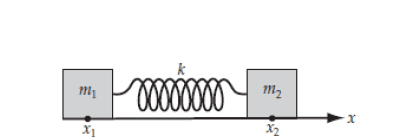
Two masses 𝑚1 = 100g and 𝑚2 = 200g slide freely in a horizontal frictionless track and are
connected by a spring whose force constant is 𝑘 = 0.5 N/m. Find the frequency of the
oscillatory motion of the system. [Hint: write down the equation of motion of each mass in
the center of mass frame]
Relevant Equations
m2(x2) = -kΔ(x2)
m1(x1)=-kΔ(x1)
Here is the diagram of the problem:
1585905555897.png

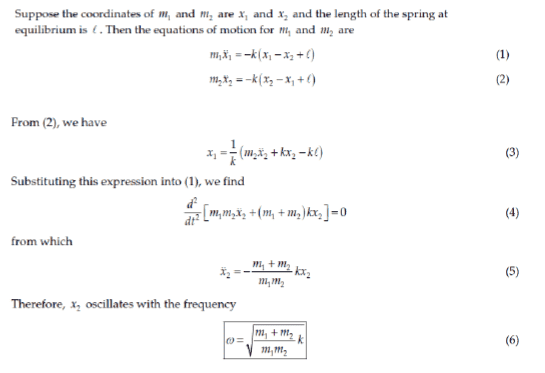
and here is the answer of the question:
1585905586400.png

What I don't understand is equation 1 and 2.
The Hook's law states that F = -k(change in x)
Why the change in x1 equals to x1-x2+l? x1-x2 equals to the length of the compressed spring. I cannot convince myself that the length of the compressed spring plus the length of the uncompressed spring equals to the change in x1.
 

Attachments

  • 1585905472581.png
    1585905472581.png
    3.5 KB · Views: 220
Physics news on Phys.org
Tony Hau said:
x1-x2 equals to the length of the compressed spring
Doesn't look like that !
 
Tony Hau said:
Hook's law states that F = -k(change in x)
Only if someone tells us what ##x## is !
 
Tony Hau said:
x1-x2 equals to the length of the compressed spring.

x1 and x2 are the positions of the 2 masses as a function of time. These are changing all the time. That isn’t the length of the compressed spring (or the uncompressed spring) that is the length of the spring at any moment. (The whole solution takes the masses as having no width, but that is fine as any width just gets incorporated into l and you can call l the positions when the spring is at equilibrium rather than the length of the spring at equilibrium)

The length of the spring at any moment x1-x2 (or with just a change of sign x2-x1) minus the equilibrium length l is how far the spring is stretched or compressed at any moment. This is the x that goes into Hooke’s law. Equations 1 and 2 are simply Hooke’s law with the appropriate sign change for which direction each mass is being pulled.
 
  • Like
Likes   Reactions: Tony Hau
BvU said:
Only if someone tells us what ##x## is !
I am confused, can you explain more?
 
Cutter Ketch said:
x1 and x2 are the positions of the 2 masses as a function of time. These are changing all the time. That isn’t the length of the compressed spring (or the uncompressed spring) that is the length of the spring at any moment. (The whole solution takes the masses as having no width, but that is fine as any width just gets incorporated into l and you can call l the positions when the spring is at equilibrium rather than the length of the spring at equilibrium)

The length of the spring at any moment x1-x2 (or with just a change of sign x2-x1) minus the equilibrium length l is how far the spring is stretched or compressed at any moment. This is the x that goes into Hooke’s law. Equations 1 and 2 are simply Hooke’s law with the appropriate sign change for which direction each mass is being pulled.
I got your point. But how should I understand the Hooke's Law in this case? I thought that the change in x in the Hooke' Law equals to 0.5l-(x-the x of centre of mass). Basically what I think is that the x of the centre of mass is not changing. So we find the distance from x to the centre of mass. Then we minus it with the distance from the unstreched end to the centre of mass. Here we get the change in x.
 
Tony Hau said:
I am confused, can you explain more?
Apparently. Your "change in x" in "F = -k(change in x) " requires definition. Something like "length minus length in the state with F = 0".

In the picture ##x_2 > x_1## clearly. So ##x_1-x_2 < 0## and the spring is relaxed (F=0) when ##x_1-x_2 + {\mathcal l} = 0## .

With ##x_1-x_2 + {\mathcal l} < 0##, for example when ##x_1## stays the same and ##x_2## is increased, the spring will pull to the right on ##m_1##, i.e. ##\ddot x_1>0##.

Conclusion: ##m_1\ddot x = -k(x_1-x_2 + {\mathcal l} )## is the correct expression for ##m_1##.

@Tony Hau: Can you now do the same reasoning for to get an expression for ##m_2## ?

Note: there is a typo in (2) -- and (3) is correct -- I now understand your confusion.
 
  • Like
Likes   Reactions: Tony Hau
Tony Hau said:
I got your point. But how should I understand the Hooke's Law in this case? I thought that the change in x in the Hooke' Law equals to 0.5l-(x-the x of centre of mass). Basically what I think is that the x of the centre of mass is not changing. So we find the distance from x to the centre of mass. Then we minus it with the distance from the unstreched end to the centre of mass. Here we get the change in x.

By Hooke’s law it requires a force = -kx to stretch a spring by x. However that only describes the force at one end. We usually think of the spring as being attached to a wall or something. But really that is also the force at the other end of the spring. You can’t stretch a spring by applying a force to only one end! So the Hooke’s law force has to be applied at both ends of the spring. In this case there are masses at both ends. They must experience equal and opposite forces and the force they experience is kx. If the spring is stretched x one feels a force of kx toward the left and the other feels a force of kx to the right.
 
  • Like
Likes   Reactions: Tony Hau
Cutter Ketch said:
By Hooke’s law it requires a force = -kx to stretch a spring by x. However that only describes the force at one end. We usually think of the spring as being attached to a wall or something. But really that is also the force at the other end of the spring. You can’t stretch a spring by applying a force to only one end! So the Hooke’s law force has to be applied at both ends of the spring. In this case there are masses at both ends. They must experience equal and opposite forces and the force they experience is kx. If the spring is stretched x one feels a force of kx toward the left and the other feels a force of kx to the right.
Thanks for you reply. It is much clearer than what is written on textbooks.
 
  • #10
BvU said:
Apparently. Your "change in x" in "F = -k(change in x) " requires definition. Something like "length minus length in the state with F = 0".

In the picture ##x_2 > x_1## clearly. So ##x_1-x_2 < 0## and the spring is relaxed (F=0) when ##x_1-x_2 + {\mathcal l} = 0## .

With ##x_1-x_2 + {\mathcal l} < 0##, for example when ##x_1## stays the same and ##x_2## is increased, the spring will pull to the right on ##m_1##, i.e. ##\ddot x_1>0##.

Conclusion: ##m_1\ddot x = -k(x_1-x_2 + {\mathcal l} )## is the correct expression for ##m_1##.

@Tony Hau: Can you now do the same reasoning for to get an expression for ##m_2## ?

Note: there is a typo in (2) -- and (3) is correct -- I now understand your confusion.
Is it ##m_2\ddot x = -k(x_2-x_1 - {\mathcal l} )## for the equation 3?
It is because when x2 -x1-l<0, the spring is compressed and the acceleration of mass 2 is positive,directed towards the right.
 
Last edited:
  • #11
One last question: I am confused with equation 5. What does that x2 on the right hand side mean? x2 is not the difference between the unstretched and stretched spring in this equation. It is simply the coordinate of x2. In that case, x2 is always positive as shown in the diagram. That means that the acceleration of x2 is always negative, directed towards the left. It doesn't make sense.
 
  • #12
Tony Hau said:
One last question: I am confused with equation 5. What does that x2 on the right hand side mean? x2 is not the difference between the unstretched and stretched spring in this equation. It is simply the coordinate of x2. In that case, x2 is always positive as shown in the diagram. That means that the acceleration of x2 is always negative, directed towards the left. It doesn't make sense.
Equation 5 is obtained from equation 4 by two integrations. Each should introduce an unknown constant to be resolved using boundary conditions. The author seems to have forgotten this in the second integration.
Have a go at doing it correctly.
 
  • #13
Tony Hau said:
Is it ##m_2\ddot x = -k(x_2-x_1 - \ell )## for the equation 3?
It is because when x2 -x1-l<0, the spring is compressed and the acceleration of mass 2 is positive,directed towards the right.
Actually that's the corrected version of Eq. (2).
 
  • Like
Likes   Reactions: Tony Hau
  • #14
The masses are connected to the ends of the same spring, so they ave subjected to forces of the same magnitude and opposite direction. x1 is the position of m1 and x2 is that of m2. The length of the spring os x2-x1, and the magnitude of the spring force is F=k(x2-x1-Lo). When the spring is stretched, this force pulls both masses towards the CM, and it pushes them apart, when the spring is compressed.
1585985015374.png
If m1 moves to the right, the spring pushes it backward, and pushes m2 forward., to the positive x direction. . When m2 moves to the right, the spring pulls m1 to the right and m2 to the left.

According to Newton's Second Law,
##\ddot x_1=\frac{k}{m_1}(x_2-x_1-L_o)## (1)
##\ddot x_2= -\frac{k}{m_2}(x_2-x_1-L_o)## (2)
Subtract (1) from(2):
##\ddot x_2-\ddot x_1=-k(\frac{1}{m_1}+\frac{1}{m_2})(x_2-x_1-L_o)## (3)
Introduce the variable u=x2-x1-Lo, ,the change of length of the spring,.
 
  • Like
Likes   Reactions: Delta2, Tony Hau and SammyS
  • #15
Tony Hau said:
In that case, x2 is always positive as shown in the diagram. That means that the acceleration of x2 is always negative, directed towards the left. It doesn't make sense.

Yes the right hand mass stays on the right hand side, but it moves left and right as the spring vibrates. It starts out toward the left. Eventually it reaches the equilibrium point of the spring. However, by that point it has accumulated momentum. It moves through the equilibrium point and starts to compress the spring. Now the spring is pushing to the right. The force and the acceleration are now to the right. The force decelerates the mass until it stops and turns around. However by that time the spring is compressed, so it starts accelerating the mass back to the right. And you can see that the system oscillates.
 
  • Like
Likes   Reactions: Tony Hau
  • #16
Cutter Ketch said:
Yes the right hand mass stays on the right hand side, but it moves left and right as the spring vibrates. It starts out toward the left. Eventually it reaches the equilibrium point of the spring. However, by that point it has accumulated momentum. It moves through the equilibrium point and starts to compress the spring. Now the spring is pushing to the right. The force and the acceleration are now to the right. The force decelerates the mass until it stops and turns around. However by that time the spring is compressed, so it starts accelerating the mass back to the right. And you can see that the system oscillates.
Crystal clear, thanks!
 
  • #17
ehild said:
The masses are connected to the ends of the same spring, so they ave subjected to forces of the same magnitude and opposite direction. x1 is the position of m1 and x2 is that of m2. The length of the spring os x2-x1, and the magnitude of the spring force is F=k(x2-x1-Lo). When the spring is stretched, this force pulls both masses towards the CM, and it pushes them apart, when the spring is compressed.
View attachment 259956If m1 moves to the right, the spring pushes it backward, and pushes m2 forward., to the positive x direction. . When m2 moves to the right, the spring pulls m1 to the right and m2 to the left.

According to Newton's Second Law,
##\ddot x_1=\frac{k}{m_1}(x_2-x_1-L_o)## (1)
##\ddot x_2= -\frac{k}{m_2}(x_2-x_1-L_o)## (2)
Subtract (1) from(2):
##\ddot x_2-\ddot x_1=-k(\frac{1}{m_1}+\frac{1}{m_2})(x_2-x_1-L_o)## (3)
Introduce the variable u=x2-x1-Lo, ,the change of length of the spring,.
The spring constant in this case becomes k(m1+m2) and the mass becomes m1*m2.
 

Attachments

  • 2020-04-05 12.17.39.jpg
    2020-04-05 12.17.39.jpg
    20.8 KB · Views: 210
  • #18
Tony Hau said:
The spring constant in this case becomes k(m1+m2) and the mass becomes m1*m2.
It's true that, ##\ \ k\left(\dfrac1{m_1}+\dfrac1{m_2}\right) = \dfrac{k\left(m_1+m_2\right)}{m_1 m_2}##, and comparing that with ##\dfrac k m ##, your conclusion looks reasonable ... except for the units. A spring constant should not have units of N⋅kg/m and mass should not have units of kg2.

Instead, think of that as ##\displaystyle \frac{k}{\left(\dfrac{m_1 m_2}{m_1+m_2}\right)} \ \ .##

OR ... Using m for either of the masses and M for the other you can think of this system as having an altered mass with the given spring constant or as an altered spring constant with either mass. Rewrite your expression (for ω2 ) as any of the following.

##\displaystyle \dfrac{k}{m\left(\dfrac{ M}{m+M}\right)} \ \ ##

##\displaystyle \dfrac {k \left( \dfrac{ m+M}{M } \right) }{m}\ \ ##
 
  • Like
Likes   Reactions: Tony Hau

Similar threads

Replies
3
Views
4K
  • · Replies 4 ·
Replies
4
Views
3K
  • · Replies 16 ·
Replies
16
Views
3K
  • · Replies 10 ·
Replies
10
Views
2K
  • · Replies 5 ·
Replies
5
Views
3K
Replies
6
Views
3K
  • · Replies 11 ·
Replies
11
Views
2K
  • · Replies 1 ·
Replies
1
Views
1K
  • · Replies 11 ·
Replies
11
Views
3K
  • · Replies 3 ·
Replies
3
Views
3K