Discussion Overview
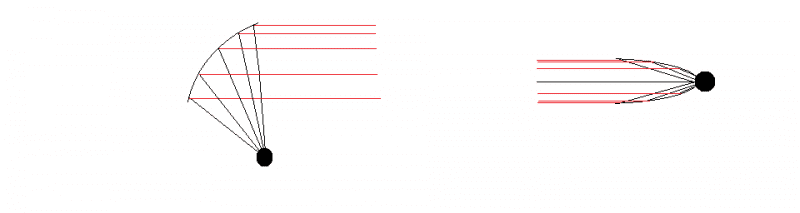
The discussion revolves around optimizing sound reflection using different types of reflectors. Participants explore the theoretical and practical aspects of sound wave behavior, including the effectiveness of various reflector shapes and materials, as well as the implications for sound range and amplitude. The conversation includes considerations of design and functionality in a near-field ultrasonic measurement context.
Discussion Character
- Exploratory
- Technical explanation
- Debate/contested
- Mathematical reasoning
Main Points Raised
- One participant describes two types of sound reflectors and asks which would be more effective in producing parallel sound waves.
- Some participants suggest that both reflectors could theoretically work equally well, depending on their design.
- There is a discussion about the effects of diffraction on sound waves and how the width of the reflector's aperture influences beam spread.
- Participants raise questions about the scale of the setup and the wavelength involved, emphasizing the need for clearer specifications.
- Some propose that using an offset paraboloid could enhance system gain, while others express concerns about the practical challenges of constructing such shapes.
- There is mention of a formula for estimating the directivity of a reflector, though it is noted that this is a rough estimate and other factors may influence the outcome.
- One participant questions the feasibility of using the same transducer for both transmission and reception, suggesting that separate reflectors might be necessary.
- Another participant inquires about the possibility of using a cone-shaped reflector and seeks clarification on its design requirements.
Areas of Agreement / Disagreement
Participants express a range of views on the effectiveness of different reflector designs, with no clear consensus on which approach is superior. Some agree on theoretical principles, while practical implementation remains contested.
Contextual Notes
Limitations include a lack of specific details regarding the scale of the setup and the wavelengths involved, which may affect the applicability of theoretical models discussed. Additionally, the conversation reflects uncertainty about the practical construction of proposed reflector shapes.
Who May Find This Useful
This discussion may be of interest to those involved in acoustics, ultrasonic measurement systems, and sound engineering, particularly in contexts requiring precise sound wave manipulation.