How to solve for EMF and internal resistance in a circuit?

Click For Summary

Homework Help Overview

The discussion revolves around calculating the electromotive force (EMF) and internal resistance in a circuit involving a battery and resistors. Participants are exploring the relationships between voltage, current, and resistance in both open and closed circuit scenarios.

Discussion Character

  • Exploratory, Conceptual clarification, Mathematical reasoning, Problem interpretation, Assumption checking

Approaches and Questions Raised

  • Participants discuss their attempts to calculate voltage across resistors in different circuit configurations and express confusion about the application of the equation V=E-ir. Questions arise regarding whether to consider total resistance or just internal resistance in the calculations.

Discussion Status

Some participants are attempting to set up equations based on their voltage calculations, while others are questioning the validity of their approaches and results. There is a mix of interpretations regarding the current values used in the equations, and some guidance has been offered on how to equate the voltage equations to find unknowns.

Contextual Notes

Participants note the challenge of not having complete information about the internal resistance of the battery and the implications this has on their calculations. There is also mention of a quiz approaching, adding urgency to the discussion.

np115
Messages
5
Reaction score
3
Homework Statement
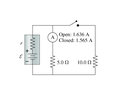
What is the emf of the battery in the figure(Figure 1)?
What is the internal resistance of the battery in the figure?
Relevant Equations
V=iR
V=E-ir
I know the answers are 9 V and .5 ohms but I have no idea how to get there. Originally I solved for Delta V in the open circuit through (1.636)(5) which gave me 8.18V. Then, I solved for Delta V in the closed circuit through (1.565)(1/((1/5)+(1/10)) which gave me 5.51 V. I used these voltages to set up the equations using V=E-ir. *this is something that really confuses me! is this equation referring to the total resistance in the circuit or just the internal resistance in the battery? If it is total, how would I put this into the equation?* Using that equation I got 8.18 V = E -(1.636 (r+5)) and 5.21 = E - (1.565(r+3.33)). Then, I used elimination to solve but got really confused because things do not add up. I have a quiz tomorrow over this and I have NO IDEA WHAT I"M DOING! Really appreciate some help!
 

Attachments

  • EMopen:closed.jpeg
    EMopen:closed.jpeg
    6 KB · Views: 181
Physics news on Phys.org
np115 said:
I know the answers are 9 V and .5 ohms but I have no idea how to get there. Originally I solved for Delta V in the open circuit through (1.636)(5) which gave me 8.18V.
How did you do this? You don't know R of the open circuit because you don't know r of the battery. So it's V=IR=1.565*(5+r), which can't yet be solved.
Similar situation for the closed circuit.

Try setting up your two voltage equations and making them equal to each other. That gets rid of V, leaving you with two equations and 1 unknown variable, which is solvable.
 
wait why would it be 1.565(r+5)? that's the current value for the open circuit. So shouldn't it be 1.636(r+5)? and when I solved that by setting both equations equal to each other, i got r=-41.8 which doesn't make any sense. And when I tried solving it with your equations, I got r=33.45.
 
Could you solve for the two currents if instead you were told the battery V and r and not the two currents?
 
I'm sure you could since the change in voltage for both circuits would still be the same so if you put both equations equal to each other, you could solve for i.
 
np115 said:
ait why would it be 1.565(r+5)? that's the current value for the open circuit. So shouldn't it be 1.636(r+5)?
My apologies, I mixed up the values and for some reason thought the ammeter was located on the top wire before it branched off to the 5 ohm resistor. Getting only 1 current value for the 2-branch circuit makes things much more difficult. It's been a while since I did basic circuits. Let me give it some thought and get back to you.
 
Ok, here we go.
First, find all the info you can for your first circuit (when switch is open). You know the current, so you know the voltage across the resistor.

Now, do the same thing for the circuit when the switch is closed. Notice that when the switch is closed, you have ##R_5## and ##R_{10}## in parallel, and both are in series with ##R_1##, the battery's resistor. Remember that parallel resistors have something in common (hint: it starts with a V). We want the current through both branches (we have one already).

Once you have the current through both branches, you know the current through the battery for both circuits (they gave us the current for the first one). Use these, try some KVL and Ohm's law, and if you need more help let me know.
 
Last edited:
I got it, thank you guys so much for your help!
 
  • Like
Likes   Reactions: Drakkith, berkeman and hutchphd
np115 said:
I got it, thank you guys so much for your help!
Np. Sorry for the confusion at first. My EE skills are very rusty.
 

Similar threads

  • · Replies 2 ·
Replies
2
Views
2K
  • · Replies 6 ·
Replies
6
Views
2K
  • · Replies 14 ·
Replies
14
Views
3K
  • · Replies 4 ·
Replies
4
Views
3K
  • · Replies 4 ·
Replies
4
Views
2K
  • · Replies 7 ·
Replies
7
Views
2K
  • · Replies 6 ·
Replies
6
Views
3K
  • · Replies 8 ·
Replies
8
Views
13K
  • · Replies 4 ·
Replies
4
Views
3K
  • · Replies 24 ·
Replies
24
Views
5K