I bet my friend I could design a circuit with no background

Click For Summary
SUMMARY

The forum discussion centers around a business student who bets he can design a circuit for a Biomedical Engineering class project within two weeks, despite having no prior experience in science or circuit design. Participants suggest starting with understanding the problem statement and researching basic circuit concepts. Key recommendations include using operational amplifiers (op-amps) for signal amplification and detection, as well as consulting component datasheets. The consensus is that while the challenge is daunting, it is not impossible with the right resources and guidance.

PREREQUISITES
  • Basic understanding of circuit components, particularly operational amplifiers (op-amps).
  • Familiarity with datasheets for electronic components.
  • Knowledge of signal amplification and detection techniques.
  • Ability to interpret and paraphrase technical problem statements.
NEXT STEPS
  • Research operational amplifier (op-amp) summing circuits and their applications.
  • Learn about photodiodes and their role in light detection.
  • Explore resources like Instructables for step-by-step circuit design guides.
  • Understand the principles of audio signal modulation for laser transmission.
USEFUL FOR

This discussion is beneficial for aspiring circuit designers, engineering students, and anyone interested in practical electronics projects, particularly those with limited experience in the field.

jley18
Messages
2
Reaction score
0
Hey everyone! This is my first post here so take it easy on me!

Before I get into the circuit I'll give a little backstory here. I'm a business student at a US college right now and I have a good friend who is a Biomedical engineering student. We were arguing about whether or not I would be able to do what she does in her classes. Being rather impulsive and overconfident, I bet her that I could design the final project from her toughest class in two weeks. That may have been my first mistake, but I consider myself a smart guy and I love a challenge like this one, especially since I've always had an interest in learning about circuits. If I pull it off, she's agreed to take me on an all expenses paid long weekend vacation to wherever I choose so I'm pretty motivated and since it's the summer I have plenty of time on my hands to do it. The rules are that I can use any help that would have been available to her when she was taking the class (so forums, any software, my engineer father etc...) and I must use the materials in the kit from the class and it has to satisfy the rubric with a passing grade

Now onto the technical stuff. Keep in mind I have NO background or experience in much science at all honestly so this stuff may as well be in Chinese to me at this point. I've uploaded the rubric for you guys to check out. I imagine it must seem pretty basic to you as professionals in this field so I'm hoping that some of you may enjoy this story and decide to guide me a little in this endeavor.

Here are my questions so far:
Where should I start? What concepts should I begin by learning that are necessary for this circuit?
What software should I download?
And, in general, if you were in my position what approach would you take in taking on this challenge?
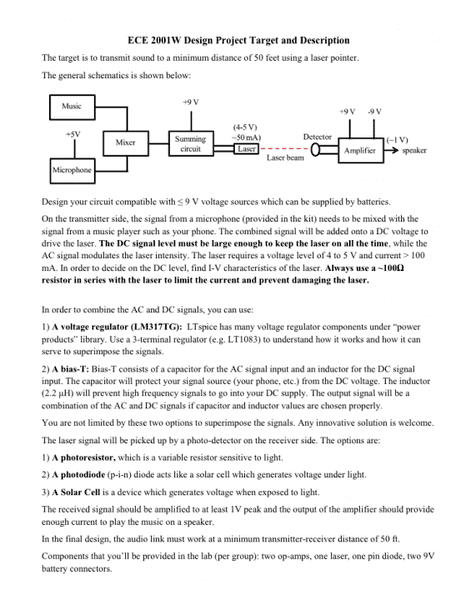
Screen Shot 2016-07-18 at 2.44.05 PM.png
 
Engineering news on Phys.org
Good luck with your challenge! What will you owe, when you lose your bet? Just asking?
 
CalcNerd said:
Good luck with your challenge! What will you owe, when you lose your bet? Just asking?

I have to do her laundry for a month. Pretty one sided bet I know but she's got a heck of a lot more money than I do.

Thanks for the well wishes!
 
I think you should start with the problem statement. Do you understand the significance of every word in every sentence? How the words relate to the diagram?

Perhaps you could paraphrase the entire problem statement in your own words and post it here. We can help by telling you if you got it right.
 
jley18 said:
...but I consider myself a smart guy...
Your first mistake. I know that I know a lot of stuff about a lot of different stuff. But I would never assume I could pull something like that off. From what I can see your bet should be that you can get someone else to do the work for you and come up with the required end result.
Keep in mind I have NO background or experience in much science at all honestly so this stuff may as well be in Chinese to me at this point.
With your understanding based on the above quote I would say that is your only option.
 
Not a very original problem. Try googling send sound with a laser.
 
I did this exact project for a class 20 years ago, except we used a fiber to send the audio rather than a laser pointer. It's actually pretty simple if you know what parts to use and how to design an op-amp amplifier.

Free hint: don't use a solar cell.
 
Do you have any specific questions for us? I'd start with trying to understand and build the receiver side. Clearly, since you are only given a photodiode, you will be using that to detect your laser light. You'll obviously have one op-amp at the receiver and one at the transmitter.

First I would print out the datasheets of your components even if you don't understand them yet.

To give you another vague hint I'll tell you that for your transmitter you need to amplify(?) and shift up your AC audio signal into an appropriate DC signal to power your laser. You can do that easily by adding your audio signal to an appropriate voltage using the first op amp and the right resistors. Check out schematics of an op amp "summing" circuit online.

Then you'll need to detect the laser light with your PD. You can do your own research on how to do this. (hint: reverse bias the photodiode and then measure the voltage generated across a resistor placed in series with the PD since the PD produces a reverse current that is roughly proportional to the light intensity) You'll use the second op amp to kinda do the opposite of the first op amp (shift down your DC signal into an AC signal that can drive a speaker). Hope that helps.

Mods, I hope I haven't given too many hints.
 
Looks like @jley18 has gone quiet. Probably busy doing laundry... :smile:
 
  • Like
Likes   Reactions: CalcNerd, anorlunda, leright and 1 other person
  • #10
Apply business skills- visit different sources until you find a step-by-step solution (Instructables). Otherwise, stick to business... unless you want to hurt your brain
 
  • Like
Likes   Reactions: leright
  • #11
The guy's gone quiet so he probably lost the bet. Sorry but most business majors are not equipped to jump into circuit design like that. If they were that interested they would not be in the business school, they'd be in the engineering school. I would say circuit design is one of the harder more time consuming things to learn, not something one can learn in a month without an unusually high aptitude.
 
Last edited by a moderator:
  • #12
Kind of like playing the state lottery. The state is betting millions of dollars against my one dollar that I won't win. The state has taken lots of my money over the years. Every bet is a sucker bet. But a dollar ain't as bad as a month's labor. I guess this is comparable to betting dollars to donuts. Not an even bet, but a bad one, non-the-less.
.
As a business major, perhaps he will find a flaw in the contract?
 
  • #13
CalcNerd said:
.
As a business major, perhaps he will find a flaw in the contract?

No, that would be the lawyer. The business major's job is to show some powerpoints describing synergy and then lay some people off.
 

Similar threads

  • · Replies 6 ·
Replies
6
Views
2K
  • · Replies 6 ·
Replies
6
Views
3K
  • · Replies 11 ·
Replies
11
Views
2K
  • · Replies 22 ·
Replies
22
Views
5K
  • · Replies 3 ·
Replies
3
Views
2K
  • · Replies 11 ·
Replies
11
Views
4K
  • · Replies 7 ·
Replies
7
Views
2K
  • · Replies 9 ·
Replies
9
Views
5K
Replies
12
Views
3K
  • · Replies 10 ·
Replies
10
Views
2K