Discussion Overview
The discussion revolves around troubleshooting a homemade DC motor for a school project. Participants explore various aspects of the motor's construction, including the materials used for the armature, commutator, and brushes, as well as the arrangement of magnets and the electrical connections. The focus is on identifying issues that prevent the rotor from functioning properly.
Discussion Character
- Exploratory
- Technical explanation
- Debate/contested
- Homework-related
Main Points Raised
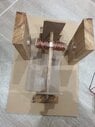
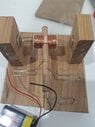
- One participant describes their motor's construction using copper wire, wood, neodymium magnets, and paper clips, noting that the rotor does not move despite current passing through the wires.
- Another participant suggests that the rotor should be a single coil with consistent helicity and that the stator magnets should be arranged in a specific orientation.
- There is a discussion about the necessity of using an iron armature instead of a wooden one, with some participants asserting that an iron armature is essential for proper function.
- Concerns are raised about the friction in the bearings and suggestions are made to either use an iron armature or modify the wooden bearings to reduce friction.
- Participants discuss the importance of ensuring the correct polarity of the magnets and the need to reduce the gap between the armature and the magnets for better performance.
- One participant reports a small force when the motor is jump-started but notes that it does not continue to spin on its own.
- There are suggestions to check the orientation of the magnets and to use a compass to verify their polarity.
Areas of Agreement / Disagreement
Participants express multiple competing views regarding the materials and construction methods for the motor. There is no consensus on the exact cause of the motor's failure to operate effectively, and various suggestions are offered without agreement on a single solution.
Contextual Notes
Participants mention various construction details, such as the need for soldering connections and the potential impact of the bearings on motor performance. There are unresolved questions about the effectiveness of the current setup and the necessity of specific materials.
Who May Find This Useful
This discussion may be useful for students and hobbyists interested in building or troubleshooting DC motors, particularly in educational settings or DIY projects.