Ideal gas law- Find the pressure

Click For Summary
SUMMARY

The forum discussion centers on the application of the Ideal Gas Law, specifically addressing the confusion surrounding the pressure variable during calculations. Participants clarify that the pressure variable, denoted as ##p##, is not constant and must be determined based on the volume changes in the equation. The discussion highlights a common mistake in algebraic manipulation, where participants mistakenly equate the final pressure to ##6pV## instead of correctly simplifying it to ##3pV##. The importance of consistent notation, particularly the use of lowercase ##p## for pressure, is also emphasized.

PREREQUISITES
  • Understanding of the Ideal Gas Law (PV=nRT)
  • Basic algebraic manipulation skills
  • Familiarity with pressure and volume concepts in thermodynamics
  • Knowledge of notation conventions in physics
NEXT STEPS
  • Review the Ideal Gas Law and its applications in various scenarios
  • Practice algebraic manipulation of equations involving pressure and volume
  • Study common mistakes in thermodynamic calculations
  • Learn about notation standards in scientific equations
USEFUL FOR

Students studying physics or chemistry, educators teaching thermodynamics, and anyone involved in solving gas law problems.

Woopa
Messages
20
Reaction score
4
Homework Statement
A container of an ideal gas that is isolated from its surroundings is divided into two parts. One part has double the volume of the other. The pressure in each part is p and the temperature is the same. The partition is removed. What is the pressure in the container now?
Relevant Equations
PV=nRT
Question:
1645529215001.png

Answer:
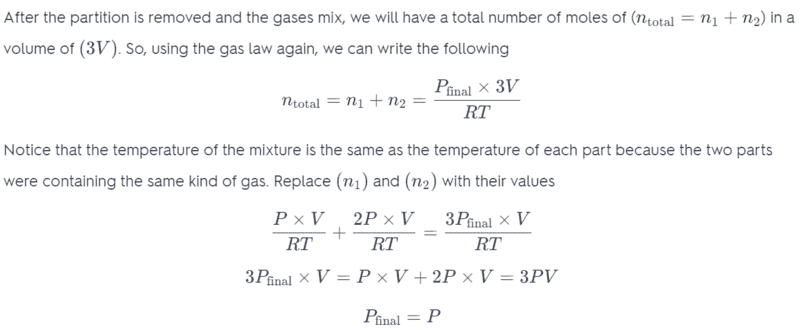
1645529385444.png

In the third last line of working, I do not understand why the pressure variable is changing? Shouldn't pressure remain constant and only the Volume change?
 
Physics news on Phys.org
Woopa said:
In the third last line of working, I do not understand why the pressure variable is changing? Shouldn't pressure remain constant and only the Volume change?
Where do you see anything changing ? Strictly speaking ##p_{\rm\, final} ## is unknown and to be determined.
Then the outcome is ##p_{\rm \, final} = p##

Comment: they use capital ##P## in the solution, which is undesirable: once lower case ##p## , always lower case ##p##

##\ ##
 
The 2 and 3 numbers are for V rather than for p.
 
Lnewqban said:
The 2 and 3 numbers are for V rather than for p.
Do you mean it is a typo/ error in the worked solution?
 
V + 2V = 3V
 
  • Like
Likes   Reactions: Woopa
Lnewqban said:
V + 2V = 3V
Ah yes that make sense I can see now the numbers are actually for V, the way they've written out the equation has confused me.

However I am still arriving at the final answer P=2P. I must be making a mistake in my algebra. I will post my working in a moment
 
1645540153027.jpg


Where is my mistake?
 
##p⋅V/RT+p⋅(2V)/RT=p⋅(V+2V)/RT##
 
  • Like
Likes   Reactions: Lnewqban and Woopa
##pV+2pV=p(V+2V)=3pV##

You are saying that it's equal to ##6pV##. That's your error.
 
  • Like
Likes   Reactions: Woopa

Similar threads

  • · Replies 2 ·
Replies
2
Views
3K
Replies
4
Views
2K
  • · Replies 10 ·
Replies
10
Views
3K
  • · Replies 2 ·
Replies
2
Views
2K
  • · Replies 33 ·
2
Replies
33
Views
2K
  • · Replies 4 ·
Replies
4
Views
3K
  • · Replies 9 ·
Replies
9
Views
2K
  • · Replies 1 ·
Replies
1
Views
729
  • · Replies 8 ·
Replies
8
Views
2K
  • · Replies 3 ·
Replies
3
Views
10K