Image of a Convex Lens Cut in Half Horizontally

Click For Summary
SUMMARY

When a convex lens is cut in half horizontally, the bottom half can still form an image despite the removal of the top half. The image is produced by rays passing through the remaining part of the lens, and while cutting the lens reduces the number of rays contributing to the image, it does not alter the image's location. The principal rays are useful for quick image location but are not the only rays that contribute to image formation.

PREREQUISITES
  • Understanding of basic optics principles, particularly lens behavior.
  • Familiarity with ray diagrams and how they illustrate light paths through lenses.
  • Knowledge of focal points and optical centers in convex lenses.
  • Ability to interpret and analyze diagrams related to lens optics.
NEXT STEPS
  • Study the principles of ray optics, focusing on how light interacts with convex lenses.
  • Learn about the effects of lens modifications on image formation, including partial obstructions.
  • Explore the concept of image brightness and how it relates to the number of rays passing through a lens.
  • Investigate the mathematical equations governing lens optics, such as the lens maker's equation.
USEFUL FOR

Students of physics, educators teaching optics, and anyone interested in understanding the behavior of lenses in optical systems.

LovePhys
Messages
57
Reaction score
0
Hello everyone,

A friend of mine came up with this question in class and I really do not have a good answer.

Suppose you have a convex lens that has been cut in half horizontally and the top half removed.
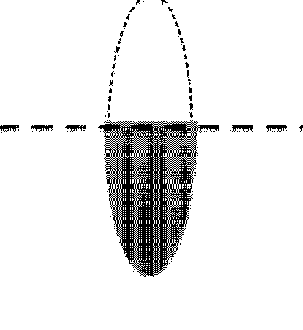
attachment.php?attachmentid=58939&stc=1&d=1369227004.png

The question is: Will the bottom half of the lens still form an image?
I really have no idea of how approach this problem. Normally, suppose that an object is placed on the principal axis, then one of the three special rays is supposed to go through the optical center of the lens. But in this case, the top half has been removed, would that have an impact on the optical center?

Any help would be greatly appreciated.
Thank you,
LovePhys
 

Attachments

  • lens.png
    lens.png
    1.4 KB · Views: 1,686
Science news on Phys.org
The image is formed by rays that pass through all parts of the lens. Cutting away half the lens (or equivalently, blocking half of it with a piece of cardboard) blocks half the rays, but the other half still go through and reach the image, at the same location.

The principal rays are special only for us humans, because they're easy to trace through the focal points so we can use them to locate the image quickly.

In the diagram below, the principal rays are in red. The other rays in black each contribute equally to the image.

attachment.php?attachmentid=58941&stc=1&d=1369231578.gif
 

Attachments

  • rays.gif
    rays.gif
    21 KB · Views: 1,627
Last edited:
  • Like
Likes   Reactions: 1 person
Thats right. Reducing the number of rays will only cause the image to dim.
 
@jtbell and physwizard: I understand it now. Thank you very much!
 
That's a nice way of thinking about the problem, jtbell! :)
 

Similar threads

  • · Replies 4 ·
Replies
4
Views
2K
  • · Replies 40 ·
2
Replies
40
Views
6K
  • · Replies 58 ·
2
Replies
58
Views
8K
  • · Replies 4 ·
Replies
4
Views
2K
  • · Replies 24 ·
Replies
24
Views
3K
  • · Replies 17 ·
Replies
17
Views
3K
  • · Replies 17 ·
Replies
17
Views
2K
  • · Replies 8 ·
Replies
8
Views
3K
  • · Replies 2 ·
Replies
2
Views
2K
  • · Replies 15 ·
Replies
15
Views
2K