Improving Torque Data Signal with Digital Filtering

Click For Summary
SUMMARY

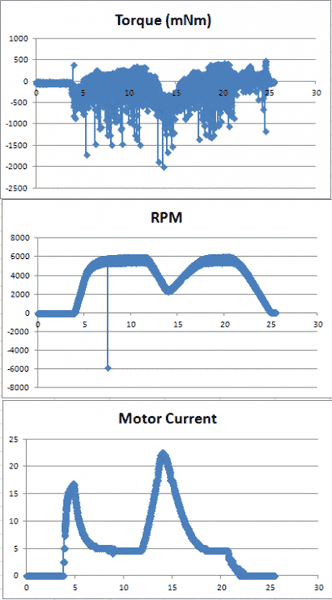
The discussion focuses on improving the quality of torque signal measurements from a three-phase brushless motor using digital filtering techniques. The user experiences noisy torque signals during data acquisition, particularly after applying a brake to the motor. A suggested solution involves applying a digital filter using the z-transform, specifically the filter defined by H(z) = 0.01z² / ((z - 0.9)(z - 0.9)), which can enhance the clarity of the torque signal to match the RPM signal quality.

PREREQUISITES
  • Understanding of three-phase brushless motor operation
  • Familiarity with torque sensor measurements
  • Knowledge of digital signal processing concepts
  • Experience with z-transform and digital filtering techniques
NEXT STEPS
  • Research digital filtering techniques in signal processing
  • Learn about the z-transform and its applications in filtering
  • Explore advanced filtering methods for noise reduction in torque signals
  • Investigate data acquisition systems for brushless motors
USEFUL FOR

Engineers and technicians working with brushless motors, signal processing specialists, and anyone involved in improving measurement accuracy in torque and speed applications.

Trainee28
Messages
9
Reaction score
0
Hello,

I have a three phase brushless motor and was trying to measure its torque and speed using a torque sensor. The motor will first go to its maximum speed which is about 6000RPM, then I applied a brake to decrease its velocity. Here is what I get as a result of data acquisition :
upload_2015-7-3_11-41-17.png

The problem is that the torque signal looks kinda mess up. I wish to get a signal as nice as the RPM. Does anyone know how can this be done? Some kind of signal processing steps?

Please help me.
 

Attachments

  • upload_2015-7-3_11-34-59.png
    upload_2015-7-3_11-34-59.png
    17.9 KB · Views: 555
Engineering news on Phys.org
It seems that you are measuring the torque after the brake. The curve for the torque does not reflect the curve for the current.
Trainee28 said:
I wish to get a signal as nice as the RPM. Does anyone know how can this be done? Some kind of signal processing steps?
If the data are sampled digitally, you can insert a digital filter ( z-transform ) like for example:

H(z) = 0.01z2 / ( ( z - 0.9 ) ( z - 0.9 ) ) = 0.01z2 / ( z2 - 1.8z + 0.81 )

( The amplification = 0.01 / ( 1 - 0.9 )2 = 1 )

You can put your already sampled data through such a filter and redraw the result.
 
Last edited:

Similar threads

  • · Replies 3 ·
Replies
3
Views
2K
  • · Replies 2 ·
Replies
2
Views
2K
  • · Replies 2 ·
Replies
2
Views
2K
Replies
4
Views
3K
  • · Replies 7 ·
Replies
7
Views
3K
  • · Replies 5 ·
Replies
5
Views
2K
  • · Replies 5 ·
Replies
5
Views
3K
Replies
16
Views
3K
  • · Replies 1 ·
Replies
1
Views
2K
  • · Replies 11 ·
Replies
11
Views
3K