Inducing EMF Through a Coil: Understanding Flux

Click For Summary
The discussion centers on the principles of electromagnetic induction, particularly the induction of electromotive force (EMF) through a coil. It is established that a change in magnetic flux is necessary to induce EMF, and that this change can occur even if the magnetic field is zero at the location of the wires. Participants debate the concept of magnetic flux acting remotely, emphasizing that flux does not need to intersect the wires directly to generate EMF. Experimental examples, such as solenoids and toroidal configurations, illustrate how varying magnetic fields can induce EMF in loops positioned outside the direct magnetic field. The conversation highlights the complexities of electromagnetic theory and the importance of understanding these principles for teaching purposes.
Cardinalmont
Gold Member
Messages
22
Reaction score
4
Thank you for reading my post. I can understand why a change in magnetic flux through a conducting surface would induce an emf, but how does this work when inducing an emf through a coil? How does the flux through the empty space between the wires have an effect on the electrons in the wire itself?

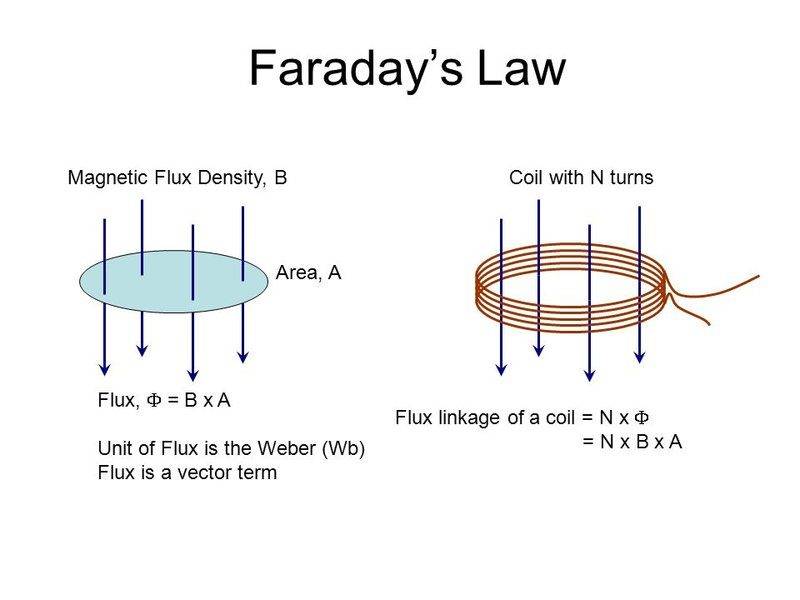
In the image below is a coil with a magnetic field going through the space between the wires but not necessarily through the wires themselves.
Flux Linkage.jpg


Thank you.
 

Attachments

  • Flux Linkage.jpg
    Flux Linkage.jpg
    28.9 KB · Views: 13,244
Physics news on Phys.org
If there is a magnetic field inside the coil, but the magnetic field where the wires are is zero, then there is no way the flux through the coil can change. It is the change in flux that induces the EMF. In order for the total flux through the coil to change, some magnetic field lines need to cross the coil.
 
In some ways, it may seem rather odd that this is how it works, but it is, what it is. Faraday's law in differential form is ## \nabla \times E=-\frac{\partial{B}}{\partial{t}} ##, and when Stokes law is applied and it is integrated over an area, it becomes ## \mathcal{E}=-\frac{d \Phi}{dt} ##. They figured out most of this stuff from the period around 1860-1880. I think it took a lot of work on their part to make heads and tails of all of this stuff.
 
  • Like
Likes alan123hk and Cardinalmont
phyzguy said:
If there is a magnetic field inside the coil, but the magnetic field where the wires are is zero, then there is no way the flux through the coil can change. It is the change in flux that induces the EMF. In order for the total flux through the coil to change, some magnetic field lines need to cross the coil.
I disagree with this statement. The magnetic flux acts remotely. It doesn't need to cross the wires of the coil.
 
Also, now that I'm really looking at this image, which is the first image on google when I searched "magnetic flux linkage," I notice that it specifically says "flux is a vector term", when magnetic flux is actually a scalar quantity in this context. Jeez...
 
Charles Link said:
I disagree with this statement. The magnetic flux acts remotely. It doesn't need to cross the wires of the coil.

In the case where B(t) = 0 at the location of the coil, explain to me how the flux Φ of B through the coil can change.
 
phyzguy said:
In the case where B(t) = 0 at the location of the coil, explain to me how the flux Φ of B through the coil can change.
One experimental example is a long current carrying solenoid of radius ## a ##, and a loop of radius ## b ##, where ## b>a ##, and the loop is around the solenoid. For a very long solenoid, for most practical purposes, the magnetic field is completely inside the solenoid and along its axis. If the current in the solenoid is made to vary with time, the magnetic field of the solenoid, which basically is inside of ## r<a ##, will change, and the loop of radius ## b ## will experience an EMF. (The lines of flux will emerge from the solenoid and come back around, but in the vicinity of the loop, the magnetic field is very weak).
 
Cardinalmont said:
Also, now that I'm really looking at this image, which is the first image on google when I searched "magnetic flux linkage," I notice that it specifically says "flux is a vector term", when magnetic flux is actually a scalar quantity in this context. Jeez...

The flux is : \Phi = \int \vec{B} \cdot \vec{dS} This is a scalar.
 
  • Like
Likes Charles Link
Charles Link said:
One experimental example is a long current carrying solenoid of radius ## a ##, and a loop of radius ## b ##, where ## b>a ##, and the loop is around the solenoid. For a very long solenoid, for most practical purposes, the magnetic field is completely inside the solenoid and along its axis. If the current in the solenoid is made to vary with time, the magnetic field of the solenoid, which basically is inside of ## r<a ##, will change, and the loop of radius ## b ## will experience an EMF. (The lines of flux will emerge from the solenoid and come back around, but in the vicinity of the loop, the magnetic field is very weak).

If all of the magnetic field lines "loop back around" inside the radius b, then the flux of B through the large coil doesn't change and there is no EMF induced. It's not possible for Φ to change unless some B field lines cut the loop.
 
  • #10
phyzguy said:
If all of the magnetic field lines "loop back around" inside the radius b, then the flux of B through the large coil doesn't change and there is no EMF induced. It's not possible for Φ to change unless some B field lines cut the loop.
The lines of flux simply need to cut through the plane of the loop, inside the loop. They don't need to cross the wires at all. It would be possible for ## B ## to remain zero always and everywhere on the wires themselves, and an EMF would still be generated.
 
  • #11
Charles Link said:
The lines of flux simply need to cut through the plane of the loop, inside the loop. They don't need to cross the wires at all. It would be possible for ## B ## to remain zero always and everywhere on the wires themselves, and an EMF would still be generated.

Yes but my original question is "why?" I'm preparing to teach electromagnetic induction and I want to have a really solid understanding before I start.
 
  • #12
Cardinalmont said:
Yes but my original question is "why?" I'm preparing to teach electromagnetic induction and I want to have a really solid understanding before I start.
There doesn't seem to be a good answer for why. They discovered this is how it is. The magnetic field can and often does act remotely in generating an EMF. Somewhat peculiar and different from most other things we encounter, but that's what it does.
 
  • Like
Likes alan123hk and Cardinalmont
  • #13
Charles Link said:
There doesn't seem to be a good answer for why. They discovered this is how it is. The magnetic field can and often does act remotely in generating an EMF. Somewhat peculiar and different from most other things we encounter, but that's what it does.
Doesn't the varying magnetic field produce an electric field and that causes the electrons in the wire to move?
(I am not sure when you say EMF if you mean Electromagnetic Force or Electromagnetic Field, by the way).
 
  • #14
tech99 said:
Doesn't the varying magnetic field produce an electric field and that causes the electrons in the wire to move?
(I am not sure when you say EMF if you mean Electromagnetic Force or Electromagnetic Field, by the way).
EMF (electromotive force) ## \mathcal{E}=\int E_{induced} \cdot ds ##, and around a closed loop, ## \mathcal{E}=-\frac{d \Phi}{dt} ##, where ## \Phi ## is the magnetic flux inside the loop and in the plane of the loop. The ## E_{induced} ## can be non-zero even in regions where there is zero magnetic field ## B ##, e.g. where there is zero magnetic field passing into the wires in which the EMF is generated. The changing ## B ## is able to remotely generate a non-zero ## E_{induced} ##. ## \\ ## @phyzguy previously questioned this result, so can I ask @vanhees71 to give an input here, in regards to posts 4,6, 7, 9 and 10, 11, and 12. I'm pretty sure I have it correct, but it's always good to get some concurrence.
 
Last edited:
  • Like
Likes sophiecentaur
  • #15
Charles Link said:
EMF (electromotive force) ## \mathcal{E}=\int E_{induced} \cdot ds ##, and around a closed loop, ## \mathcal{E}=-\frac{d \Phi}{dt} ##, where ## \Phi ## is the magnetic flux inside the loop and in the plane of the loop. The ## E_{induced} ## can be non-zero even in regions where there is zero magnetic field ## B ##, e.g. where there is zero magnetic field passing into the wires in which the EMF is generated. The changing ## B ## is able to remotely generate a non-zero ## E_{induced} ##. ## \\ ## @phyzguy previously questioned this result, so can I ask @vanhees71 to give an input here, in regards to posts 4,6, 7, 9 and 10, 11, and 12. I'm pretty sure I have it correct, but it's always good to get some concurrence.

And I still disagree with what you are saying. If I have a loop and some flux ## \Phi ## of magnetic field through the loop, it is not possible for ## \Phi ## to change unless some magnetic field lines pass through the loop. This cannot happen if B is zero everywhere in the loop. I also would like to hear what someone else like @vanhees71 has to say.
 
  • Like
Likes Charles Link
  • #16
phyzguy said:
And I still disagree with what you are saying. If I have a loop and some flux ## \Phi ## of magnetic field through the loop, it is not possible for ## \Phi ## to change unless some magnetic field lines pass through the loop. This cannot happen if B is zero everywhere in the loop. I also would like to hear what someone else like @vanhees71 has to say.
Another experimental example is a solenoid that is toroidal, and you can even put iron inside of it to enhance the magnetic field considerably. The magnetic field is very small outside of the toroid, but you could generate very large EMF's in a loop that goes around the toroid and loops through the hole in the donut, by making the current sinusoidal in time. (Many transformers have a similar design). ## \\ ## Yes, @vanhees71 , we need your input please. :)
 
  • #17
I don't understand the problem really well. Is it about the usual transformer setup, where you have some "soft iron" core and two coils wound around. If you put an AC current at one coil, you have a time-varying magnetic field, which thanks to the iron core is quite localized in the core. Since it's time varying a electric vortex field is induced according to (I try the SI, because in the next semester, I've to give a lecture for teachers' students, where I have to use the SI):
$$\vec{\nabla} \times \vec{E}=-\partial_t \vec{B}.$$
You get the electromotive force in the secondary coil by using Stokes's integral theorem using an arbitrary surface cutting the iron core with the boundary given by the coil (don't forget to multiply by the winding number ##N_2## of the coil, i.e.,)
$$\mathcal{E}_2=\int_{\partial a_2} \mathrm{d} \vec{r} \cdot \vec{E}=-N_2 \dot{\Phi}_B.$$
This must be equal to the electromotive force in the primary coil, from which you get
$$\mathcal{E}_2=\frac{N_2}{N_1} \mathcal{E}_1.$$
 
  • Like
Likes Charles Link
  • #18
Hello @vanhees71 This was somewhat helpful, but the question is, can the magnetic field of the primary coil be exactly/nearly zero at all times at the radius of the secondary coil, call it at ## r=b ## to ## r=b+\Delta b ##, i.e. can we confine the magnetic field of the primary to ## r<a+\Delta a ##, (where ## r+\Delta a <b ##) and still generate the EMF in the secondary coil?## \\ ## e.g. Let ## a=1" ## and ## b=2" ##. The magnetic field ## B(r) ## is then nearly zero for ## r>1.1" ##. My claim is that ## B(r=2") \approx 0 ## for this problem at all times, (in principle ## B(r=2")=0 ##), even though ## E_{induced}(r=2") ## is non-zero. ## \\ ## Large regions of non-zero ## E_{induced} ## seem to get created by what can be a very localized region of magnetic field ## B ## that undergoes a change in time. In the case of a toroid, my claim is that the magnetic field can be confined to the interior of the toroid, and we get plenty of ## E_{induced} ## outside the toroid if we cause the magnetic field to change inside the toroid.
 
Last edited:
  • #19
Charles Link said:
Hello @vanhees71 In the case of a toroid, my claim is that the magnetic field can be confined to the interior of the toroid, and we get plenty of ## E_{induced} ## outside the toroid if we cause the magnetic field to change inside the toroid.
This claim seems correct. In fact, with a toroid, a straight wire passing through it will still have the same voltage induced as a small turn. The straight wire is in a circuit which forms a huge loop. It does not matter how big the turn is, the voltage will be the same. I am not sure if Maxwell's Equations actually say this.
 
  • Like
Likes Charles Link
  • #20
If Maxwell's equations don't say, then it is wrong almost with certainty. As long as no quantum effects are relevant, Maxwell's electromagnetics (including optics!) is the most accurate theory ever!
 
  • #21
Maxwell's equations say it with ## \nabla \times E=-\frac{\partial{B}}{\partial{t}} ## along with Stokes theorem to give EMF ## \mathcal{E}=\int E \cdot ds=-\frac{d \Phi}{dt} ##.
 
  • #22
The differential form is correct, the integral form only if there are no moving parts in your surface and boundary. The correct integral form is (in SI units)
$$\frac{\mathrm{d} \Phi_B}{\mathrm{d} t}=\frac{\mathrm{d}}{\mathrm{d} t} \int_A \mathrm{d}^2 \vec{f} \cdot \vec{B}=-\mathcal{E}=\int_{\partial A} \mathrm{d} \vec{r} \cdot (\vec{E}+\vec{v} \times \vec{B}).$$
Here ##\vec{v}## is the velocity of the boundary ##\partial A## of the surface ##A## used to define the magnetic flux.
 
  • Like
Likes alan123hk and Charles Link
  • #23
I have an explanation: when the flux that does cut the wire of the coil induces EMF an electric field, and so a magnetic field, is included. This field is affected by the empty space inside of the coil, and so the coil's own magnetic field is varied, thereby including EMF from the flux cut in the empty area inside of the coil
 
  • #24
phyzguy said:
And I still disagree with what you are saying. If I have a loop and some flux ## \Phi ## of magnetic field through the loop, it is not possible for ## \Phi ## to change unless some magnetic field lines pass through the loop. This cannot happen if B is zero everywhere in the loop. I also would like to hear what someone else like @vanhees71 has to say.
Can you specify what do you mena when you say "through the loop"? Usually this means through the area delimited by the contour of the loop. Is this what you mean? Or you rather mean through the metallic wire going around this area?
 
  • #25
Of course, if the electric field across the surface ##A## is 0 all the time, the magnetic flux through the surface is 0, and so is the electromotive force. See #22, where the complete integral form of Faraday's law for moving surfaces and boundaries is given.
 
  • #26
vanhees71 said:
I don't understand the problem really well. Is it about the usual transformer setup, where you have some "soft iron" core and two coils wound around. If you put an AC current at one coil, you have a time-varying magnetic field, which thanks to the iron core is quite localized in the core. Since it's time varying a electric vortex field is induced according to (I try the SI, because in the next semester, I've to give a lecture for teachers' students, where I have to use the SI):
$$\vec{\nabla} \times \vec{E}=-\partial_t \vec{B}.$$
You get the electromotive force in the secondary coil by using Stokes's integral theorem using an arbitrary surface cutting the iron core with the boundary given by the coil (don't forget to multiply by the winding number ##N_2## of the coil, i.e.,)
$$\mathcal{E}_2=\int_{\partial a_2} \mathrm{d} \vec{r} \cdot \vec{E}=-N_2 \dot{\Phi}_B.$$
This must be equal to the electromotive force in the primary coil, from which you get
$$\mathcal{E}_2=\frac{N_2}{N_1} \mathcal{E}_1.$$
Simple: the time-varying magnetic field inside the coil produces a time-varying electric field that permeates through the core to the outside. And this time-varying electric field outside the core produces a time-varying magnetic field outside the core which interacts with the coil outside! (This is a conceptual way to visualize this)!
 
  • Skeptical
Likes hutchphd and berkeman
  • #27
See: https://www.physicsforums.com/threa...duction-lecture-16.948122/page-6#post-6857043
You might find this thread of interest=look at in particular posts 187, 188, 189, and 194. There doesn't seem to be complete agreement in the Physics Forums regarding this topic, but you still may find this of interest. It is up to the individual to ultimately determine what is good physics and what isn't.

Note: I got the necessary edits in to these posts before the thread was closed. I stick by my conclusions on this. We don't have complete agreement with everyone, but that is ok.
 
Last edited:
  • #28
phyzguy said:
And I still disagree with what you are saying. If I have a loop and some flux Φ of magnetic field through the loop, it is not possible for Φ to change unless some magnetic field lines pass through the loop. This cannot happen if B is zero everywhere in the loop. I also would like to hear what someone else like @vanhees71 has to say.
I think I might understand your argument. Why does magnetic flux through a coil induce an emf without actually touching or cutting the coil wires? From a logic and reasoning standpoint, this is a little unbelievable. I noticed that the integral form of Faraday's law does not seem to contain information about the distance between the magnetic flux (situation discussed now is coil wire) and the integral curve, but in fact if there is a separation distance between them, it must take time to transmit the information about the change of magnetic flux to the the coil wire.

So I think the information about the change in magnetic flux is transmitted to the the coil wire in the form of a time-varying electromagnetic field, and there is a certain delay time. The transmission speed in vacuum is the speed of light.

Generally speaking, when we use the integral form of Faraday's law, we assume that the distance is much smaller than the wavelength of the operating frequency, so we ignore this time delay effect.
 
Last edited:
  • #29
The ideal very long solenoid has a uniform magnetic field inside it in the z direction, and zero magnetic field outside of it. Experimentally, a very predictable EMF results in a loop of wire external to the solenoid that encompasses the solenoid if the current in the solenoid changes, resulting in a change in the magnetic field inside the solenoid. For all practical purposes, there is zero magnetic field in this external loop of wire.

Faraday's law for the EMF, ## \mathcal{E}=- \frac{d \Phi}{dt} ##, which is the Maxwell formula ## \nabla \times E =-\dot{B} ##, integrated over an area along with Stokes' theorem, works with very high precision. I don't have a good explanation though for how and why the changing magnetic field is able to act very non-locally, creating the EMF in a very predictable manner.
 
Last edited:
  • #30
Charles Link said:
For all practical purposes, there is zero magnetic field in this external loop of wire
So even though I say that information about changes in the magnetic field is transmitted to the coil wires, that might be a little misleading. I agree with your point about short-range electromagnetic induction applications, such as the paradigm we discuss here, where there is no measurable magnetic field at all in the external coil. Even if a magnetic field exists, its strength is too weak to measure. :smile:
 
  • Like
Likes Charles Link

Similar threads

  • · Replies 1 ·
Replies
1
Views
2K
  • · Replies 5 ·
Replies
5
Views
596
  • · Replies 6 ·
Replies
6
Views
2K
  • · Replies 7 ·
Replies
7
Views
3K
  • · Replies 27 ·
Replies
27
Views
3K
  • · Replies 16 ·
Replies
16
Views
4K
  • · Replies 4 ·
Replies
4
Views
2K
  • · Replies 4 ·
Replies
4
Views
3K
  • · Replies 3 ·
Replies
3
Views
2K
  • · Replies 42 ·
2
Replies
42
Views
3K