Integration by Parts Homework: Get Help Now

Click For Summary

Homework Help Overview

The discussion revolves around the application of integration by parts in the context of integrating sine functions raised to a power. Participants are exploring how to approach the problem and clarify the nature of the function involved.

Discussion Character

  • Exploratory, Conceptual clarification, Problem interpretation

Approaches and Questions Raised

  • Some participants express uncertainty about how to initiate the problem, particularly regarding the use of integration by parts. Others suggest examining specific cases to identify patterns and question the definitions and roles of the variables involved.

Discussion Status

The discussion is active, with participants offering hints and questioning assumptions. There is no explicit consensus yet, but some guidance has been provided regarding potential approaches to the problem.

Contextual Notes

Participants note the absence of specific equations and express confusion about the terminology used, particularly regarding the classification of the function as a sum versus a function of an exponent.

uzman1243
Messages
80
Reaction score
1

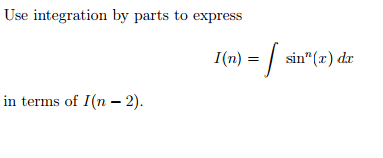
Homework Statement


attachment.php?attachmentid=69417&stc=1&d=1399253516.png

Homework Equations


N/A

The Attempt at a Solution


I can't even begin the attempt because I don't know how you could use intergration by parts for this sum in the first place.
Can you help me out?
 

Attachments

  • Untitled.png
    Untitled.png
    3.4 KB · Views: 499
  • Like
Likes   Reactions: 1 person
Physics news on Phys.org
First of all, I(n) is not a sum. I is a function which depends on the exponent of the sine function in the integrand.

You might try to determine what I(n) is for some discrete values of n, like n = 2, 3, 4, etc. and see if a pattern emerges.
 
  • Like
Likes   Reactions: 1 person
uzman1243 said:

Homework Statement


attachment.php?attachmentid=69417&stc=1&d=1399253516.png

Homework Equations


N/A

The Attempt at a Solution


I can't even begin the attempt because I don't know how you could use intergration by parts for this sum in the first place.
Can you help me out?
What sum ?

Let u = sin(n-1)(x), and dv = sin(x) dx

(The King beat me by fractions of a minute!)
 
  • Like
Likes   Reactions: 1 person
hint
$$\int\! \sin^n(x) \, \mathrm{d}x=\int\! \sin^{n-2}(x)\sin^{2}(x) \, \mathrm{d}x=\int\! \sin^{n-2}(x)\big(1-\cos^{2}(x)\big) \, \mathrm{d}x$$
 
  • Like
Likes   Reactions: 1 person
This does not look like precalculus.
 
SammyS said:
What sum ?

Let u = sin(n-1)(x), and dv = sin(x) dx

(The King beat me by fractions of a minute!)

Lol. He did.

Anyways, can you tell me why sin(n-1)(x)?
 
uzman1243 said:
Lol. He did.

Anyways, can you tell me why sin(n-1)(x)?
(n-1) is half way from n to (n-2) .


Try it and see what happens !
 
  • Like
Likes   Reactions: 1 person

Similar threads

  • · Replies 4 ·
Replies
4
Views
3K
  • · Replies 13 ·
Replies
13
Views
2K
  • · Replies 1 ·
Replies
1
Views
2K
  • · Replies 13 ·
Replies
13
Views
2K
  • · Replies 18 ·
Replies
18
Views
4K
  • · Replies 5 ·
Replies
5
Views
1K
  • · Replies 1 ·
Replies
1
Views
2K
  • · Replies 5 ·
Replies
5
Views
2K
  • · Replies 4 ·
Replies
4
Views
2K
  • · Replies 3 ·
Replies
3
Views
2K