Integration by parts, Partial fraction expansion, Improper Integrals

Join the discussion
Ask a follow-up here, or get your own question answered by working scientists, mathematicians and engineers — people, not an autocomplete.
Real named experts · corrections over time · the nuance an AI answer skips
3 replies · 2K views
ertagon2
Messages
36
Reaction score
0
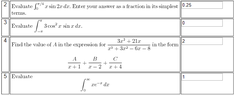
View attachment 7785
  1. -
  2. check if right
  3. check if right
  4. Now, 2 seems to be the right answer for A yet when i made x=5 and subtracted new form form the old one I got a difference of ~$\frac{4}{9}$ (should be 0 obviously) I got A=2 B=$\frac{45}{21}$ C=2
  5. How to calculate $\lim_{{x}\to{\infty}}(- e^{-x})$
 

Attachments
  • mathsq2.png
    mathsq2.png
    6.3 KB · Views: 166
Physics news on Phys.org
2. Correct
3. Yes, notice that it's an odd function $f(-x)=-f(x)$ so the "areas" cancel out.
4. Might want to check your math here a bit. The answer is correct ($A=2$), but $B=3$ and $C=-2$.
Also, $\lim_{{x}\to{\infty}}(e^{-x})=\lim_{{x}\to{\infty}}1/e^x=0$ since the denominator goes to infinity.
 
Since when is 0.25 a fraction in simplest form?
 
Prove It said:
Since when is 0.25 a fraction in simplest form?

so =$\frac{1}{4}$ ?