Interference patterns in thin films arise from multiple reflections at the film's interfaces, resulting in a combination of light waves that can create distinct bands. The term "separated" refers to the observable spacing between these interference bands, which can be influenced by factors like film thickness and light wavelength. In the context of measuring a fiber's diameter, the interference bands observed can provide crucial data, but understanding the principles of destructive interference is essential for accurate calculations. The discussion emphasizes the importance of independent research and comprehension before seeking help with complex physics problems. Engaging with foundational concepts in thin film interference is necessary for solving related homework questions effectively.
#1
haha1234
109
0
Why the interference patterns are separated when there are many light beams transmit through the film?
There are multiple reflections between all of the interfaces. What emerges will be the sum of all these.
What do you mean, in this context, by the word "separated"?
Yes, I think you need to explain your question more clearly. I too cannot understand what you are asking.
#4
haha1234
109
0
This is the question
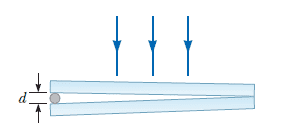
An investigator finds a fiber at a crime scene that he wishes to use as evidence against a suspect. He gives the fiber to a technician to test the properties of the fiber. To measure the diameter d of the fiber, the technician places it between two flat glass plates at their ends as in the figure below. When the plates, of length 15.0 cm, are illuminated from above with light of wavelength 610 nm, she observes interference bands separated by 0.555 mm. What is the diameter of the fiber?
I don't know why there are interference patterns separating,and I want to know if destructive interference occurs,how to measure the diameter of the fibre?
This is clearly a homework question. It should be in the Homework section at the very top of the index.
You cannot expect a simple answer for this sort of question on PF. You need to demonstrate that you have actually tried for an answer on your own. Say what you have found out so far and what you think about it. We do not spoon feed students. The topics of thin film interference and Newton's Rings will be thrown up in hundreds of hits on Google. Read what Wiki has to say about it and then come back to discuss it.
I would like to fan out a laser pointer's beam into a sheet of light, so basically stretch it along a single axis so it creates a plain. I wasn't sure if a cylindrical lens was the right tool for the job? And I figure I might need a few laser pointers all piped into it to ensure enough light is left after it is stretched.