Is Callen right in claiming dQ=TdS for all quasi-static processes?

Click For Summary
SUMMARY

Callen's definition of quasi-static processes in his book "Thermodynamics and an Introduction to Thermostatistics" asserts that such processes consist of a dense succession of equilibrium states. He claims that the relationship $$dQ=TdS$$, which describes heat transfer, is valid only for quasi-static processes. The discussion raises questions about the validity of this claim, particularly whether it can be proven that $$dQ=TdS$$ necessarily follows from Callen's definition of quasi-staticity. The publication "The impossible process: thermodynamic reversibility" by John D. Norton is referenced as a potential resource for further understanding the contradictions in thermodynamic descriptions.

PREREQUISITES
  • Understanding of thermodynamic concepts, specifically quasi-static processes.
  • Familiarity with the first and second laws of thermodynamics.
  • Knowledge of the mathematical formulation of thermodynamic equations, including $$dQ$$ and $$TdS$$.
  • Basic comprehension of equilibrium and non-equilibrium states in thermodynamics.
NEXT STEPS
  • Study the derivation of $$dQ=TdS$$ in Callen's "Thermodynamics and an Introduction to Thermostatistics", particularly sections 1.8 and 2.1.
  • Read John D. Norton's paper "The impossible process: thermodynamic reversibility" for insights on thermodynamic reversibility.
  • Explore the implications of quasi-static processes in real-world applications and their limitations.
  • Investigate alternative definitions and characterizations of thermodynamic processes in contemporary literature.
USEFUL FOR

This discussion is beneficial for students and professionals in thermodynamics, particularly those studying heat transfer, equilibrium states, and the foundational principles of thermodynamic processes.

Anna57
Messages
4
Reaction score
0
TL;DR
A question regarding the validity of the relationship $$dQ=TdS$$ for all quasi-static processes. Based on Callen's Thermodynamics.
Hello!

I am currently reading the second edition of Callen's Thermodynamics and an Introduction to Thermostatistics, and I have a question regarding Callen's definition of quasi-static. On page 96, Callen says:

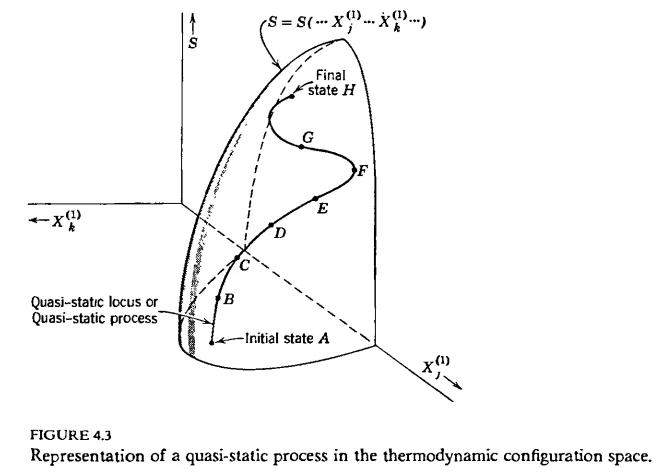
Consider an arbitrary curve drawn on the hypersurface of Fig. 4.3*, from an inital state to a terminal state. Such a curve is known as a quasi-static process. A quasi-static process is thus defined in terms of a dense succession of equilibrium states.

*Fig. 4.3, the hypersurface defined by the entropy function graphed in its configuration space

1761353219931.webp
Another way of characterizing Callen's definition is that a process is quasi-static if it traces out a continuous curve in the system's configuration space. So far it's all well and good. A little later, Callen claims that the identification of $$TdS$$ as the heat transfer is only valid for a quasi-static process. In seemingly the rest of the book, he takes this to be a necessary criterion for quasi-staticity. A process which does not obey $$dQ=TdS$$, no matter how well it seems to fit the original definition in terms of equilibrium states, is apparently not quasi-static. I am having a lot of trouble understanding how Callen draws this conclusion as it is not motivated and other motivations later on are predicated on this being true. Is it possible to prove, based on the definition of quasi-staticity given above, that it necessarily follows that $$dQ=TdS$$ for any, arbitrary quasi-static process? I have searched far and wide but cannot find any general proof. I am having trouble believing it is even true, and sources online even seem to disagree.
 
Science news on Phys.org
The following publication might be of help for you:

The impossible process: thermodynamic reversibility’ by John D. Norton (Studies in History and Philosophy of Science Part B: Studies in History and Philosophy of Modern Physics, 55, pp. 43–61)

Abstract
Standard descriptions of thermodynamically reversible processes attribute contradictory properties to them: they are in equilibrium yet still change their state. Or they are comprised of non-equilibrium states that are so close to equilibrium that the difference does not matter. One cannot have states that both change and no not change at the same time. In place of this internally contradictory characterization, the term “thermodynamically reversible process” is here construed as a label for a set of real processes of change involving only non-equilibrium states. The properties usually attributed to a thermodynamically reversible process are recovered as the limiting properties of this set. No single process, that is, no system undergoing change, equilibrium or otherwise, carries those limiting properties. The paper concludes with an historical survey of characterizations of thermodynamically reversible processes and a critical analysis of their shortcomings.
 
Anna57 said:
Is it possible to prove, based on the definition of quasi-staticity given above, that it necessarily follows that $$dQ=TdS$$ for any, arbitrary quasi-static process? I have searched far and wide but cannot find any general proof. I am having trouble believing it is even true, and sources online even seem to disagree.
It appears to me that Callen’s deduction of ##dQ = T dS## for quasi-static processes is essentially contained in sections 1.8 and 2.1.

Section 1.8 defines ##dQ## for a quasi-static process. Section 2.1 derives ##dQ = T dS## for quasi-static processes.

Maybe I'm overlooking something.
 
Anna57 said:
A little later, Callen claims that the identification of $$TdS$$ as the heat transfer is only valid for a quasi-static process. In seemingly the rest of the book, he takes this to be a necessary criterion for quasi-staticity. A process which does not obey $$dQ=TdS$$, no matter how well it seems to fit the original definition in terms of equilibrium states, is apparently not quasi-static. I am having a lot of trouble understanding how Callen draws this conclusion as it is not motivated and other motivations later on are predicated on this being true. Is it possible to prove, based on the definition of quasi-staticity given above, that it necessarily follows that $$dQ=TdS$$ for any, arbitrary quasi-static process? I have searched far and wide but cannot find any general proof. I am having trouble believing it is even true, and sources online even seem to disagree.
$$\Delta S=\int dS=\int dQ/T$$ is the definition of change in entropy, where dQ is the infinitesimal heat flow over a reversible path. Of course, in realty there is no such thing as a reversible path. A quasi-static path - one in which the thermodynamic changes occur with the system very close to, but not at or arbitrarily close to, thermodynamic equilibrium - merely approximates a reversible path.

This is the result of applying infinitesimal calculus to systems consisting of a finite number of finite sized particles. At some point, the math no longer represents reality.

AM
 
  • Like
Likes   Reactions: Chestermiller
A quasi-static path is considered to represent a continuous sequence of thermodynamic equilibrium states.
 
When I was a student, I remember endless discussions about the difference between quasistatic and reversible processes. Different authors didn't agree on the definition. It's been a long time since I read Callen's book, but I recall sometimes feeling frustrated while reading it. Some important elements of the reasoning were rejected in exercises.
The case of a material exhibiting hysteresis is sometimes cited as an example of a system that can evolve quasistatically yet irreversibly. But it's all a matter of scale, and Barkhausen's experiment, which demonstrates the abrupt movement of the Weiss domain walls, raises the question of whether the evolution is truly "quasistatic." Not to mention that a system without an equation of state is difficult to treat in thermodynamics.

So, in my opinion, if you consider that "quasistatic" and "reversible" are the same thing, we can indeed write that ##\delta Q = T dS## since by definition, the creation of entropy is zero.
 

Similar threads

  • · Replies 5 ·
Replies
5
Views
3K
  • · Replies 13 ·
Replies
13
Views
4K
  • · Replies 1 ·
Replies
1
Views
3K
  • · Replies 19 ·
Replies
19
Views
4K
Replies
4
Views
3K
  • · Replies 4 ·
Replies
4
Views
9K
  • · Replies 3 ·
Replies
3
Views
8K
  • · Replies 22 ·
Replies
22
Views
6K
  • · Replies 7 ·
Replies
7
Views
2K