Is My Solution to the Grade 11 Physics Problem Correct?

Click For Summary
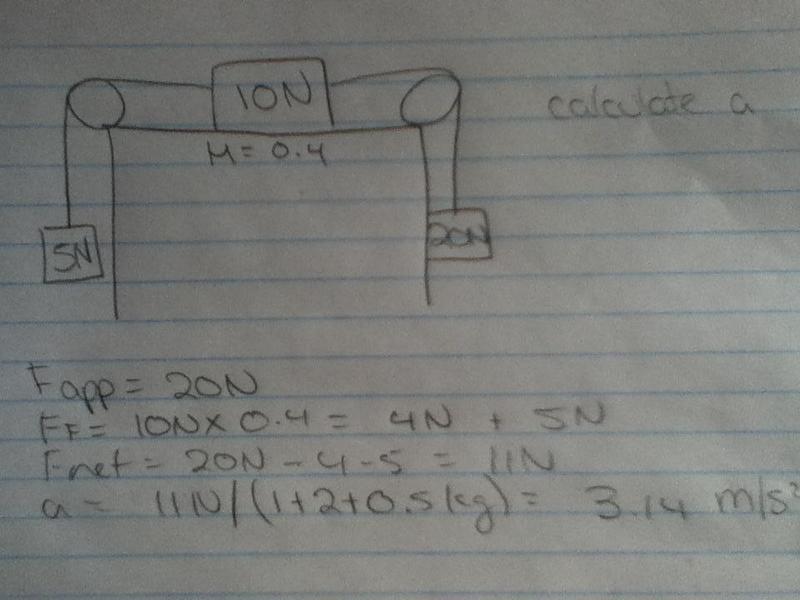
The discussion revolves around the correctness of a solution to a Grade 11 physics problem involving acceleration and friction. The initial approach is validated if gravitational acceleration is approximated at 10 m/s², assuming no friction between the 20N weight and the side. However, there are errors noted, particularly in the misinterpretation of forces, where the 5N weight was incorrectly considered part of the frictional force, and the friction force should only be 4N. Additionally, the misuse of the equals sign in the equations is highlighted as a significant mistake. Overall, while the final answer is deemed correct, attention to detail in the equations is emphasized as crucial for accuracy.
taotao
Messages
5
Reaction score
0
Find the acceleration of the system
Ff= u(Fn)
Fnet=ma

IMG_1389.jpg


I would just like to know if the way that I solved this problem is correct.
 
Physics news on Phys.org
Yes, if you estimate g to be 10\frac{m}{s^2} instead of 9.8\frac{m}{s^2} then this is correct.(Assuming there's no friction between the 20N weight and the side)EDIT:
It kind of looks like you said the 5N weight was a part of the frictional force, which isn't true.

At any rate, your answer is correct.
 
Yes, the second line of working is wrong---for two reasons. The only friction force here is the 4N.

An equals sign means exactly that, viz, "equals". You have misused it on that line.

Apart from those matters, it looks good! :smile:
 
You wrote 10 x 0.4 = 4+5 which is not correct. As a teacher I do take points away from my students when they do that even if they get the correct equation at the end. Always make sure that every equation you write on the paper is correct.

Tip: Don't just write down the steps you took when using the calculator. That doesn't work.
 
The book claims the answer is that all the magnitudes are the same because "the gravitational force on the penguin is the same". I'm having trouble understanding this. I thought the buoyant force was equal to the weight of the fluid displaced. Weight depends on mass which depends on density. Therefore, due to the differing densities the buoyant force will be different in each case? Is this incorrect?

Similar threads

Replies
6
Views
3K
  • · Replies 6 ·
Replies
6
Views
865
  • · Replies 5 ·
Replies
5
Views
4K
  • · Replies 6 ·
Replies
6
Views
3K
Replies
15
Views
2K
Replies
5
Views
6K
  • · Replies 6 ·
Replies
6
Views
4K
  • · Replies 21 ·
Replies
21
Views
3K
Replies
3
Views
3K
  • · Replies 21 ·
Replies
21
Views
2K