Dale said:
This is no paradox, it is standard experimental science. Well-considered and carefully-executed controls are critical to good experiments. Good science is difficult. And challenges to mainstream results are especially difficult, precisely because they already went through that careful effort. We hold all scientists to this high standard.
In the end, this is the difference between the “independent researcher” and the “crackpot”. The “independent researcher” is doing actual science outside of a university or corporate setting, while the “crackpot” is just posturing.
Indeed, nobody can. Nor should they.
You need to ask yourself if you are an independent researcher or a crackpot. Researchers (independent or not) see their observations/questions as an opportunity for them to do some scientific research and contribute to the body of knowledge. If you see your own research questions as a burden to be placed on others then you are not a researcher.
Assuming that you are an independent researcher, at this point you are at the “observation/question” stage of the scientific method. You have an interesting observation. Now you do your background research and form a question about possible mechanisms that could explain your observation. Then you design an experimentally testable hypothesis. You have received a lot of advice about important controls and measurements, which should inform your experimental design. Then you execute the experiment, analyze the data, and report the results. That is the scientific method, the mark of any researcher
Yes, I'm an independent researcher with access to a functional kitchen, a bunch of thermometers, and several different types of microscopes.
My “laboratory” is as sophisticated as it can be.
I also do not expect the community to do the work for me.
However, when the observations from an outsider contradict the textbook, even with precise quantitative data, it is not taken seriously by the academic community, because "challenges to mainstream results are especially difficult, precisely because they already went through that careful effort."
Nevertheless, that effort took place inside institutions, with peer review, with labs, with grants and prestige.
I do not have any of those.
That’s why my focus is to present qualitative observations that are robust, cheap, and visible enough, so that it could raise curiosity.
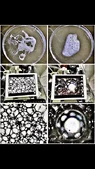
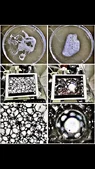
The gas bubbles that form in still water and survive freezing.
The structures that fracture under microscopy.
Or, like this comparison between these two apparently distinct types of vesicles (i.e., bubbles):
One type seems empty, as one would expect from empty voids filled by air; the other presents 5 recurrent patterns.
I couldn’t find official literature about the second one, which is much more frequent, at any magnification from the most type of fluids.
Here, again, however, I refrain myself from presenting any conclusion, because my goal is for others to go look for themselves.
At the end of the day, I’m an independent researcher without theories, but with observations.