Labyrinth Seal Leakage Calculation ?

Click For Summary
SUMMARY

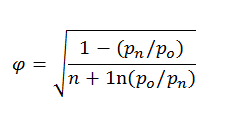
The discussion centers on the labyrinth seal leakage equation, specifically the expansion ratio formula. A participant seeks clarification on the term '1n', suspecting it may refer to the natural logarithm function, denoted as ln(x). This interpretation aligns with standard mathematical notation, where 'ln' represents the logarithm to the base e. The confusion arises from the formatting of 'n' and '1n', which appear different in the equation.

PREREQUISITES
  • Understanding of mechanical engineering principles
  • Familiarity with logarithmic functions, particularly natural logarithms
  • Knowledge of labyrinth seal design and its applications
  • Basic mathematical skills for interpreting equations
NEXT STEPS
  • Research the application of natural logarithms in engineering equations
  • Study labyrinth seal design and its impact on leakage rates
  • Explore advanced topics in fluid dynamics related to seal performance
  • Review mechanical engineering textbooks focusing on sealing technologies
USEFUL FOR

Mechanical engineering students, design engineers, and professionals involved in sealing technology and fluid dynamics will benefit from this discussion.

FFX
Messages
8
Reaction score
0
I'm studying mechanical engineering, just have a question on the labyrinth seal leakage equation.

More specifically, the expansion ratio formula.
7qsh.png


What does the '1n' stand for?
With 'n + 1n', I'm assuming those two n's are different since one looks like it's in italics and the other looks normal. Can someone please clear this up for me? I understand the rest of the equation, I just can't find what '1n' stands for in my textbook.
 
Physics news on Phys.org
FFX said:
I'm studying mechanical engineering, just have a question on the labyrinth seal leakage equation.

More specifically, the expansion ratio formula.

7qsh.png


What does the '1n' stand for?
With 'n + 1n', I'm assuming those two n's are different since one looks like it's in italics and the other looks normal. Can someone please clear this up for me? I understand the rest of the equation, I just can't find what '1n' stands for in my textbook.

Perhaps it's meant to be the natural log function ln(x)? That's the log base e of its argument.
 

Similar threads

  • · Replies 6 ·
Replies
6
Views
4K
  • · Replies 16 ·
Replies
16
Views
1K
  • · Replies 4 ·
Replies
4
Views
4K
Replies
15
Views
6K
  • · Replies 45 ·
2
Replies
45
Views
7K
  • · Replies 2 ·
Replies
2
Views
2K
  • · Replies 1 ·
Replies
1
Views
11K
  • · Replies 1 ·
Replies
1
Views
2K
  • · Replies 2 ·
Replies
2
Views
2K
Replies
1
Views
2K