Law of conservation of angular momentum

Click For Summary
SUMMARY

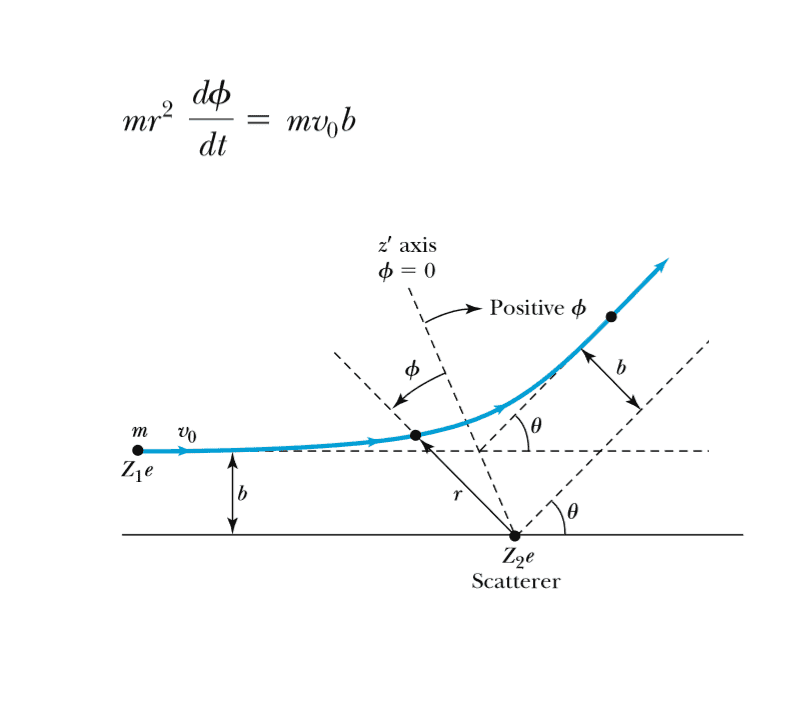
The discussion centers on the application of the law of conservation of angular momentum in the context of scattering events involving an electron. Participants clarify the relationship between initial and final angular momentum, specifically how the distance 'b' relates to the vector 'r' in the equations L1 = mV x R and L2 = mv x r. It is established that 'b' represents a component of 'r' before and after scattering, leading to the conclusion that b = r sin(θ) for initial momentum calculations. The final angular momentum is expressed as L = m*(dΦ/dt)*b*sin(θ).

PREREQUISITES
  • Understanding of angular momentum and its conservation principles.
  • Familiarity with vector calculus, specifically the cross product.
  • Knowledge of basic physics concepts such as momentum (p = mv).
  • Ability to interpret and analyze graphical representations of physical scenarios.
NEXT STEPS
  • Study the principles of angular momentum conservation in various physical systems.
  • Learn about the cross product and its applications in vector calculus.
  • Explore the relationship between angular displacement and angular velocity.
  • Review examples of scattering events in particle physics to solidify understanding of momentum transfer.
USEFUL FOR

Students of physics, particularly those studying mechanics and vector calculus, as well as educators seeking to clarify concepts related to angular momentum and scattering phenomena.

Boltzman Oscillation
Messages
233
Reaction score
26
Given the figure, how can i arrive to this formula knowing that angular momentum is conserved?
vectorandfigure.png


I know that p = mv and L = p x r. So the initial momentum will be L1 = mV x R and the final momentum will be L2 = mv x r.

I am not sure how R will equal to b since the distance between the initial position of the electron is clearly not b distance apart from the scatterer. I am also not sure how to modify the final angular momentum to fit the formula.
 

Attachments

  • vectorandfigure.png
    vectorandfigure.png
    10.2 KB · Views: 1,816
Physics news on Phys.org
Boltzmann Oscillation said:
I know that p = mv and L = p x r. So the initial momentum will be L1 = mV x R and the final momentum will be L2 = mv x r.

I am not sure how R will equal to b since the distance between the initial position of the electron is clearly not b ...
Your b is the magnitude of the r vector component, that is perpendicular to p (or v), before and after the scattering. Do you understand the cross product?
https://en.wikipedia.org/wiki/Cross_product
 
Last edited:
A.T. said:
Your b is the magnitude of the r vector component, that is perpendicular to p (or v), before and after the scattering. Do you understand the cross product?
https://en.wikipedia.org/wiki/Cross_product
yes I understand the cross product but I've not had enough practice with it (my math foundations class was a mess). Isnt the magnitude how large the arrow is? In that case then the magnitude b wouldn't be the same as the magnitude of vector r would it? r stretches and shortens throughout the path of movement.
 
Boltzmann Oscillation said:
In that case then the magnitude b wouldn't be the same as the magnitude of vector r would it?
Look at your picture. Do they look the same?

Boltzmann Oscillation said:
r stretches and shortens throughout the path of movement.
Yes, but b is just one component of r, before and after scattering, not throughout.
 
A.T. said:
Look at your picture. Do they look the same?Yes, but b is just one component of r, before and after scattering, not throughout.
ohh so I am only looking at before and after the scattering and not throughout. Hmm so in that case r = b in both cases. Now the velocity of the particle after the scattering can be described by position/time. Well position will be given by the angle. The derivative of position in respect to time is position right? So the velocity will equal d(angle)/dt. The final angular momentum will then equal:

L = m * d(angle)/dt x b. = m*(dΦ/dt)*bsin(90) = m*(dΦ/dt)?

Ugh why dint I learn vector calculus correctly? :(
I guess its best to take my time to learn it now so it won't impede me later.
 
A.T. said:
b is just one component of r
Boltzmann Oscillation said:
r = b
No, see above.
 
A.T. said:
No, see above.
Okay so L = m*(dΦ/dt) x r = m*(dΦ/dt)*b*sin(angle between the two) ?
 
Boltzmann Oscillation said:
Okay so L = m*(dΦ/dt) x r = m*(dΦ/dt)*b*sin(angle between the two) ?
Which is greater, b or |r|?
 
A.T. said:
Which is greater, b or |r|?
err I thought b was the magnitude of r? so arent they the same in errrr greatness?
 
  • #10
Boltzmann Oscillation said:
err I thought b was the magnitude of r? so arent they the same in errrr greatness?
sigh, on the initial momentum then b will be the yth component of r while in the final momentum r will be greater than b.
 
  • #11
Boltzmann Oscillation said:
sigh, on the initial momentum then b will be the yth component of r while in the final momentum r will be greater than b.
So what is the mathematical relation between b and r?
 
  • #12
A.T. said:
So what is the mathematical relation between b and r?
Well for initial momentum:

sin(θ) = b/r

I guess for the final momentum this doesn't change. On inspection of the figure, I conclude that it doesn't change. Thus b = rsin(θ).
Thus L = m*(dΦ/dt) x r = m*(dΦ/dt)*b*sin(θ) = m*(dΦ/dt)*b^2/r?
 

Similar threads

  • · Replies 10 ·
Replies
10
Views
753
  • · Replies 6 ·
Replies
6
Views
769
  • · Replies 30 ·
2
Replies
30
Views
3K
  • · Replies 16 ·
Replies
16
Views
1K
  • · Replies 4 ·
Replies
4
Views
2K
  • · Replies 3 ·
Replies
3
Views
3K
  • · Replies 2 ·
Replies
2
Views
3K
  • · Replies 4 ·
Replies
4
Views
2K
  • · Replies 6 ·
Replies
6
Views
2K
  • · Replies 9 ·
Replies
9
Views
6K