Spinning Bike Wheel Example, how is angular momentum conserved?

Click For Summary

Discussion Overview

The discussion revolves around the conservation of angular momentum in the context of a person holding a spinning bike wheel and flipping it over. Participants explore the implications of angular momentum conservation when considering different axes of rotation, the relationship between the wheel and the person/chair, and the conditions under which angular momentum can be added together.

Discussion Character

  • Exploratory
  • Technical explanation
  • Debate/contested

Main Points Raised

  • Some participants assert that angular momentum is conserved in the system of the person, chair, and wheel, but question how angular momentum can be added when the wheel and person are about different axes.
  • Others propose that the center of mass of the wheel does not move relative to the stool axis, allowing for the addition of angular momentum despite the different axes.
  • A participant expresses confusion about the distinction between the wheel's rotation around the stool axis and its orbital angular momentum, seeking clarification on the relationship between these concepts.
  • Some participants clarify that the angular momentum vector of the system can be represented as a sum of the individual components, including the spin of the person/chair and the wheel, as well as the orbital angular momentum of the wheel.
  • One participant discusses the mathematical basis for adding angular momentum vectors, emphasizing that angular momentum is an intrinsic property of point masses and can be measured consistently across different inertial frames.
  • Another participant notes that the system is only partially isolated, suggesting that the vertical component of angular momentum must be conserved, and describes a scenario involving a person turning the wheel to illustrate this point.

Areas of Agreement / Disagreement

Participants express varying levels of understanding regarding the addition of angular momentum vectors and the conditions under which they can be combined. There is no consensus on the clarity of the explanation or the implications of different axes of rotation.

Contextual Notes

Some participants reference the parallel axis theorem and the concept of orbital angular momentum, indicating that the discussion involves complex mathematical and physical principles that may not be fully resolved within the thread.

alkaspeltzar
Messages
354
Reaction score
37
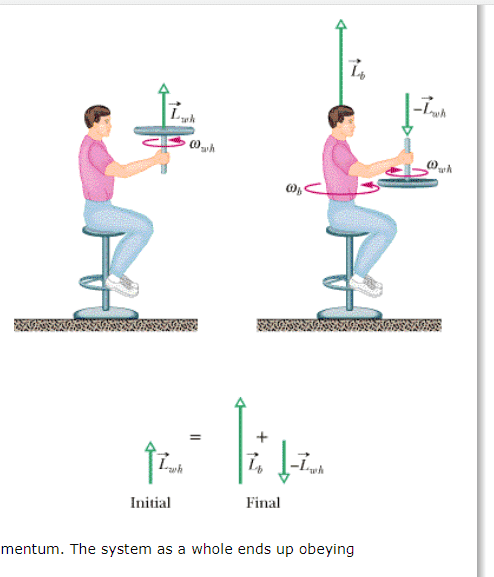
In the classic example of a person holding a spinning bike wheel, as they flip the wheel over, angular momentum is conserved by the person/chair spinning with 2x the angular momentum of the initial wheel. Not questioning that.

However, I thought ang momentum is always conserved about a point/axis? IF so, how do they add since the wheel and person are about two different axis?

See below, you can see they add, but are showing the angular momentum of the wheel adding to the angular mom. of the chair/person, which are two different axis.

IS it because the ang momentum of the wheel prior to flipping is the same at any axis? Looking for clarification on why they can add.
1610923663143.png
 

Attachments

  • 1610923643389.png
    1610923643389.png
    334 bytes · Views: 268
Physics news on Phys.org
They add although they are about different axes because the center of mass of the wheel does not move relative to the stool axis. If it did, then yes, you would have to consider the "orbital" angular momentum of the wheel.
 
kuruman said:
They add although they are about different axes because the center of mass of the wheel does not move relative to the stool axis. If it did, then yes, you would have to consider the "orbital" angular momentum of the wheel.
I understand oribtal Ang momentum, but I don't see the difference. Isn't the wheel still rotating around the stool axis?

The wheel doesn't move relative to the person or stool, is that what you mean?
 
Yes, sorry, I was a bit hasty with my explanation. The angular momentum vector that points up in the "final" picture is the vector sum of the spin of the person plus chair, the spin of the wheel and the orbital angular momentum of the spinning wheel. Strictly speaking, there should be three vectors drawn in the "final" picture, two of which are up and have a combined magnitude of twice the magnitude of the down vector.
 
  • Like
Likes   Reactions: alkaspeltzar
kuruman said:
Yes, sorry, I was a bit hasty with my explanation. The angular momentum vector that points up in the "final" picture is the vector sum of the spin of the person plus chair, the spin of the wheel and the orbital angular momentum of the spinning wheel. Strictly speaking, there should be three vectors drawn in the "final" picture, two of which are up and have a combined magnitude of twice the magnitude of the down vector.
Okay so originally there is the angular momentum of the wheel, and since it is not moving to the axis of the chair, it would be equal to the Ang momentum of the wheel about the chairs axis. Like you said, if the cofm doesn't move, axis doesn't matter

But then as you flip the wheel, there would be a negative angular momentum of the wheel. This would cause then the angular momentum of the whole chair/person which includes the oribital portion of the wheel. This is twice the Ang momentum, so the sum of it all is still the same as inital.

Does my interpretation make sense? Thks for help
 
alkaspeltzar said:
However, I thought ang momentum is always conserved about a point/axis? IF so, how do they add since the wheel and person are about two different axis?

1610923663143-png.png

Note that Lb contains the angular momentum from the disc translating along a circle around the stool axis. See:
https://en.wikipedia.org/wiki/Parallel_axis_theorem
 
Last edited:
A.T. said:
Note that Lb contains the angular momentum from the disc translating along a circle around the stool axis. See:
https://en.wikipedia.org/wiki/Parallel_axis_theorem
That's what I was saying in my above explanation. If you take the angular momentum of the disk spinning about its axis or the chair aixs, it is the same. This is because the translation part is part of the entire chair/disk/person rotation. Thks for clarifying
 
Last edited:
alkaspeltzar said:
Summary:: Ang momentum of the wheel is about a different axis than the person/chair, how can they be added together?

In the classic example of a person holding a spinning bike wheel, as they flip the wheel over, angular momentum is conserved by the person/chair spinning with 2x the angular momentum of the initial wheel. Not questioning that.

However, I thought ang momentum is always conserved about a point/axis? IF so, how do they add since the wheel and person are about two different axis?

See below, you can see they add, but are showing the angular momentum of the wheel adding to the angular mom. of the chair/person, which are two different axis.

IS it because the ang momentum of the wheel prior to flipping is the same at any axis? Looking for clarification on why they can add.
Good question. It is not immediately obvious that you can simply add angular momentum vectors.
One has to work it out.

If we take a point mass with mass m relative to an inertial point c, its angular momentum is:
L = r x mv = r x m(dr/dt) where r is the displacement vector from c to m.

If we measure the angular momentum relative to c at an arbitrary inertial point p (same inertial frame) such that the displacement vector from p to c is s, (the displacement from p to m being s + r) we get:
L' = r x m(d(s + r)/dt) = r x m(ds/dt) + r x m(dr/dt) = r x m(dr/dt) = L [since ds/dt = 0]

It is a bit more math but it can similarly be shown that if p is a point in any inertial frame, moving at velocity vp relative to c, L' = L

So the angular momentum of a point mass relative to an inertial point c is the same vector (same magnitude and direction) at all inertial points (ie. it is the same regardless of the inertial point at which it is measured).

So to determine the total angular momentum of a system of two point particles m and m' about two different inertial points c and c' (respectively), measuring their angular momentum at an arbitrary inertial point in the same inertial reference frame can be achieved by simply add their angular momentum vectors as measured at c and c'. Angular momentum is, therefore, an intrinsic property of the point mass.

Generalizing to n point particles in a rigid body, we can see that the angular momentum of a rigid body about an axis can be determined by simply adding the angular momenta of each point mass that comprises the body about a point on the axis.

Generalizing further and taking n rigid bodies comprising a system, we can say that the angular momentum of the system is the sum of the angular momenta vectors of each body.

Since dL/dt = r x F = τ the angular momentum of a rigid body rotating about an axis can only change if there is a torque applied that is external to the point mass or rotating body.

We then configure two freely rotating bodies together in a system on which no external torque is applied:
L = L1 + L2. Because there is no external torque, this means that dL/dt = dL1/dt + dL2/dt = 0. The angular momenta of each of those two bodies can change because one body can apply a torque to the other. But we can see that dL1/dt = - dL2/dt so there must be an equal and opposite torque applied by the other. We can, therefore, conclude that the sum of the angular momenta vectors of each body in the system is conserved in the absence of an external torque.

I hope that clarifies more than it confuses.

AM
 
Last edited:
Andrew Mason said:
Good question. It is not immediately obvious that you can simply add angular momentum vectors.
One has to work it out.
The person + stool + wheel system is only partially isolated in the sense that the floor can exert torques only in the horizontal direction which implies that the vertical component of the system's angular momentum must be conserved. In other words, the sum of all the "before" vertical angular momenta must be equal to the sum of all the "after" vertical angular momenta. If the person initially holds the wheel with its axis horizontal and turns it by 90o to put it along the vertical, the stool's spin will be opposite to the wheel's to keep the total vertical angular momentum zero. I used to spin myself my self this way, stop and then spin the other way when I did the demo during my teaching days.

This situation is the rotational equivalent of the two skaters moving together and then pushing against each other. Regardless of the direction of the action-reaction push, linear momentum in the horizontal direction is conserved because the ice can exert forces only in the vertical direction.
 
  • #10
In the system as described, turning the wheel axis is going to exert a torque with a horizontal component. Since the stool can only turn on a vertical axis, that horizontal change in angular momentum is applied to the earth. So, as you point out, only angular momentum in the vertical direction will be conserved. This problem can be avoided if the system was gimballed so that no axis is constrained.

AM
 

Similar threads

  • · Replies 36 ·
2
Replies
36
Views
4K
  • · Replies 2 ·
Replies
2
Views
2K
  • · Replies 10 ·
Replies
10
Views
2K
  • · Replies 5 ·
Replies
5
Views
4K
  • · Replies 2 ·
Replies
2
Views
3K
  • · Replies 30 ·
2
Replies
30
Views
4K
  • · Replies 39 ·
2
Replies
39
Views
4K
  • · Replies 10 ·
Replies
10
Views
2K
  • · Replies 3 ·
Replies
3
Views
3K
  • · Replies 8 ·
Replies
8
Views
3K