Lifting Arrangement: Inner Slings Capacity Question

  • Thread starter trabel
  • Start date
  • Tags Tags
    Lifting
8 replies · 4K views · last reply
trabel
Messages
4
Reaction score
0
Hi guys,

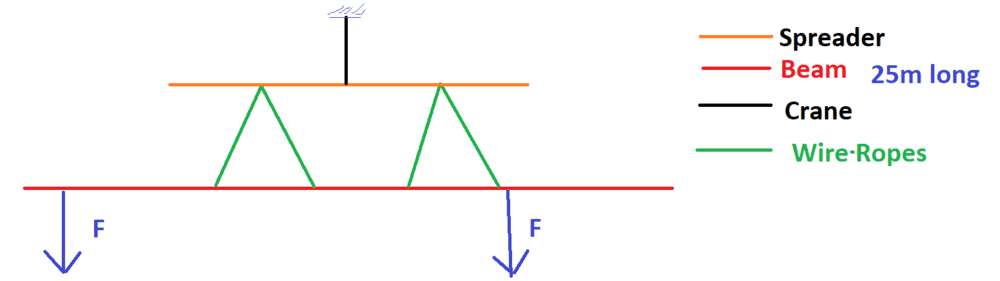
Just an easy question. Looking at the lifting arrangement below -Do you know if the inner slings (attached towards middle of the beam) works as much as the external ones?

Diagram of a lifting arrangement: a crane hook above an orange spreader bar, with two green wire-rope slings in an inverted V shape attached to a horizontal red beam labelled 25m long, with downward arrows marked F at each end of the beam.


Cheers!
 
Welcome, trabel! :smile:
Your crane can't lift that out of balance load (center of mass of red beam is not directly under the crane's cable).
 
Thanks for reply!
Yeah, let's say there are no external forces, just only self weight. Do you think slings will see the same force?
What do you think about beam stiffness, and its deflection under self weight.
 
Last edited:
BTW. I suppose it is a well known issue with lifting long soft (not so stiff) structures.
 
For a perfectly stiff, uniform beam, the slings are all under the same tension. For a real beam, the outer slings or the inner slings could be at higher tension - depends on whether the placement makes the beam 'smile' or 'frown.'
 
  • Like
Likes   Reactions: Lnewqban and trabel
10 points go tooooooooooooooooo DULLARD
error
 
Attachments
  • Simulation screenshot of a curved arc with a colour gradient from blue at the lower left through red at the top to green at the lower right, with two zigzag spring-like elements and a horizontal line above it.
    1586199233821.png
    5.4 KB · Views: 312
Last edited:
If too slender, both, the spreader and the beam will also tend to buckle under own weight.
 
  • Like
Likes   Reactions: trabel
Some things to consider when lifting:

If the center of gravity is not directly under the crane hook before lifting, it will be after lifting. In between, it will swing, possibly violently.

It is necessary to calculate strength of the lifting beam, and also the load. It is not a given that the load can be lifted by connecting where convenient.

It is necessary to calculate the strength of every lifting sling. Also the strength of all shackles, eyebolts, and other lifting hardware.

It is necessary to calculate the strength of lifting lugs, and their attachment to the load. Do not assume that bolt patterns and/or welds are loaded symmetrically.

The crane load includes the weight of the lifting beam and other hardware.

Slings come in discrete nominal lengths. The exact lengths are all different. Three or more slings in a row will not share the load the way you think. One way to deal with this is to have two slings plus ratchet straps. Tighten the ratchet straps while lifting the load so as to properly share the load.

Sometimes you are better to design the load for lifting. That can be lower cost than designing and building a lifting beam that only gets used once.

Beware the trap of dumping all lifting calculations on one person, then telling that person that "regular work" is more important. They will pencil whip the lifting diagrams. Not me, but I have seen it.
 
  • Informative
  • Like
Likes   Reactions: Lnewqban and berkeman